Real estate income runs a spectrum from truly passive (REITs) to an active business (short-term rentals). Here's where each model sits and how to pick your level.
By J. MasseyApril 18, 2026
Share
Disclosure: This post may contain affiliate links. If you purchase through our links, we may earn a commission at no extra cost to you. We only recommend tools and services J. Massey's team actually uses.
Learn more →
TL;DR: Real estate income runs on a spectrum from truly passive (REITs, crowdfunding) to fully active business operations (short-term rentals). The IRS classifies most rental activity as passive for tax purposes, but operational reality tells a different story. Your path depends on three variables: time commitment, capital available, and control preferences.
The core trade-offs:
* REITs and crowdfunding require zero operational time but offer no control and capped returns
* Long-term rentals with property management need 2-4 hours monthly and build equity
* Short-term rentals demand 2-15 hours weekly but produce 2-4x the income of long-term rentals in comparable markets
* Tax treatment depends on real estate professional status and material participation, not operational effort
* Starting capital ranges from $10 for REITs to $50,000+ for owned STR properties
What Most Articles Won't Tell You
A REIT that pays quarterly dividends while you do nothing is passive. A short-term rental where you're coordinating cleaners and answering guest messages at 11 PM is not.
Both get called "passive real estate income" in articles written by people who've never run either. The phrase collapses a spectrum into one category and pretends the trade-offs don't exist.
I've been operating short-term rentals since before rental arbitrage was a phrase most people knew. I've consulted on hundreds of properties. I've trained more than 10,000 operators. The word "passive" hides a spectrum, and where you land on that spectrum determines whether you're buying an investment or starting a business.
This article maps that spectrum. You'll see where REITs, crowdfunding, long-term rentals, and short-term rentals sit operationally and how the IRS classifies each model for tax purposes. You'll get a framework to pick your level based on time, capital, and risk tolerance.
No hype. Just the operational reality of what "passive" requires at each level.
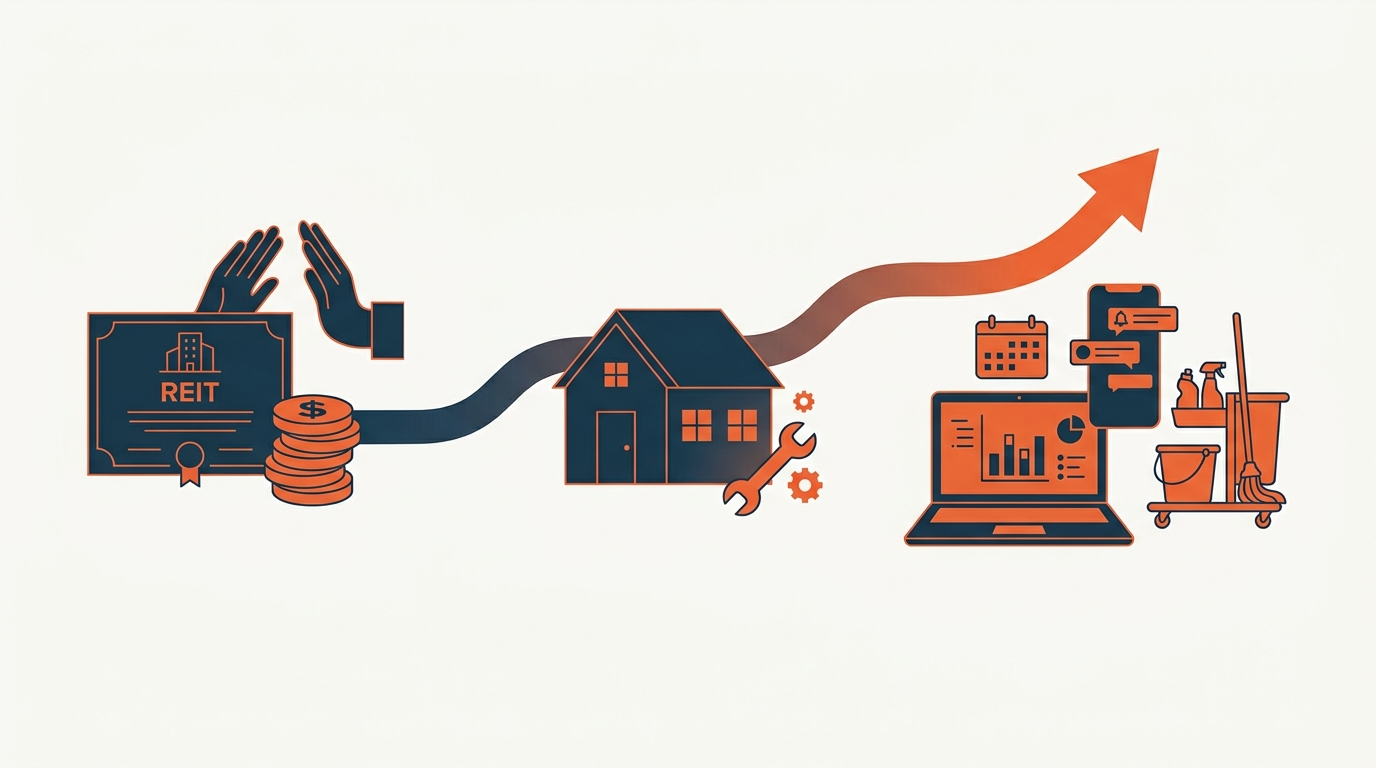
A left-to-right spectrum of real estate income from a hands-off REIT to a mostly passive long-term rental to an active short-term rental, with an arrow showing increasing effort.
Passive income means money that shows up without you trading time for it directly. Here's the problem: most real estate content treats "passive" as binary. You're either working or you're not.
Real estate doesn't work that way.
You own a REIT and never think about it except when dividends hit your brokerage account. That's passive. You own a long-term rental and spend two hours monthly reviewing financials and fielding the occasional maintenance call. That's mostly passive. You run a short-term rental and respond to guest messages, coordinate cleaners, adjust pricing weekly, and troubleshoot the Wi-Fi at 9 PM. That's a business.
All three get labeled "passive real estate income" in the same breath.
The confusion costs operators years. They read an article about building passive income with rental properties, assume it means money with no work, buy a short-term rental, and six months later they're burned out. The work never stopped. Or they invest in a REIT expecting real estate ownership, watch it move with the stock market, and wonder why it doesn't feel like owning property.
The problem isn't one false claim. The problem is the framing. Most content collapses the spectrum into one category.
The truth: passivity in real estate runs on a continuum. On one end, you own a financial instrument that produces income with zero operator involvement. On the other end, you run a cash-flowing business that requires daily decisions. In between, you've got models that blend the two.
Where you land depends on three variables: how much time you're willing to spend, how much control you want, and how much capital you're starting with.
Key point: Passivity in real estate is a spectrum, not a category. Your position on that spectrum determines whether you're investing or operating.
The Real-Estate Passivity Spectrum: Three Zones
Here's the framework I use with every operator who asks about passive real estate income. Three zones, three different trade-off structures.
Zone 1: Truly Passive
REITs, real estate crowdfunding, syndications, private notes. You own a financial position. Someone else operates the properties. Your involvement is writing the check and collecting returns.
* Time commitment: minutes per quarter
* Control: none to minimal
* Capital: $10 on some platforms to $25,000+ for accredited deals
Zone 2: Mostly Passive
Long-term rental property with professional property management. You own the asset. A property manager handles tenant placement, maintenance coordination, and monthly operations. Your involvement is reviewing financials, approving major repairs, and making strategic decisions.
* Time commitment: 2-4 hours monthly per property
* Control: high on big decisions, delegated on daily operations
* Capital: $30,000 to $100,000+ for a down payment depending on market
Zone 3: Active Business
Short-term rentals and rental arbitrage. You operate the property as a hospitality business. Guest communication, pricing adjustments, cleaning coordination, review management, and maintenance troubleshooting all flow through you or systems you've built.
* Time commitment: 5-15 hours weekly per property until systems are in place, then 2-5 hours weekly
* Control: total
* Capital: $5,000 to $50,000 for arbitrage, $50,000+ for owned STR properties
Most operators start in Zone 1 or Zone 2 and assume that's where they'll stay. Then they hear about short-term rental returns, see the cash flow numbers, and jump to Zone 3 without understanding they started a business.
The spectrum isn't good or bad. It's a trade-off structure. More passivity means less control and often lower returns per dollar invested. More operator involvement means higher returns and more control, but you're trading time.
The operators who succeed pick their zone on purpose and build the systems that zone requires.
Key point: Match your zone to your actual constraints (time, capital, control preference), not to what sounds appealing.
Zone 1: REITs, Crowdfunding, Syndications, Notes
If you want real estate exposure with zero operational involvement, this is your zone.
REITs are the most accessible entry point. You buy shares of a publicly traded real estate investment trust the same way you'd buy stock. The REIT owns and operates commercial properties, apartment buildings, storage facilities, or other real estate. You collect dividends. Over the long term, REITs have delivered total returns around 9-11% annualized, though individual sectors and time periods vary. Some years are up sharply. Others aren't.
The trade-off: you have no control. The REIT's management team makes every decision. You're along for the ride. REITs also move with the stock market in ways direct property ownership doesn't. Volatility is real.
Real estate crowdfunding platforms sit one step up the involvement ladder. You invest in specific projects or funds. Platforms like Fundrise, RealtyMogul, and others pool capital from multiple investors to fund real estate deals. Some platforms let you start with $10, though accredited-only platforms require $5,000 to $25,000 per deal.
The trade-off: illiquidity. Debt deals run 12 to 36 months. Equity investments often require 3 to 7 years. You can't pull your money out early without penalties or secondary-market friction.
Syndications work similarly but with higher minimums and a more direct relationship with the deal sponsor. You invest in a specific property or portfolio alongside other limited partners. A syndicator operates the property. You receive distributions based on the operating agreement. Minimums start at $50,000.
Private notes are the least common entry point for beginners. You lend money to a real estate investor or developer. They pay you interest. You hold a lien position on the property as security. If they default, you foreclose. This requires capital, underwriting skills, and comfort with legal processes most operators aren't ready for early on.
All four models share the same core structure: you provide capital, someone else does the work, you collect returns. The passivity is real. The control is gone. The returns are capped by what the operators produce and what the deal structure allows.
If your goal is real estate exposure without becoming an operator, this is the zone. You're investing, not operating.
Key point: Zone 1 is truly passive but offers no control over decisions or deal structure. Returns are capped by what the operator delivers.
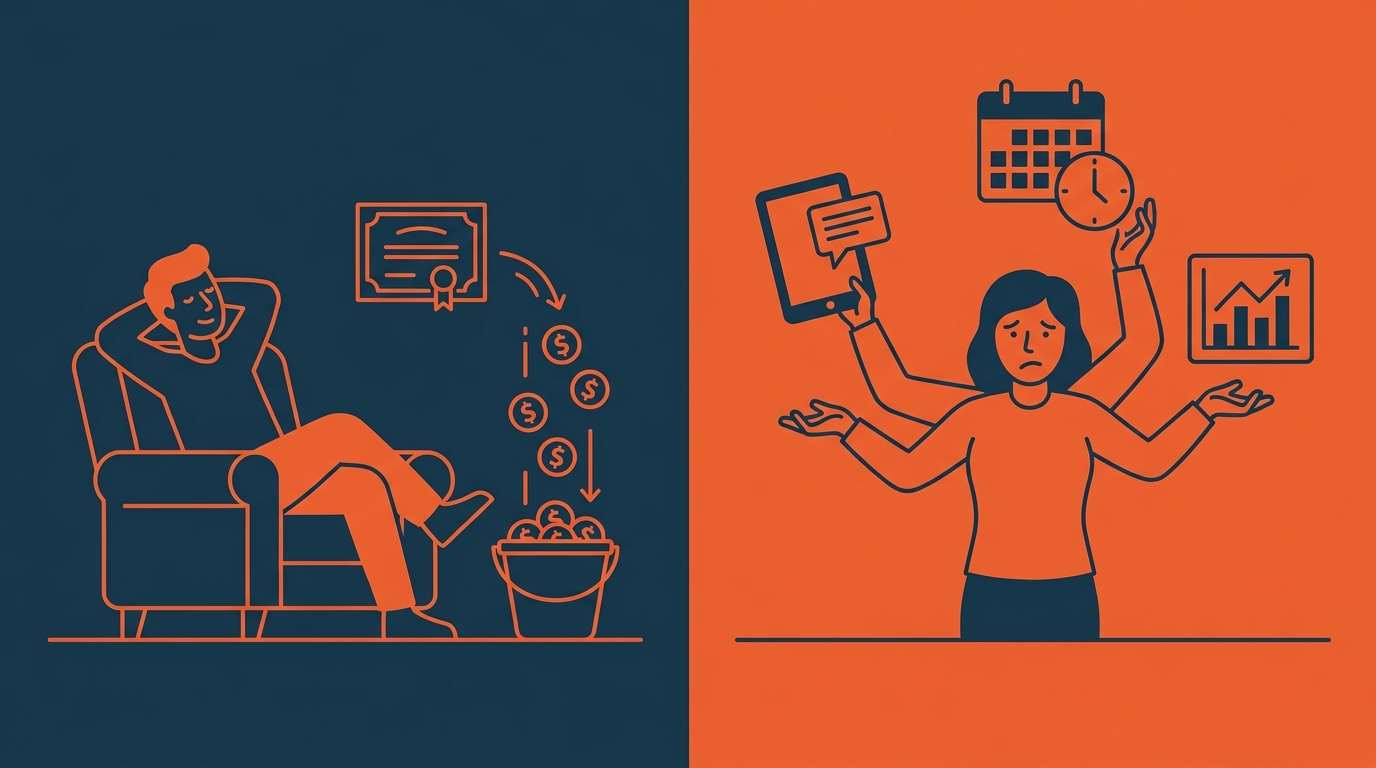
A split comparison of a hands-off REIT investor relaxing versus an active short-term-rental operator juggling guest messages, cleaning, and pricing.
Long-term rentals sit in the middle of the spectrum. You own the asset. You control the big decisions. If you hire a property manager, the daily operations run without you.
Here's how it works. You buy a property. You place a tenant on a 12-month lease. The tenant pays rent monthly. You cover the mortgage, insurance, taxes, and maintenance. What's left is your cash flow.
If you self-manage, you're handling tenant communication, maintenance coordination, rent collection, and lease renewals. Time commitment: 3-6 hours monthly per property, more when something breaks or a tenant moves out.
If you hire a property manager, they handle tenant placement, maintenance, and monthly operations. You review financials, approve repairs over a certain threshold, and make strategic decisions about rent increases or improvements. Time commitment: 2-4 hours monthly per property. Property managers charge 8% to 12% of monthly rent. That fee cuts into cash flow but buys back your time.
The trade-off structure is clear. Long-term rentals give you asset ownership and moderate control. With a property manager, the time commitment stays low. The returns are lower than short-term rentals in comparable markets, and you're exposed to tenant risk, vacancy cycles, and property management quality.
This model works for operators who want real estate ownership without running a hospitality business. You're building equity through mortgage paydown and appreciation. You're collecting monthly cash flow. You're not fielding guest complaints at 11 PM.
If that trade-off structure fits your goals, long-term rentals are a solid foundation. If you want higher cash flow and you're willing to operate a business, the next zone is where those returns live.
Key point: Long-term rentals with property management offer asset ownership and moderate passivity. Returns are lower than STRs but the time commitment stays manageable.
Zone 3: Short-Term Rentals and Arbitrage
Short-term rentals are not passive. They're a business.
Read that again before you buy a property or sign a lease. The returns are real. The work is also real. Go into this thinking it's passive income and you'll burn out inside six months.
Here's what running a short-term rental involves. You list the property on Airbnb, Vrbo, or both. Guests book for 1 to 7 nights on average. You communicate with them before, during, and after their stay. You coordinate cleaning after every checkout. You manage pricing daily or weekly based on demand, seasonality, and local events. You handle maintenance issues when they come up. You respond to reviews. You troubleshoot Wi-Fi, door codes, appliance problems, and the occasional neighbor complaint.
If you don't build systems, you're doing all of that manually. Time commitment: 10-15 hours weekly per property.
If you build the right systems (automated guest messaging, review responses, dynamic pricing, a reliable cleaning team, a maintenance network), that drops to 2-5 hours weekly per property. The systems separate operators who scale from operators who grind.
The returns justify the investment in systems. Short-term rentals generate 2x to 4x the monthly income of a comparable long-term rental in the same market. The trade-off is the operational load. You're running a hospitality business. Own that or don't start.
Rental arbitrage is the low-capital entry point into short-term rentals. You lease a property from a landlord, get written permission to sublease it as a short-term rental, furnish it, and list it on Airbnb or Vrbo. You operate it the same way you'd operate an owned STR. You don't own the property. You're profiting from the spread between your lease cost and your STR income.
Capital requirements: $5,000 to $15,000 to get started, depending on your market and furnishing costs. The model removes the need for a down payment, which means you start generating cash flow without waiting years to save $50,000. You're also learning the operations without balance-sheet risk. That's the inversion most operators miss: learn how to run the business before you own the asset.
The trade-off: you don't build equity. Arbitrage is a cash-flow business, not a wealth-building play through property ownership. But if you want to test whether you're willing to do the work before you buy, arbitrage is the right test.
Key point: Short-term rentals are active businesses that produce 2-4x the returns of long-term rentals. Systems reduce the time commitment from 10-15 hours weekly to 2-5 hours weekly per property.
What the IRS Calls Passive (And When STR Income Flips to Active)
The IRS has its own definition of "passive," and it doesn't match the operational reality you read above.
Here's the rule. The IRS treats rental activity as passive income even if you're actively involved in running it, unless you qualify as a real estate professional under IRC §469(c)(7). That means most rental income is classified as passive for tax purposes regardless of how much time you spend on it. (Source: IRS Publication 925.)
To qualify as a real estate professional, you need to meet two tests. First, you must spend more than 750 hours per year in real-property trades or businesses in which you materially participate. Second, more than half of your total personal-services time for the year must be spent in real property. If you meet both tests, your rental activity becomes non-passive. That opens the door to deducting rental losses against your ordinary income without the passive-loss limitations that otherwise apply.
Most operators don't qualify. If you have a W-2 job and you're running rentals on the side, you're not hitting 750 hours in real estate, and you're not spending more than half your working time there. Your rental income stays passive for tax purposes.
Short-term rentals are different. If the average guest stay is 7 days or fewer, the IRS does not classify the activity as a "rental activity" under the passive-loss rules. That's Treasury Regulation §1.469-1T(e)(3)(ii). If you also materially participate in the STR business, the income becomes active, not passive. Material participation has multiple tests; the most common path is spending more than 500 hours per year on the activity.
Why does this matter? Active income from STRs offsets your W-2 wages if you're showing losses in the early years (often driven by depreciation and startup costs). Passive rental losses from long-term rentals can't do that unless you qualify for the $25,000 special allowance, which phases out between $100,000 and $150,000 of modified adjusted gross income (MAGI) under IRC §469(i). (Source: IRS Publication 925.)
One more fact: residential rental property is depreciated over 27.5 years under IRS rules. (Source: IRS Publication 527.) That depreciation is a paper loss that reduces your taxable income. If your rental activity is passive and you don't qualify for the special allowance, those losses get suspended until you sell the property or generate enough passive income to absorb them. If your STR activity is active, the losses offset your ordinary income in the year they're incurred.
The tax structure rewards operators who go deep on short-term rentals and treat it as a business. Long-term rental operators who hold properties as a side activity stay in passive classification, which limits how they use losses in the near term.
This is educational information only, not tax, financial, or investment advice. Tax treatment depends on your specific facts and changes over time. Talk to a CPA who understands real estate before making decisions based on any of this. For a full breakdown of STR tax strategy, read the STR tax pillar here.
Key point: The IRS classifies most rentals as passive regardless of effort. STRs with average stays of 7 days or fewer and material participation flip to active income, allowing losses to offset W-2 wages.
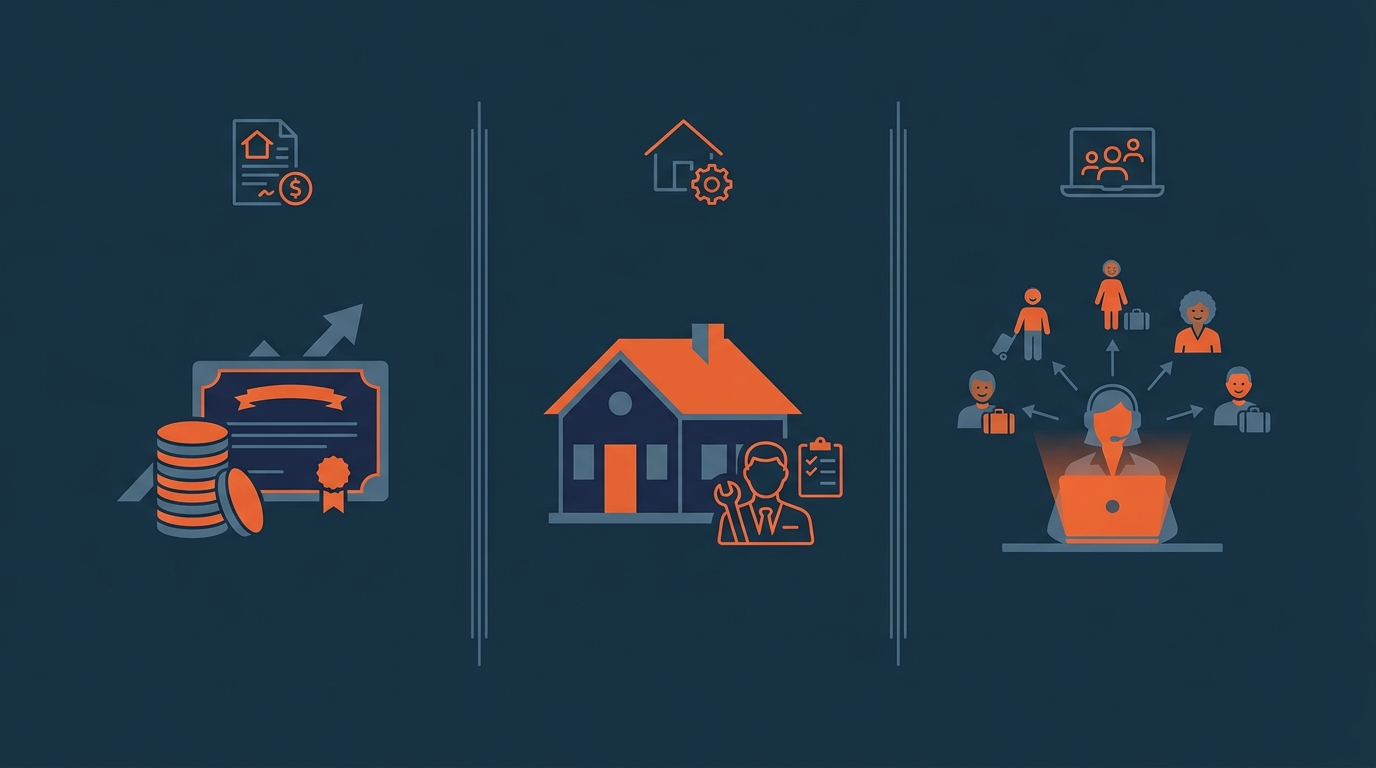
Three labeled columns comparing a truly passive REIT, a mostly passive long-term rental with a property manager, and an active short-term-rental business.
You've seen the spectrum. Now pick your position.
Start with time. How many hours per week are you willing to spend on real estate?
* Close to zero: Zone 1. REITs or crowdfunding.
* A few hours monthly: Zone 2. Long-term rentals with property management.
* Ready to build systems and run a business: Zone 3. Short-term rentals.
Next, capital.
* Under $10,000: REITs, some crowdfunding platforms, or rental arbitrage.
* $30,000 to $100,000: buy a long-term rental with financing or start an owned short-term rental.
* $50,000 and up: syndications become accessible, or deploy multiple arbitrage deals simultaneously.
Last, risk and control.
* Comfortable letting someone else make all the decisions: Zone 1 works.
* Want asset ownership but fine delegating operations: Zone 2 fits.
* Need full control and willing to do the work for higher returns: Zone 3 is the path.
The operators who get stuck pick based on what sounds good instead of what their constraints allow. They want passive income, so they pick a model that sounds passive, then realize six months in that the model doesn't match their time availability, capital position, or control needs.
Pick based on what's true right now. You move across the spectrum as your situation changes. The operator who starts with a REIT moves to long-term rentals when they have more capital. The operator who starts with rental arbitrage moves to owned STRs once they've proven they run the operations profitably.
The sequence determines the outcome. Get the first position right. Build from there.
Key point: Match your zone to your actual time, capital, and control constraints, not to aspirational positioning. You move across the spectrum as your situation changes.
A Realistic First Step
Here's the move I give most operators starting from zero.
Open a brokerage account. Buy a REIT or a real estate crowdfunding position with $500 to $2,000. Watch how it performs for 90 days. Read the quarterly reports. Track the distributions. Get familiar with how real estate investments report returns. That's your Zone 1 foundation. You're in the market. You're learning the language.
While that's running, pick a market you're interested in and start researching rental comps. Look at Airbnb and Vrbo listings in that market. Check occupancy rates. Run the numbers on what a long-term rental would cash flow versus what a short-term rental would produce in the same zip code.
If the STR numbers show 2x to 3x the long-term rental income and you're willing to do the work, start researching rental arbitrage in that market. Find landlords open to subleasing. Get the first deal under contract. Furnish it. List it. Operate it for six months. That's your Zone 3 test: running the business with low capital risk, learning whether you want to do the work. If you do, scale to property two. If you don't, you learned that for $5,000 instead of $50,000.
If the long-term rental numbers make more sense for your market or time availability, save for a down payment. Buy your first property. Hire a property manager. Run it for 12 months. Track the cash flow. Learn what good property management looks like in practice.
The operators who succeed start small, test the model, and scale based on what the data shows. The operators who struggle quit their job, buy three properties at once, and realize six months later they picked the wrong zone for their situation.
Start with one position. Prove it works. Build from there.
Key point: Test one model at the smallest viable scale before committing capital or quitting your job. Prove the operations work, then scale.
Frequently Asked Questions
Is rental income passive income?
For tax purposes, yes in most cases. The IRS classifies most rental activity as passive even if you're actively managing it, unless you qualify as a real estate professional or your average guest stay is 7 days or fewer (which flips STR income to active). Operationally, it depends on the model. REITs and crowdfunding are truly passive. Long-term rentals with property management are mostly passive. Short-term rentals require active systems and ongoing management.
How much money do you need to start earning passive income from real estate?
You start with $10 on some crowdfunding platforms or by buying REIT shares through a brokerage account. Rental arbitrage requires $5,000 to $15,000. Buying a long-term rental property requires $30,000 to $100,000 for a down payment and closing costs depending on the market. Short-term rental ownership starts around $50,000 in most markets.
What is the most passive way to invest in real estate?
REITs. You buy shares of a publicly traded real estate investment trust through a standard brokerage account. You collect dividends. You make no operational decisions. The management team runs everything. It's as close to truly passive real estate exposure as you get.
Are short-term rentals passive income?
No, not operationally, and often not for tax purposes either. If your average guest stay is 7 days or fewer and you materially participate in the business, the IRS does not classify your STR as a passive rental activity. That means STR income gets treated as active income, not passive. The tax implication: STR losses offset your W-2 wages if you materially participate. Talk to a CPA about your specific situation.
How do beginners build passive income with real estate?
Start with the model that matches your time, capital, and control constraints, not the model that sounds best. For most beginners, that means starting with a REIT or crowdfunding position to learn how real estate investments report returns, then moving to a long-term rental or rental arbitrage deal once you understand the landscape. Build one position. Prove it works. Scale from there.
What's the difference between passive and active income for tax purposes?
The IRS classifies most rental income as passive unless you qualify as a real estate professional (more than 750 hours per year in real-property trades or businesses, and more than half your total working time spent there). Short-term rentals with average stays of 7 days or fewer and material participation (500+ hours per year) flip to active income. Active income losses offset W-2 wages. Passive losses offset only passive income unless you qualify for the $25,000 special allowance (which phases out between $100,000-$150,000 MAGI).
Key Takeaways
* Real estate income runs on a passivity spectrum from truly passive (REITs, crowdfunding) to fully active (short-term rentals).
* Zone 1 (REITs, crowdfunding) requires zero time but offers no control. Zone 2 (long-term rentals with property management) requires 2-4 hours monthly and builds equity. Zone 3 (short-term rentals) requires 2-15 hours weekly but produces 2-4x the income of long-term rentals.
* The IRS classifies most rental income as passive for tax purposes regardless of effort. Short-term rentals with average stays of 7 days or fewer and material participation flip to active income, allowing losses to offset W-2 wages.
* Starting capital ranges from $10 for REITs to $5,000-$15,000 for rental arbitrage to $50,000+ for owned STR properties.
* Pick your zone based on actual time, capital, and control constraints, not aspirational positioning. Test one model at the smallest viable scale before committing larger capital.
* Systems separate STR operators who scale from operators who grind. Automated guest comms, review responses, dynamic pricing, and a reliable cleaning team drop time commitment from 10-15 hours weekly to 2-5 hours weekly per property.
* Rental arbitrage lets you learn STR operations without balance-sheet risk before buying property. You're learning whether you want to do the work for $5,000 instead of $50,000.
*Disclaimer: This article is educational only and does not constitute tax, financial, or investment advice. Tax treatment depends on your specific facts and changes over time. Consult a qualified CPA or financial advisor before making investment decisions.*
Ready to figure out which path fits your situation? Download the free starter guide, *Which Real-Estate Income Path Fits You*, and map the trade-offs for each model against your time, capital, and goals. Get the guide here.
If you're leaning toward short-term rentals and you want to talk through whether arbitrage or ownership makes sense for your market, book a strategy call. We'll run the numbers for your situation and hand you the next three moves.