Is This Guide for You? (Owner vs. Arbitrage vs. Co-Host)
This guide is written for the owner path. You control the property — you own it, you're buying it, or you're renting out a room or unit you control. If you want to start an Airbnb without owning property, that's a different path with different economics and a different set of risks. We cover that separately in our guide to starting an Airbnb without owning property. The steps below assume you have access to a property you can legally rent short-term.
Step 1: Verify Local Laws Before You Spend Anything
⤢ Hover to enlarge

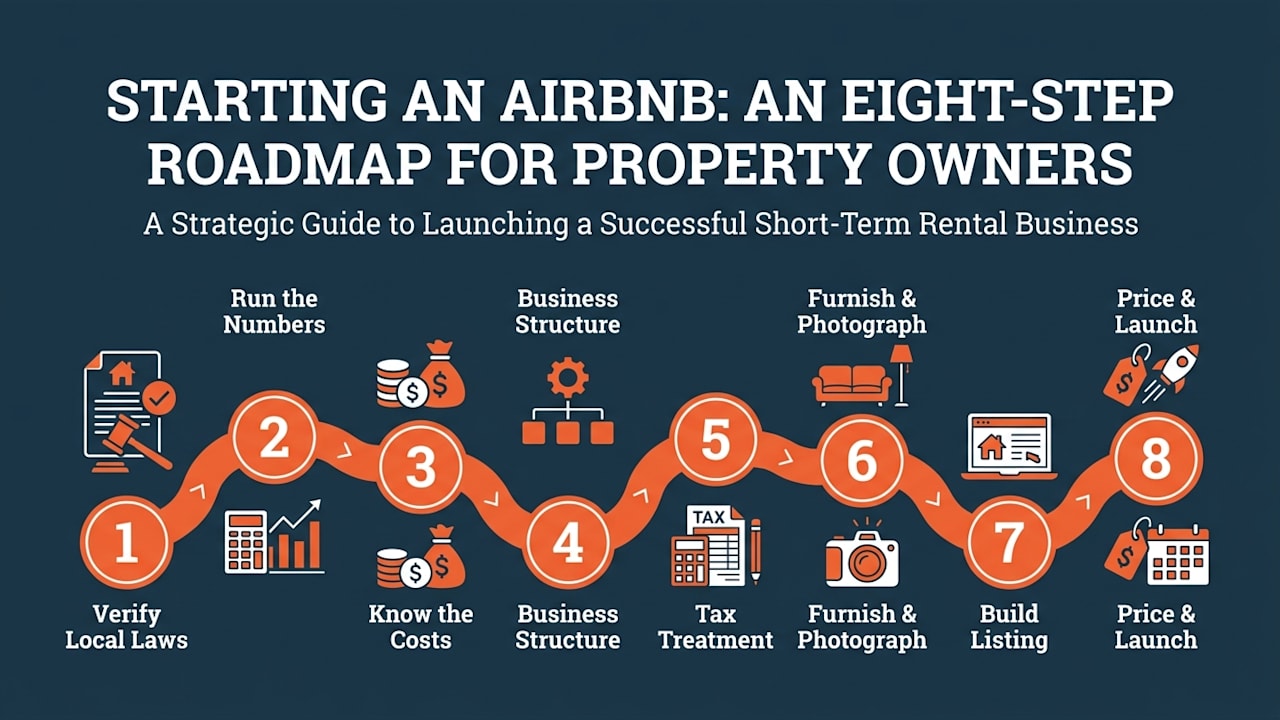
The eight-step Airbnb owner roadmap from verifying local laws through launch
Most US cities require short-term-rental registration or permits before you list legally. Rules shift by jurisdiction. Some cities require annual renewal. Some cap rental nights. Some restrict STRs to owner-occupied properties only.
Operating without required permits exposes you to fines and forced delisting in most US markets.
Run two searches: "[your city] short-term rental permit" and "[your county] transient occupancy tax." Go to the official government site. You need current requirements, not a blogger's summary from 2023.
Transient occupancy tax: Most jurisdictions require hosts to collect and remit transient occupancy tax. Some call it hotel tax or lodging tax. Example: some New York counties impose 14% transient occupancy tax on STR stays (NYS Tug Hill Commission STR guide). Airbnb auto-collects and remits this tax in many markets. Not all. Confirm your jurisdiction.
HOA and lease restrictions: If the property sits in an HOA or under a lease, check the governing documents before you furnish a single room. Some HOAs ban short-term rentals outright. Some leases do the same. Find out now.
Key point: STR rules vary by city and county and change often. Confirm current requirements with your local government before you list.
Primary source: Onondaga County, NY local law requiring STR registration (2025).
Step 2: Pick a Market and Run the Numbers
Demand signals to check: tourism draw, business travel, events calendar, proximity to hospitals or universities. Travel nurses and visiting families keep occupancy stable when markets soften.
US short-term-rental occupancy averaged roughly 55% through the first half of 2025 — AirDNA reported 54.9% for H1 2025, running near 55.5% mid-year, with monthly readings dipping to about 51% in December 2025 as new supply outpaced demand (AirDNA, Midyear STR Outlook 2025). National average. Your specific market will vary. Metropolitan leaders include New York City at 70% and Denver at 66%, both driven by year-round business and tourism demand.
The number to pressure-test isn't best-case ADR. It's median ADR at realistic occupancy in your specific submarket.
Average Daily Rate (ADR): Pull comps from your target market with AirDNA's free market overview or by searching your city on Airbnb without dates. Shows all active listings and their pricing.
Pressure-test the math: Take market median ADR × realistic occupancy (not peak) × 30 days. Subtract monthly carrying costs: mortgage or rent, utilities, insurance, supplies, cleaning. What's left is your operating margin before taxes. Run this before you furnish anything.
Saturation check: High listing counts relative to demand is a real risk. Look at occupancy rates, not listing volume. A market with 500 listings at 70% occupancy is healthier than one with 200 listings at 40%.
Key point: Validate market economics with actual occupancy and ADR data before you commit capital. The math either works or it doesn't.
Step 3: Know What It Costs to Start
Startup costs for a first US owner-listing run from a few thousand to low five figures. Furnishing, linens, supplies, professional photos, deposits, cash reserve. Space size and condition drive the range. Most first-timers land between $5,000 and $12,000 before their first booking.
Itemized breakdown:
Furnishing (bedroom, living, kitchen, bathroom): $3,000 to $10,000+ depending on unit size and condition. A one-bedroom starting from scratch runs $5,000 to $7,000 furnished at functional quality. A three-bedroom runs $10,000 to $20,000 if sourcing new. Median per-bedroom furnishing spend for new US hosts in 2026 covers bed, linens, nightstands, lamps, decor, and a share of common areas.
Furnishing consumes 60% to 70% of your budget. Furniture costs for sleeping, eating, and living eat 60% to 70% of your furnishing budget. Don't skimp on mattresses. A $400 memory foam mattress is the industry minimum. Negative reviews in 2026 that mention furnishings cite beds, pillows, or towels most often. Not decor. Spend the furnishing budget where guests put their bodies.
Linens, towels, and consumables (coffee, toiletries, cleaning supplies): $300 to $800 for initial stock, with ongoing replenishment costs.
Professional photography: $150 to $400 for a local real estate or STR photographer. Not optional. Listings with professional photos convert at a higher rate. Expect to pay $300 to $800 for professional shots. Professional photography consistently outperforms smartphone images in views and conversion. Don't skip it.
Platform setup costs: Creating an Airbnb listing is free, but factor in Airbnb's service fee. Airbnb is moving most hosts from its older split-fee model (a 3% host fee plus a separate 14.1% to 16.5% guest fee) to a single host-only fee of about 15.5%, deducted from your payout, with guests paying no separate fee at checkout. PMS-connected hosts were migrated through late 2025 and into 2026; independent hosts may still see the split fee for now. Either way, budget for roughly 15% of revenue going to the platform. Source: Airbnb Help Center, "Airbnb service fees".
STR insurance gap (see Step 4): Budget $500 to $2,000 per year for a dedicated STR policy. Average cost of dedicated Airbnb insurance ranges from $1,000 to $3,500 per year, depending on location, property value and size, and rental frequency.
Cash reserve: Keep one to three months of operating expenses in reserve before your first booking. Equipment breaks. Cleaners cancel. Guests damage things. AirCover for Hosts provides up to $3 million in host damage protection and up to $1 million in host liability insurance (Airbnb Help Center). It's a baseline, not a substitute for proper STR insurance. Confirm coverage with a licensed insurance professional.
Principal, interest, taxes, insurance, plus HOA and STR policy rider. Multiply by four. That's your minimum cash reserve at launch. Three months of carry plus one month of operating buffer.
Total realistic range for a first owner listing: a few thousand dollars (existing furnished property, minimal updates) to $15,000 to $25,000 (unfurnished unit, professional photos, full reserve).
Where operators overspend: Luxury furniture before they've validated the market. Buy functional and durable first. Upgrade after revenue proves the unit.
Key point: Most first owner-listings in the US run $5,000 to $12,000 to get guest-ready, depending on unit size and starting condition.
Step 4: Set Up the Business Structure
LLC vs. sole proprietor: You don't need an LLC to host. Many owners form a single-member LLC to create liability separation between the STR and personal assets and to keep income and expenses clean. No universal right answer. Depends on your state's LLC costs, your existing asset exposure, and how you'll file taxes. Consult a licensed professional before deciding.
EIN: If you form an LLC or want to open a business bank account without using your Social Security number, apply for an Employer Identification Number from the IRS at irs.gov. Free. Takes minutes.
Separate bank account: Open a dedicated checking account for STR income and expenses before your first booking. Not optional if you want clean books and defensible deductions.
A separate bank account for your STR isn't a formality. It's the foundation of every deduction you'll claim and every audit you'll survive.
Insurance gap: A standard homeowner's or landlord policy doesn't cover short-term rental activity. You need a dedicated STR policy or a rider that explicitly covers paying guests. AirCover for Hosts is baseline protection. Confirm proper STR coverage with a licensed insurance professional before you list.
Hosting on Airbnb without a dedicated short-term rental policy or endorsement creates a gap that has left hosts personally liable for significant damages. Most homeowners and renters insurance policies exclude short-term rental activity.
AirCover provides a solid baseline: $3 million in host damage protection and $1 million in liability coverage. Major gaps exist. It only applies to Airbnb-booked stays, excludes loss of rental income, and doesn't cover weather-related damage or incidents outside the check-in/check-out window. For hosts who use multiple platforms, host frequently, or own investment properties, AirCover alone is not sufficient.
In the United States, a serious guest injury claim involving permanent disability, lost earnings, and extensive medical costs produces judgments exceeding $1,000,000. That's the standard liability limit in most STR policies and in Airbnb AirCover. US STR hosts should consider $2,000,000 in primary STR liability coverage, supplemented by a $1,000,000 to $2,000,000 umbrella policy. Incremental annual cost of doubling liability coverage runs $100 to $300 per year.
Key point: Standard homeowner policies exclude STR activity. AirCover is a baseline, not complete coverage. Get dedicated STR insurance before you list.
Step 5: Understand Tax Treatment Before Your First Booking

⤢ Hover to enlarge

Airbnb startup cost stacked bar: furnishing, photography, insurance, and cash reserves totaling $5,000 to $12,000
*This is educational information, not tax advice. Short-term-rental tax treatment depends on your situation. Consult a licensed CPA or tax professional before filing.*
The 14-day rule: If you rent a dwelling you also use as a personal residence for fewer than 15 days in a tax year, rental income is generally not reportable as income. Source: IRS Topic No. 415. Most hosts exceed 14 days, so this is a niche exception. Worth knowing.
Schedule E (most STR owners): Short-term rental income is generally reported on Schedule E (Supplemental Income and Loss). This treats the STR as a rental activity, not a business. Source: IRS Publication 527 (2025) and IRS Topic No. 414.
Schedule C (substantial services): If you provide hotel-like services to guests (daily cleaning, meals, concierge, regular linen changes during the stay), the IRS classifies your STR as a business rather than a rental. That means Schedule C, self-employment tax, and a different deduction structure. Source: IRS Publication 527 (2025) and IRS 2025 Instructions for Schedule E.
Most STR owners report income on Schedule E. If you provide hotel-like services during a guest's stay, the IRS requires Schedule C. That changes your tax exposure significantly.
The working answer: Most hosts who clean between guests (not during stays), provide standard amenities, and respond to guest needs without daily service land on Schedule E. If you're offering daily housekeeping or meal service, talk to a CPA before you file.
A typical STR generates $15,000 to $30,000 in deductible operating expenses above revenue in the early years: furnishing, startup costs, management fees, cleaning, supplies. As an STR with material participation, those losses offset W-2 income. As a long-term rental, they're trapped in the passive bucket.
For a full breakdown of STR deductions available to owners, see our guide to STR tax deductions.
Key point: Schedule E versus Schedule C hinges on whether you provide hotel-like services during guest stays. Most hosts file Schedule E. Get professional tax guidance if your setup is unclear.
Step 6: Prepare, Furnish, and Photograph the Space
Guest-ready standard: Clean, clutter-free, functional. Every item in the space should be there because a guest needs it or because it photographs well. Remove personal items, family photos, and anything irreplaceable.
Furnishing priorities: Mattress quality matters more than almost anything else. Guest reviews mention mattress comfort more than nearly any other single item. Invest here. Comfortable mattress plus quality linens equals the baseline for five-star sleep reviews.
The mattress and the photos are the two items that will make or break your first 10 reviews. Budget accordingly.
The photo step: Professional photography is the single highest-ROI spend in your pre-launch budget. Listings with professional photos consistently outperform amateur photos in click-through and booking conversion. Shoot during daylight, open all curtains, turn on all lights. Use landscape orientation. Lead with your best photo.
Practical checklist:
Every bedroom needs: Comfortable mattress, quality linens (two sets per bed), blackout curtains, multiple charging outlets.
Every bathroom needs: Fresh towels (two sets per guest), hand soap, shampoo, conditioner, hair dryer, non-slip mat.
Kitchen: Coffee maker, cookware basics, dishware, cleaning supplies.
Living area: Reliable WiFi (non-negotiable), TV, seating for the listed guest count.
Key point: Invest in mattresses and professional photography. Guest reviews and booking conversion depend on both.
Step 7: Build a Listing That Converts
Title: Lead with property type and its strongest draw. "Quiet 2BR near [landmark/district]" beats "Cozy Home" every time. Be specific.
Description: Write to the guest comparing you to three other listings. What do you have they don't? Proximity, parking, a great kitchen, a backyard, fast WiFi? Name it. Don't bury the differentiator.
Your listing title and lead photo do more work than any other element. They're the reason a guest clicks or scrolls past.
Amenities: Check every amenity that applies. Airbnb's search filters use amenities. Missing one means missing a filtered search.
House rules: Clear rules set expectations and protect you. State check-in/check-out times, pet policy, smoking policy, and quiet hours.
Accuracy: The listing must match the space. Overpromising generates the exact reviews that tank a new listing.
Official listing path: Airbnb's four-step process: describe your place, add photos and details, set house rules and price, publish. Source: Airbnb "Host your home".
For a full breakdown of listing optimization tactics (title formulas, description structure, amenity prioritization), we cover that in detail in our listing-optimization guide.
Key point: Title and lead photo determine whether guests click. Description and amenities determine whether they book. Accuracy determines whether they review well.
Step 8: Price, Automate, and Launch

⤢ Hover to enlarge

Schedule E versus Schedule C tax treatment comparison for short-term rental owners
Dynamic pricing: Start with a competitive rate: 10% to 15% below similar comps in your market for the first five to 10 bookings while you build reviews. Once you have 10+ reviews and a strong rating, move to market rate. Tools like PriceLabs or Wheelhouse automate nightly adjustments based on demand, seasonality, and local events. Hosts who use data-driven pricing tools see 15% to 25% revenue improvements over static pricing strategies.
Calendar automation: Use Airbnb's automated messaging to handle booking confirmations, check-in instructions, and check-out reminders. Set these up before you publish the listing.
Get your automated guest messages written and scheduled before you hit publish. Your first booking comes within hours of going live.
AirCover for Hosts: Automatically included with every Airbnb listing: $3M damage protection, $1M liability insurance, guest identity verification (Source: Airbnb Help Center). Treat it as a baseline, not a complete insurance solution.
Pre-launch checklist: Permit confirmed, STR insurance in place, bank account open, automated messages set, professional photos uploaded, listing reviewed for accuracy, cleaning protocol established, cleaning crew or personal schedule confirmed.
First booking: Respond to inquiries within the hour. Your response rate and response time affect your search ranking from day one.
Key point: Start with competitive pricing below market comps to build reviews. Automate messaging before launch. Respond to inquiries fast.
Common First-Timer Mistakes and How to Avoid Them
1. Skipping the permit check: Operators who furnish first and research regulations second have lost thousands in fines and forced delistings. The permit step is Step 1 for a reason. New York City levied $72 million in STR fines in 2026, underscoring the financial risk of operating without proper permits.
2. Buying in a saturated market without checking occupancy data: High listing counts tell you nothing without occupancy rates. A market with 500 listings at 70% occupancy is healthier than one with 200 listings at 40%. The US saw rapid supply growth post-COVID, dropping national averages from 57% in 2024 to approximately 50% by early 2026.
3. Under-reserving cash: Equipment breaks on the worst possible weekend. A water heater, a broken HVAC, or a guest who damages something beyond AirCover's scope wipes out two months of margin if you don't have a reserve.
4. Amateur photos: Most common and most correctable mistake. A $200 to $300 photography session pays for itself in the first booking.
5. Filing taxes on the wrong schedule: Reporting STR income on Schedule C when Schedule E applies (or vice versa) creates IRS exposure. Get this right before your first filing. Talk to a CPA who works with STR operators.
Frequently Asked Questions
How do I start an Airbnb business as a beginner?
Confirm it's legal where you live, run the market numbers, set up the business and insurance, learn the tax rules, furnish and photograph the space, build and price the listing, then launch. Eight ordered steps. The first one is checking your local permit requirements, not furnishing the space.
How much does it cost to start an Airbnb?
Startup costs for a first US owner-listing run from a few thousand to low five figures: furnishing, linens, supplies, professional photos, deposits, and cash reserve. Space size and condition drive the range. Most first-timers land between $5,000 and $12,000 before their first booking.
Do I need a permit or license to run an Airbnb?
In most US cities, yes. A short-term-rental registration or permit, plus collection of a transient occupancy (lodging) tax. Check your specific city and county before you furnish. Rules change frequently and vary by jurisdiction.
Do I need an LLC to start an Airbnb?
No. You don't need an LLC to host. Many owners form an LLC for liability separation and a clean bank and tax setup. It's a judgment call that depends on your state's LLC costs and your existing asset exposure. Consult a licensed professional before deciding.
Is Airbnb income taxable, and what tax form do I use?
Yes, if you rent more than 14 days a year. Most owners report on Schedule E. If you provide substantial guest services during their stay (daily cleaning, meals, concierge), the IRS requires Schedule C instead. Source: IRS Publication 527 (2025). This is educational information, not tax advice. Consult a licensed CPA.
Can I start an Airbnb without owning property?
Yes. Through rental arbitrage or co-hosting. That's a different path with different economics and different risks. This guide covers the owner's path. See our dedicated guide to starting an Airbnb without owning property.
What's the difference between Schedule E and Schedule C for STR taxes?
Schedule E treats your STR as rental income. Schedule C treats it as business income subject to self-employment tax. Most STR owners who clean between guests (not during stays) and provide standard amenities file Schedule E. If you provide hotel-like services during guest stays (daily cleaning, meals, concierge), the IRS requires Schedule C. This changes your tax liability. Consult a CPA who works with STR operators.
How long does it take to get an Airbnb permit?
Varies by jurisdiction. Some cities issue permits within days online. Some require inspections and take weeks or months. Start the permit process before you furnish. Search "[your city] short-term rental permit" and go to the official government site for current processing times.
What insurance do I need for an Airbnb?
A dedicated short-term rental policy or a rider that explicitly covers paying guests. Standard homeowner's and landlord policies exclude STR activity. AirCover for Hosts provides baseline damage and liability protection ($3M damage, $1M liability), but doesn't cover loss of income, weather damage, or incidents outside the booking window. Budget $500 to $2,000 per year for proper STR insurance. Consult a licensed insurance professional before listing.
Key Takeaways
Verify local STR legality and secure required permits before you spend money on furnishing or setup. Operating without permits exposes you to fines and forced delisting.
Run market validation with actual occupancy and ADR data for your specific submarket. National averages don't predict your unit's performance.
Budget $5,000 to $12,000 for a typical first owner-listing: furnishing, professional photography, STR insurance, and three months of cash reserves.
Get dedicated STR insurance coverage. Standard homeowner policies exclude paying guests. AirCover is baseline protection, not complete coverage.
Understand Schedule E versus Schedule C tax treatment before your first booking. Most STR owners file Schedule E unless providing hotel-like services during guest stays.
Invest in professional photography and quality mattresses. Reviews and booking conversion depend on both.
Launch with competitive pricing 10% to 15% below market comps for your first five to 10 bookings to build reviews quickly.
Automate guest messaging before you publish. First bookings come fast. Response time affects search ranking from day one.
The eight steps above give you the sequence. Where most first-timers get stuck is the gap between knowing the steps and knowing whether their specific market, their specific numbers, and their specific property work. That's a different question.
Not sure your market or your numbers work? Book a free**STR diagnostic**— we'll pressure-test your plan before you spend a dollar.
---
J. Massey is an active short-term-rental operator and the founder of CashFlow Diary, where he has trained more than 10,000 entrepreneurs to build income through STR properties. He writes from the operator's seat — not the journalist's. cashflowdiary.com
