Short-Term Rental Training: How to Actually Learn the STR Business (and Whether a Course Is Worth It)
I've trained more than 10,000 operators. The question I get asked most isn't "how do I scale" or "what's the best market." It's this: <strong>Should I
By J. MasseyJune 22, 2026· 17 min read
Share
Disclosure: This post may contain affiliate links. If you purchase through our links, we may earn a commission at no extra cost to you. We only recommend tools and services J. Massey's team actually uses.
Learn more →
TL;DR: Most operators spend money on the wrong education at the wrong time. A $1,000 course that prevents one bad market entry saves $20,000. A $3,000 course that repackages YouTube content wastes $3,000 plus your time. The best operators combine free content for fundamentals, a course or mentor for structure, and a real deal to lock in the learning. The sequence matters more than the method.
You're asking the wrong question.
A good course pays for itself when it compresses months of trial and error and prevents one expensive mistake
Training is worth it only when the instructor still operates properties and the content is actionable, not motivational
Most operators who succeed combine free content, structured training, and real deals
The ROI math: $1,000 that prevents a $20,000 market mistake = 20x return
I've trained more than 10,000 operators. The question I get asked most isn't "how do I scale" or "what's the best market." It's this: should I buy a course, hire a coach, or skip training and start doing?
Here's what I know after running properties, deploying automations, and watching operators succeed and fail for a decade.
Operators buy a $3,000 course that repackages YouTube content. They hire a coach before running a single number. They skip learning entirely and lose $20,000 on a bad market entry because they didn't know what questions to ask.
This breaks down the four paths to learning STR, what each is good for, and how to tell when a course is worth it versus when it's expensive motivation.
What Are the Ways to Learn Short-Term Rentals?
Four paths exist. Most operators who succeed use three of them.
Free Content: Podcasts, YouTube, Guides, Airbnb Academy
Free content is good for orientation. It answers the "what is this business" questions. It introduces terms like ADR, occupancy, dynamic pricing, rental arbitrage. It shows you the landscape.
What it's not good for: building a business.
Free content is scattered. It's not sequenced. You'll watch 40 videos and still won't know what to do on Monday. The creators have no incentive to make you successful. They have an incentive to keep you watching.
Use free content to decide if STR is worth pursuing. Don't use it as your operating manual.
Key point: Free content orients you to the business. It won't teach you to run one.
Paid Courses: Structured Learning When the Instructor Still Operates
A good course compresses months of trial and error into a structured learning sequence. It shows you the path, names the mistakes, and hands you the systems that prevent expensive failures.
Worth it when two conditions are true:
The content is actionable — not motivational, not theoretical, but "here's the exact underwriting model, here's the exact guest communication sequence, here's the exact pricing rule structure."
The instructor still operates properties — not someone who sold their portfolio in 2019 and now only sells courses.
When those two conditions aren't met, you're paying for recycled content and outdated systems. A course not updated in two years is teaching a different market.
Key point: Courses compress time and prevent expensive mistakes, but only when the instructor operates today and the content is actionable.
Coaching or Mentorship: Highest ROI for Operators Ready to Move
Coaching is the highest ROI path for operators ready to move. Not ready to think about moving. Ready to run numbers, sign leases, and deploy systems this quarter.
What you're paying for:
Accountability — someone who knows when you're stuck versus when you're stalling.
Personalized feedback — "here's why this market won't work for arbitrage" is worth more than 10 hours of generic video content.
Real-time problem-solving — when your cleaning crew quits on a Sunday and you have guests arriving Monday, a mentor who's been there is the difference between a solved problem and a one-star review.
A mentor who has done what you're trying to do is worth more than any video library. But only when you're doing the work.
Key point: Coaching delivers the highest ROI for action takers who need accountability and real time feedback.
Learning by Doing: Running a Real Deal
This is the path that locks in the learning. You watch 100 hours of content. You won't understand dynamic pricing until you've watched your occupancy drop because you priced too high in a slow week.
You won't understand guest communication until you've had a guest ask for early check in while you're coordinating a turnover for another property.
You won't understand compliance until you've had to pull permits in a city that changed the rules.
That's not something you learn in a classroom. You learn it by putting yourself in the seat. On the job training.
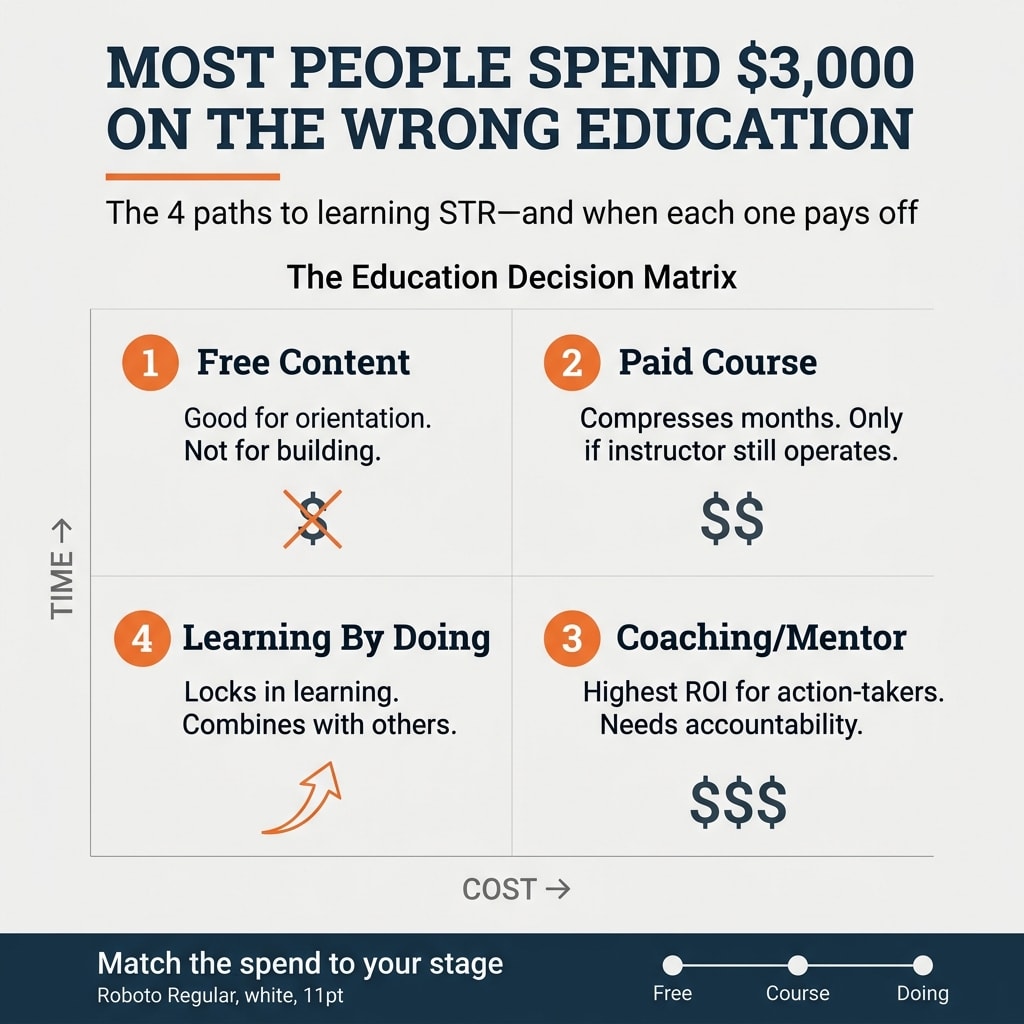
The operators I work with who move fastest combine free content for fundamentals, a course or mentor for structure, and a real deal to lock in the learning. The sequence matters more than the method.
Here's the inversion most operators miss: by starting with rental arbitrage instead of buying property, you get to figure out how to make a property profitable before you take on the full expense. You're learning with income, not debt.
Key point: Learning by doing locks in the knowledge. Arbitrage lets you learn with income instead of debt.
Four ways to learn STR: free content, course, coaching, and learning by doing
Sometimes. A good course pays for itself when it compresses months of trial and error and prevents one expensive mistake. It's not worth it when it repackages free content or is sold by someone without a verifiable operating record.
The math:
A $1,000 course that prevents one bad market entry saves you $20,000. That's a 20x return. A $1,000 course that teaches you what YouTube covers for free costs you $1,000 plus the time to figure that out.
A $3,000 course that shows you the exact underwriting model, the exact compliance checklist for your city, and the exact automation sequence for guest comms pays for itself in the first property. A $3,000 course that's mostly motivation and income screenshots with no operating substance costs you $3,000 and you still won't know what to do on Monday.
The STR education space has people who are good at selling dreams. There's a smaller number willing to tell operators that the problem is boring, structural, and solvable with a four month build instead of a mindset shift.
The test: Ask when the course was last updated. Ask how many properties the instructor manages today. When they don't answer both questions specifically, that tells you what you need to know.
Data from 10XBNB's 2026 Student Success Survey shows operators who avoided structural mistakes had 73% success rates versus 47% for those who didn't. The difference between success and failure isn't motivation. It's avoiding structural mistakes through proper training.
Match the spend to your stage. When you're deciding whether STR is right for you, start with free content. When you've run the numbers and identified a specific knowledge gap, a good course fills it. When you're ready to move and need accountability, hire a coach.
Key point: A good course pays for itself by preventing one expensive mistake. A bad course costs you money plus time.
What Should STR Training Teach?
A good training program teaches six skill areas. When a program is mostly motivation and income screenshots with little operating substance, it's selling a feeling, not a skill.
Market Selection: Data Driven, Not Gut Feel
Most operators choose markets because they live there or because someone told them it's hot. That's not market selection. That's guessing.
Good training teaches you to underwrite markets using:
Demand data — occupancy rates, seasonal patterns, event calendars
Supply analysis — competitor count, saturation, new listings per month
Regulatory environment — permit requirements, HOA restrictions, zoning rules
PriceLabs reports the vacation rental market analysis mistake at the acquisition stage is the one mistake you can't fix after the fact. Bad market selection is permanent damage.
Key point: Market selection is data driven. Living there or hearing it's hot doesn't count as analysis.
Deal Underwriting: Cash on Cash Return, DSCR, Break Even Occupancy
You need to know how to run the numbers before you sign anything. Good training teaches you:
Cash-on-cash return — what percentage return you're getting on the capital you deployed
Break-even occupancy — the minimum occupancy rate you need to cover all expenses
Expense modeling — not just rent and utilities, but cleaning, restocking, maintenance, software, permits
Vacancy buffers — what happens when occupancy drops 20% for two months
Well run arbitrage operations generate profit margins of 15% to 35%, depending on market and occupancy performance. But only when operators know how to underwrite deals, not when they're guessing.
Skipping the vacancy and slow month buffer is the most common reason new arbitrage operators go negative by month six. A good course teaches you to build for the bad case, not the great case.
Key point: Underwriting separates operators who profit from operators who bleed cash. Build for the bad case.
Operations and Automation: Guest Comms, Cleaning Systems, Review Management
You can't run more than two properties out of your head. After that, you need systems or the operation owns you.
Cleaning and turnover systems — checklists, scheduling, quality control
Review response protocols — what to say, when to say it, how to handle negative reviews
Maintenance workflows — how to handle repairs without being on-call 24/7
The goal is to automate the boring parts so your judgment stays focused on growth.
Key point: Systems free you from operational chaos. Build them before property three.
Dynamic Pricing: Not Just "Use a Tool"
Dynamic pricing tools are useful. But when you don't understand comp sets, calendar logic, and pricing rules, you're letting software guess for you.
Good training teaches you:
How to set your comp set — which properties you're actually competing with
How to read the calendar — when to push rates, when to drop them, when to hold
How to build pricing rules — weekend premiums, event-based pricing, last-minute discounts
How to interpret the data — what occupancy and ADR trends are telling you about your positioning
Pricing is the lever that determines whether you're profitable or bleeding cash. A course that doesn't teach you how to think about pricing isn't complete.
Key point: Pricing determines profit. Learn to think about it, not just automate it.
Compliance: Local Permits, HOA Rules, Zoning
This is the most under discussed topic in STR education. It's the one that shuts you down overnight.
Good training teaches you:
How to research local regulations — permits, licenses, occupancy limits, noise ordinances
How to navigate HOA restrictions — what to ask before you sign a lease
How to stay compliant — tax collection, reporting requirements, safety codes
How to handle enforcement — what to do if you get a violation notice
Violations of Austin's STR ordinance carry fines of $500 to $2,000 per violation, per day. Miami Beach runs the most aggressive fine structure of any host city: first violation $20,000, second $40,000, subsequent violations up to $100,000.
A $1,000 course that prevents one compliance violation in Miami Beach pays for itself 20 times over.
Key point: Compliance violations shut you down and cost more than any course. Learn the rules before you launch.
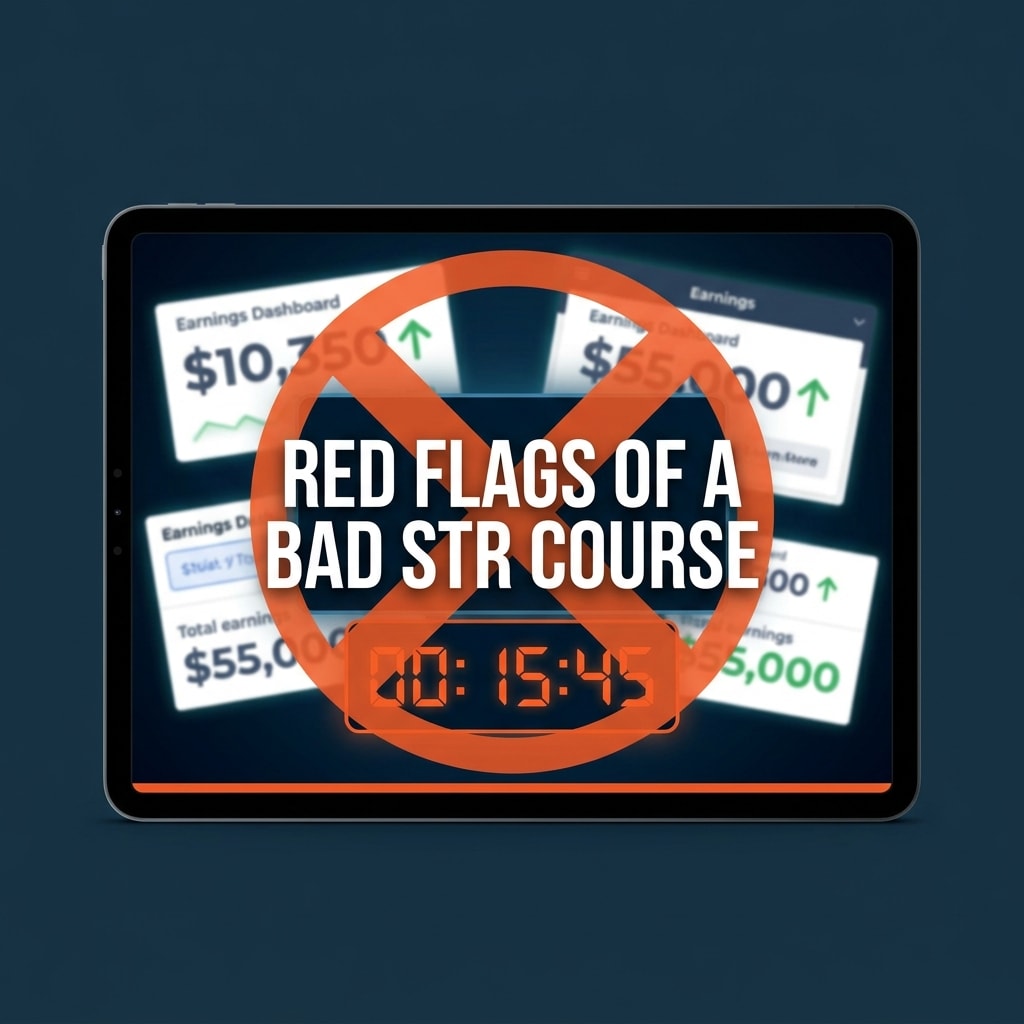
Red flags of a bad STR course: earnings screenshots and false scarcity
Six red flags. When you see three or more, walk away.
Income Screenshot Marketing
When the sales page is mostly screenshots of earnings dashboards and "look how much I made last month" posts, that's a red flag.
Income screenshots are curated by definition. They don't show expenses. They don't show the properties that failed. They don't show the months where occupancy dropped 30%.
Good training sells on systems and outcomes, not curated earnings.
No Verifiable Operating Record
Ask how many properties the instructor manages today. Not how many they used to manage. Not how many their students manage. How many they personally operate right now.
Someone who sold their portfolio years ago and only sells courses now has different incentives than someone who's still running properties.
The market changes. Regulations change. Platform algorithms change. An instructor who isn't operating in the current market is teaching outdated systems.
"Secret System" Framing
There are no secrets in STR. There are operators who do the work and operators who don't.
When the marketing is built around "the one thing no one is telling you" or "the framework the top 1% use," that's selling novelty, not substance.
Good training teaches proven systems. The edge isn't the secret. The edge is doing the boring work consistently.
When the program is valuable, it doesn't need manufactured urgency. False scarcity is a sales tactic, not a signal of quality.
Aggressive Upsell Ladders
The $97 course that exists to sell the $3,000 program that exists to sell the $15,000 mastermind.
When the business model is built on selling progressively more expensive programs instead of delivering value at each tier, you're not buying education. You're entering a funnel.
Outdated Curriculum
Ask when the course was last updated. A course not updated in two years is teaching a different market.
The global short term rental market is expected to increase from USD 138.05 billion in 2025 to USD 371.54 billion by 2035, with a CAGR of 10.41%. That explosive growth means more competition and faster regulatory changes.
When the instructor can't tell you when the content was last refreshed, that tells you everything.
Key point: Red flags include income screenshots, no operating record, secret system framing, false scarcity, upsell ladders, and outdated content.
Course vs Coaching vs Just Starting: Who Each Path Fits
Who each path fits:
Course: Structured Learners with Identified Knowledge Gaps
A course is best for someone who:
Wants a structured learning sequence — not scattered YouTube videos
Has identified a specific knowledge gap — "I don't know how to underwrite deals" or "I don't know how to handle compliance"
Is willing to implement what they learn — not just consume content
A course is worst for someone who buys it to feel ready without running a number. When you're using the course as a procrastination tool, you're wasting money.
Coaching or Mentorship: Action Takers Who Need Accountability
Coaching is best for someone who:
Is ready to move this quarter — not "thinking about it"
Needs accountability and real-time feedback — someone who knows when you're stuck versus when you're stalling
Has specific operational questions — "should I sign this lease" or "how do I handle this guest issue"
A mentor who has done what you're trying to do is worth more than any video library. But only when you're doing the work.
Just Starting: Operators Ready to Learn with Stakes
Learning by doing is best for someone who:
Has run the numbers and identified a viable deal
Is willing to learn through mistakes — not catastrophic mistakes, but the kind that teach you what the videos can't
Has access to a mentor or community for when they get stuck
The learning that sticks is the learning that comes with stakes. A real deal plus a mentor often beats a course for operators ready to move.
Rental arbitrage startup capital ranges $3,000 to $15,000 per property, covering furniture, supplies, lease deposits, and first month rent. That's the real barrier to entry, not a $3,000 course.
The Path Most Operators Take
Most operators who succeed combine all three: free content to orient, a course or mentor for structure, and a real deal to lock in the learning.
The sequence matters more than the method.
Start with free content to decide if STR is worth pursuing. Move to a course or coach when you've identified a specific knowledge gap. Start doing when you've run the numbers and found a viable deal.
Don't skip the doing part. That's where the learning happens.
Key point: Courses fit structured learners, coaching fits action takers, and doing locks in the learning. Most successful operators use all three.
Frequently Asked Questions
Is a short term rental course worth it?
Sometimes. A good course pays for itself when it compresses months of trial and error and prevents one expensive mistake. It's not worth it when it repackages free content or is sold by someone without a verifiable operating record. Match the spend to your stage.
How do I learn the short term rental business?
Most successful operators combine free content for fundamentals, a course or mentor for structure, and a real deal to lock in the learning. Start with orientation, move to structured learning when you've identified a knowledge gap, then start doing when you've run the numbers.
How much does an STR course cost?
STR courses range from $500 to $5,000 and up. Price doesn't indicate quality. A $1,000 course from an active operator is worth more than a $5,000 course from someone who hasn't run properties in years. Judge by content quality, instructor operating record, and curriculum recency.
Do I need a course to start an Airbnb?
No. You learn through free content and doing. But a good course compresses months of trial and error and prevents expensive mistakes. When you're starting with rental arbitrage, a course that teaches deal underwriting and compliance pays for itself in the first property.
What should a good STR training program teach?
A good program teaches six skills: market selection, deal underwriting, operations and automation, dynamic pricing, compliance, and guest experience. When the program is mostly motivation and income screenshots with little operating substance, it's selling a feeling, not a skill.
How do I spot a fake STR self-proclaimed expert?
Six red flags: income screenshot marketing, no verifiable operating record, "secret system" framing, pressure and false scarcity, aggressive upsell ladders, and outdated curriculum. Ask when the course was last updated and how many properties the instructor manages today. When they can't answer both specifically, walk away.
Key Takeaways
Most operators spend money on the wrong education at the wrong time. Match the spend to your stage: free content for orientation, courses for specific knowledge gaps, coaching for accountability.
A good course pays for itself when it prevents one expensive mistake. The ROI math: $1,000 that prevents a $20,000 market entry error = 20x return.
Training is worth it only when two conditions are true: the instructor still operates properties today and the content is actionable, not motivational.
Good training teaches six skills: market selection, deal underwriting, operations and automation, dynamic pricing, compliance, and guest experience.
Red flags of bad training: income screenshot marketing, no verifiable operating record, secret system framing, false scarcity, aggressive upsell ladders, and outdated curriculum.
Most successful operators combine all three paths: free content to orient, a course or mentor for structure, and a real deal to lock in the learning. The sequence matters more than the method.
Learning by doing locks in the knowledge. Start with rental arbitrage to learn with income, not debt.
A real STR learning roadmap: market selection, underwriting, operations, pricing, compliance
Before you spend a dollar on a course, get clear on what you need to learn for your situation.
When you're deciding whether STR is right for you, start with free content. Read our complete guide to rental arbitrage and explore the free STR tools we've built for underwriting practice.
When you've identified a specific knowledge gap and you're ready to move, get a free diagnostic call. We'll tell you what you need to learn for your situation. No sales pitch, no pressure.
Book your free diagnostic call here.
When you want a structured learning roadmap delivered to your inbox, grab the free STR Learning Roadmap. It's the sequence we use with operators who are getting started.
When you're ready to turn learning into action, read how to build an Airbnb business plan or explore the ownership path when you're past arbitrage.
The operators who move fastest stop consuming and start doing. Pick your next move and run it.
Get a Free Diagnostic Before You Spend on Training
Before you pay for any course, get a free diagnostic call — we'll map exactly what you need to learn for your situation, at no cost. Book your free diagnostic call.