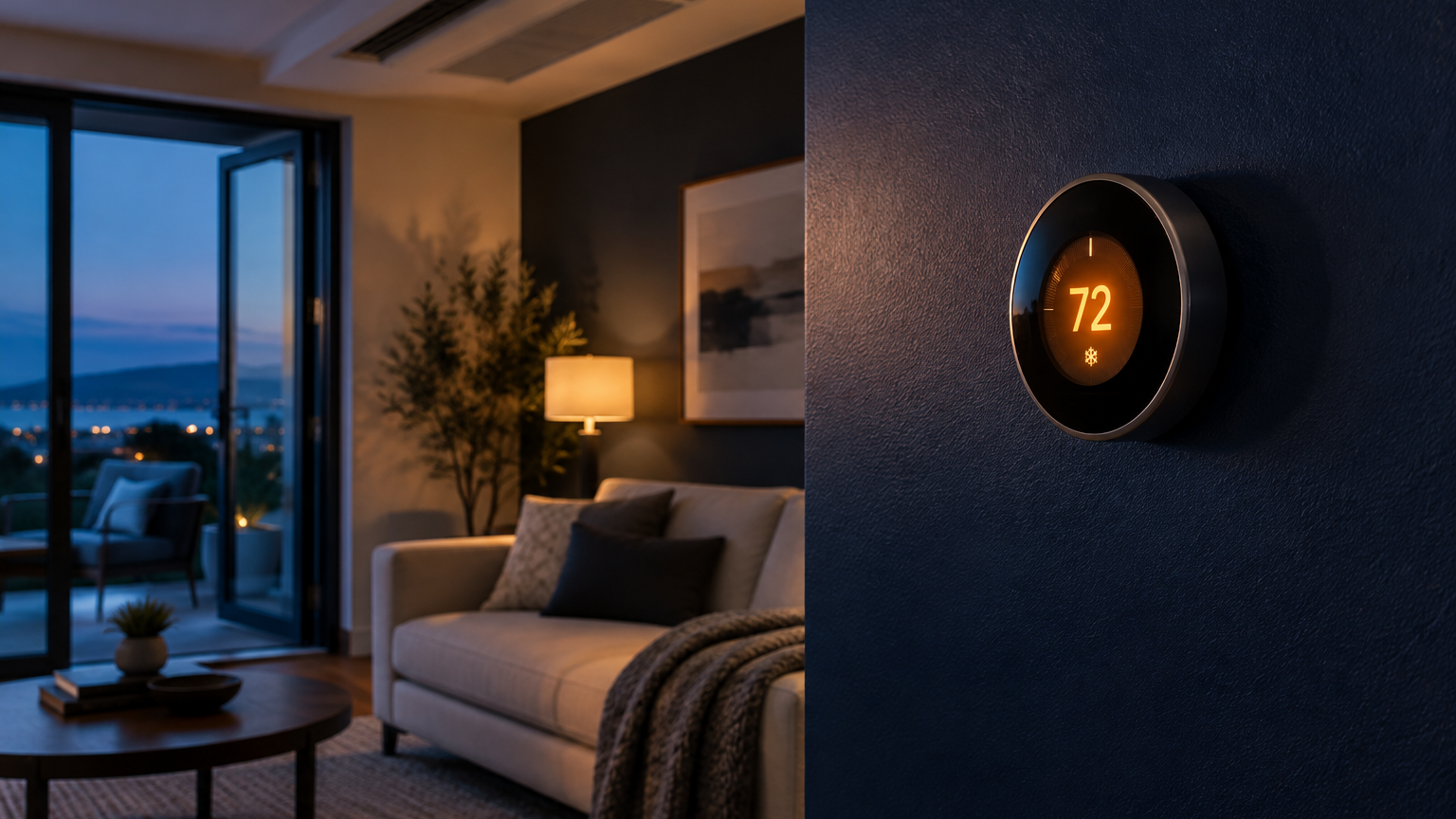
If your short term rental utility cost is climbing faster than your nightly rate, the fix is almost never a sternly worded house rule. It is a hard temperature limit on the thermostat, an alert that tells you within a day when a unit is burning more power than it should, and a lease clause that decides in advance who pays when a guest runs the AC at 64 degrees with the patio door open. Guests do not pay the power bill, so they do not manage it. Your equipment and your paperwork have to do that job for you.
I have operated short term rentals since 2016, most of them on master leases where the utility bill sits in my name and not the landlord's. That structure is where utility drift hurts most: the revenue is capped by the market, the rent is fixed by the lease, and utilities are the one line that moves on you — in my own units that line has swung 30 to 60 percent between a mild month and a bad one. Below is the operating system I use to keep that line inside a band I underwrote, rather than discovering the problem on a statement 45 days later.
Why utilities move more than any other operating line
Heating and cooling is the largest controllable draw in a residential unit. The U.S. Energy Information Administration puts space heating and air conditioning at 52 percent of the average household's annual energy use, with the remaining share spread across water heating, lighting, refrigeration and everything you plug in. ENERGY STAR frames the same math in dollars: for the average American household, almost half the annual energy bill goes to heating and cooling, more than $900 a year.
Now change one variable: occupancy behavior. A long-term tenant pays their own bill and sets the thermostat like someone who pays their own bill. Your guest is on vacation for four nights, has no meter awareness at all, and may run the HVAC at an extreme setpoint the entire stay, including the hours they are out of the unit. Add back-to-back turnovers where a cleaner props the door open in August, and a unit that ran $140 in May can run $200 in July with no change to the equipment.
Utilities are not a fixed cost in an STR — they are a variable cost driven by guest behavior, and variable costs need instrumentation.
Set a per-unit baseline before you buy a single device
You cannot detect an overage without a normal. Before you install anything, build a 12-month baseline per unit so you know what shoulder season, peak cooling and peak heating actually cost you in that building.
Pull the last 12 statements for each account (electric, gas, water, internet, trash if it is billed to you). If the unit is new to you, ask the utility for the address's usage history. In my experience providers will often release a year or two of kWh or therm history for a service address once you are the account holder or have the owner's written authorization, but release rules vary by provider — ask what they require before you assume you can get it. Convert everything to two numbers per month: units consumed and dollars.
Keep the consumption column, not just the dollars. Rates change on you. The EIA's Electric Power Monthly shows the U.S. average residential price rising from 12.55 cents per kWh in 2016 to 17.30 cents per kWh in 2025 — a bill can grow while your actual usage falls, and if you only track dollars you will chase the wrong problem.
Baseline field | Where it comes from | Why you need it |
|---|
Monthly kWh, 12 months | Utility usage history for the service address | Separates a usage problem from a rate increase |
Monthly therms or gas units | Gas statement or utility history | Winter setpoint abuse shows up here first |
Peak month cost | Highest of the 12 statements | The number your underwriting must survive |
Cost per occupied night | Monthly cost divided by nights booked | The only figure comparable across units and seasons |
Rate per kWh or therm | Current statement, not last year's | Tells you when a spike is price, not behavior |
Cost per occupied night is the metric that matters. A $260 July bill on 29 booked nights is a healthier unit than a $190 bill on 12 booked nights, and only the per-night figure shows it. I hold a target band per unit and treat any month more than 20 percent above the band as an investigation, not a rounding error. The same per-unit discipline applies to every other variable line, which is why I track utilities beside cleaning and supplies in one place — see the STR operating costs guide for the full cost stack.
Lock the equipment, then write the rule
House rules asking guests to be considerate with the AC do nothing. A locked setpoint range does. Configure the thermostat itself so the extremes are unreachable:
1. Set a permitted range, not a fixed temperature
Give guests real control inside a band — for example 68 to 76 degrees in cooling season. A band feels generous and prevents the 62-degree stunt that freezes the coil and runs the compressor for hours. A single locked temperature generates complaints and one-star reviews; a band almost never does.
2. Use the lock feature, not a note on the wall
Every connected thermostat I have deployed in a rental has supported either a passcode lock on the unit or a range restriction from the hosting dashboard; check the spec sheet for that feature before you buy, not after. ENERGY STAR certifies smart thermostats based on actual field data showing energy savings; the features it lists include remote control from a phone and geofencing that adjusts temperature as you approach home. In a rental you want the remote control and the range restriction far more than the learning algorithm — a learning schedule trained on a revolving cast of guests learns nothing useful.
3. Reset to a vacancy setpoint at checkout
The gap between checkout and check-in is free money. Push the unit to an unoccupied setpoint automatically at checkout time and pre-condition it two hours before arrival. On a unit with 30 percent vacancy, that is roughly a third of the month running at an efficient setting instead of whatever the last guest left behind.
4. Close the physical leaks that make setpoints irrelevant
A door sensor on the patio slider, weatherstripping, and a working screen door do more for a summer bill than any dashboard. If the unit cannot hold temperature, guests respond by pushing the thermostat further, and you pay for both problems.
Build the alert layer so you find spikes in a day, not a quarter
The point of monitoring is time to intervene. A statement arrives after the money is gone; an alert arrives while the guest is still in the unit and a message can fix it.
Three tiers, cheapest first:
Thermostat-side alerts. Most connected thermostats will notify you on extreme setpoints, runtime beyond a threshold, or a temperature that will not converge on the target. Runtime alerts are the highest-signal ones — a compressor running 20 hours a day is either a guest with the door open or a failing system, and both need you today.
Utility-side alerts. Every electric and gas provider I have held an account with has offered some form of free high-usage or bill-projection alert in the online portal — log in and look for yours. Zero hardware, no install, and they arrive mid-cycle. Turn these on for every account the day you open it.
Circuit-level monitoring. A meter-panel energy monitor breaks consumption out by circuit, so you can see HVAC, water heater and dryer separately. This is the tier that pays for itself on multi-unit portfolios or when you suspect a specific appliance rather than guest behavior.
Whatever tier you use, decide the response in advance. My rule: a runtime alert triggers a check of the door and window sensors first, then a polite guest message about the patio door, then a maintenance visit if runtime stays high after the guest leaves. Alerts without a written response path just become notifications you swipe away.
Decide who pays before there is something to argue about
Two documents govern the money, and both get written before a guest ever books.
Your lease with the landlord. If you are running arbitrage, the utility language is a negotiated term, not boilerplate. Three structures I have used: the operator holds all accounts and absorbs all usage; the landlord holds a master account and bills the operator; or the operator pays up to a monthly cap with anything above it split. Caps look attractive when you are the operator with a good baseline and dangerous when you have no usage history at all — never agree to a cap on a building you have not baselined. If the lease is still open, this belongs in the same conversation as permits and subletting rights; the landlord pitch and lease clause script is where I frame those terms.
Your listing and guest terms. Before you plan on billing a guest for utility overage, read your platform's current fee and resolution rules yourself — they change, and they differ by platform. My own operating rule is to charge a guest only through the platform's documented process and only for something disclosed before booking, because a surprise energy invoice buys you a chargeback and a review that costs more than the electricity. I recommend building the expected peak cost into the nightly rate for July and January and reserving guest-level charges for genuine damage — a broken window left open through a freeze, not a guest who liked 68 degrees. Extended stays over 28 days are the exception where a disclosed utility passthrough is worth considering, because that is where a single guest's consumption stops averaging out.
If you are pricing a unit right now, the shape of this decision is identical to the one on cleaning: absorb it in the rate, or charge it as a fee and defend the number. I worked through that tradeoff in the cleaning fee and cleaner pay breakdown.
A 30-day rollout for one unit
Do this on your worst-performing unit first, not across the portfolio.
Days 1 to 5. Pull 12 months of statements. Build the baseline table above. Calculate cost per occupied night for the last three months.
Days 6 to 10. Turn on every free alert your utility portal offers. This costs nothing and is often enough to catch the first spike.
Days 11 to 15. Install or reconfigure the thermostat: permitted range, passcode lock, checkout and pre-arrival schedules, runtime alert threshold set at roughly 25 percent above your baseline daily runtime.
Days 16 to 20. Walk the unit for leaks: slider seal, window latches, attic hatch, dryer vent, water heater setting. Fix what a caulk gun and weatherstripping can fix.
Days 21 to 30. Write the response playbook: who gets the alert, what message goes to the guest, when a technician is dispatched, and where the incident gets logged. Add the alert-response step to your existing turnover checklist so the cleaner reports a propped door as a defect.
At day 30 you should have a baseline, a locked range, at least two alert sources and a written response. That is the whole system. Circuit-level monitoring and per-unit submetering are month-two decisions, and only worth the spend where you already know which line is leaking.
What good looks like after a season
The honest outcome of this work is not a dramatic bill reduction. It is a narrower band and a shorter reaction time, which is what protects an underwritten margin.
Signal | Before instrumentation | After instrumentation |
|---|
Time to detect a spike | 30 to 45 days, on the statement | Same day to 3 days, on the alert |
Setpoint range guests can reach | Whatever the dial allows | The band you configured |
Vacant-hour conditioning | Last guest's setting | Automatic vacancy setpoint |
What you can prove to a landlord | A dollar total | Usage history, runtime, and per-night cost |
What a bad month tells you | Something happened | Which circuit or which stay |
That last row is the one operators undervalue. When a landlord questions a utility cap or an insurer asks about a frozen pipe, usage data and runtime logs are evidence. A stack of statements is not.
If you want a second set of eyes on how utilities sit inside your underwriting before you sign the next lease, walk through it on a free diagnostic call and bring your last three statements.
Frequently asked questions
Can I charge Airbnb guests for utilities?
Check Airbnb's current fee and resolution policies before you try — I do not treat any passthrough as allowed unless it is disclosed before booking and handled through the platform's own process, and under 28 nights I have not found it worth the friction. My practice is to price the expected peak into the nightly rate and reserve guest charges for damage, such as a window left open through a freeze.
What temperature range should I lock the thermostat to?
Start with 68 to 76 degrees Fahrenheit in cooling season and 60 to 72 in heating season, then adjust from complaint data and your own bills. Lock a range, not a single temperature — a band prevents extremes without triggering reviews about a unit the guest cannot control.
Do smart thermostats actually save money in a rental?
ENERGY STAR certifies these thermostats based on field data showing energy savings, but in a rental most of the benefit comes from the two features you control: a locked setpoint range and automatic vacancy setbacks between stays. Treat the learning features as irrelevant, because your occupancy pattern changes every four nights.
Should the landlord or the operator hold the utility accounts on an arbitrage lease?
Hold them yourself when you can. Accounts in your name give you usage history, alert access and the ability to prove consumption later. If the landlord insists on holding a master account, negotiate access to the usage data in writing, not just the invoice.
How much should utilities be as a percentage of revenue?
Rather than chase a benchmark, hold a per-unit band in cost per occupied night from your own 12-month baseline, and investigate any month more than 20 percent above it. Climate, unit size, and whether gas or electric heat serves the building move the percentage too much for a national figure to be useful.
Is submetering worth it for a single unit?
Usually no. Circuit-level monitoring earns its place on multi-unit portfolios, on buildings where you are billed through a landlord's master account and need to verify the allocation, or when you suspect one appliance. On one unit, a locked thermostat plus free utility alerts captures most of the value.
Sources
U.S. Energy Information Administration, Use of energy explained — Energy use in homes: space heating and air conditioning accounted for 52 percent of average household annual energy consumption in 2020. https://www.eia.gov/energyexplained/use-of-energy/homes.php
U.S. Energy Information Administration, Electric Power Monthly, Table 5.3, average price of electricity to ultimate customers (data for June 2026, released August 26, 2026): U.S. residential average 12.55 cents per kWh in 2016 and 17.30 cents per kWh in 2025. https://www.eia.gov/electricity/monthly/epm_table_grapher.php?t=table_5_03
ENERGY STAR, Smart Thermostats: certified smart thermostats are independently certified based on actual field data to deliver energy savings; almost half of the average American household's annual energy bill, more than $900 a year, goes to heating and cooling. https://www.energystar.gov/products/smart_thermostats