VA vs. Operations Lead: Why Most STR Operators Hire the Wrong One
A VA gives you back hours. An operations lead gives you back the business. Most STR operators hire the wrong one at the wrong time — here's the diagnostic.
By J. MasseyJune 16, 2026· 10 min read
Share
Disclosure: This post may contain affiliate links. If you purchase through our links, we may earn a commission at no extra cost to you. We only recommend tools and services J. Massey's team actually uses.
Learn more →
TL;DR: A VA handles tasks you give them. An ops lead builds the systems that remove you as the operational bottleneck. Most operators hire the VA at property three when they needed the ops lead at property two.
The core distinction:
VAs execute defined tasks and handle messaging volume
Operations leads architect systems and own operational infrastructure
VAs free up hours in your day
Ops leads remove you as the ceiling on growth
Wrong hire = same bottleneck, higher payroll
Interactive · 20-second self-check
Are you ready to hire your first VA?
Your readiness
Check the boxes that apply
The signal isn't a revenue number — it's that the operation can't run without you.
The wall shows up around property three. Sometimes four. Rarely past five.
I've spent 15+ years in this space, trained more than 10,000 operators through CashFlowDiary, and recorded 237+ podcast episodes breaking down the deals that work and the ones that don't. The pattern below shows up in every cycle.
The friction isn't work volume. You can handle the work. The problem is you can't run more than two properties out of your head, and most operators try to do exactly that for too long.
The result is predictable: comms slip, reviews drop, cleaning crews quit on Sunday, and the operator concludes scaling was a mistake.
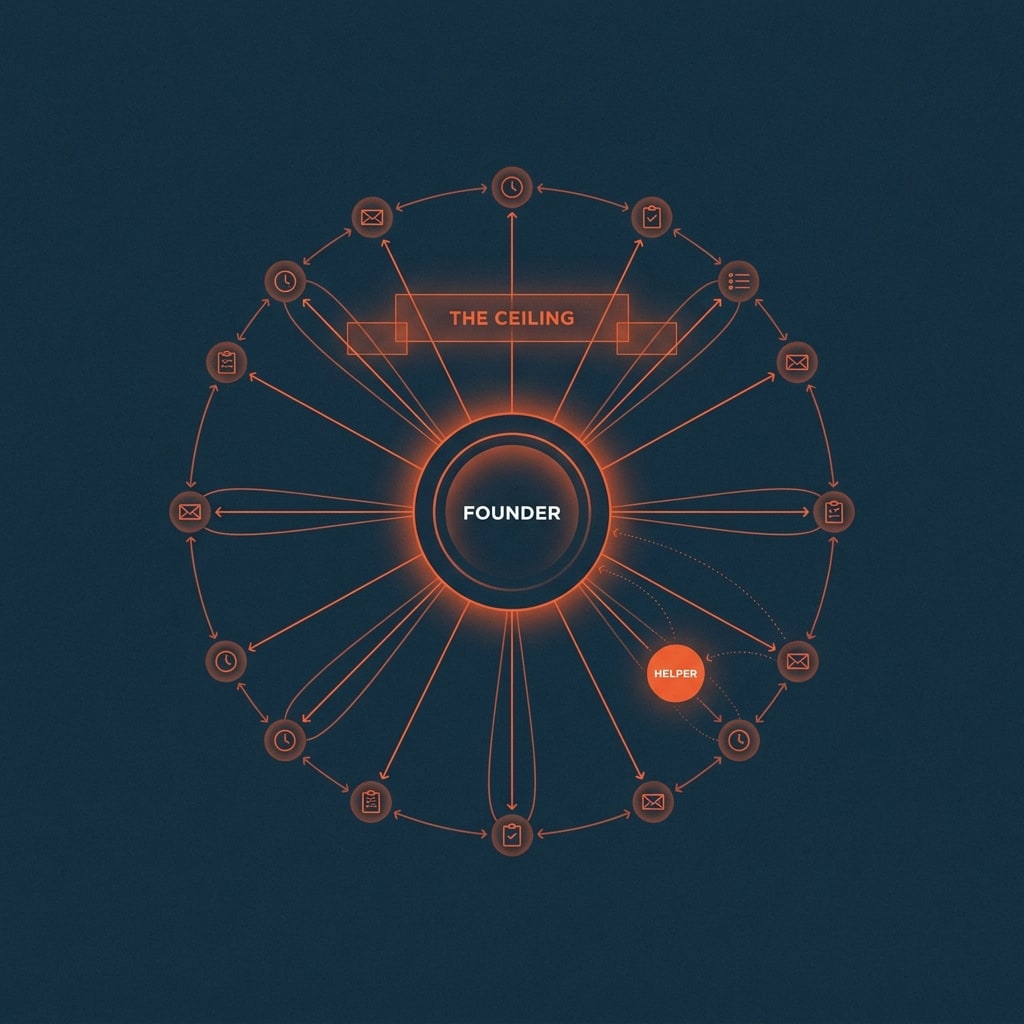
The founder bottleneck vs systems that run without you
The VA hire solves messaging volume.
Forty guest conversations running at once. Check-in questions, WiFi passwords, early arrival asks, late checkout negotiations. The VA takes the inbox off your phone.
Real relief. For about six weeks.
Then the toilet handle breaks. Linen service misses a pickup. Guest reports damage. Smart lock battery dies at 9pm. Supply closet runs out of trash bags.
"The wall shows up around property three. Sometimes four. Rarely past five."
— J. Massey · CashFlowDiary
The VA solves none of those. They were hired to execute tasks you hand them, not build systems.
Key point: Task execution and system architecture are structurally different roles. Hiring for one when you need the other leaves the bottleneck in place.
What Changes at Scale: Operations Get Infrastructure
At three properties, the replenishable supply closet becomes a full-time inventory job.
Linens to organize and clean. Relationships with cleaning vendors. Toiletry kits. Maintenance schedules. Toilet handles break once a week across a portfolio. You need a system for that.
The VA handles guest-facing comms. The ops lead builds the entire operational infrastructure underneath you as volume grows.
Founder time-use analyses consistently show the same pattern: a large share of the week goes to operational tasks and context-switching, leaving little room for strategic growth. If dispatching maintenance and tracking linen inventory still routes through you, scaling isn't happening. Replication is.
The Structural Difference Between Roles
VAs execute the tasks you define. Ops leads define the tasks that need executing.
VAs need clear instructions. Ops leads build the instruction manual.
VAs report problems to you. Ops leads solve problems before they reach you.
When a guest messages about a broken lock at 8pm, the VA forwards it. The ops lead has a locksmith on file, a backup code system in place, and a guest compensation protocol already built.
Key point: One role removes tasks from your plate. The other removes decision load entirely.
When to Make the Transition: The Revenue Signal
The transition point hits between $5K and $10K monthly revenue in most service businesses. For STR operators, that's roughly three to five properties depending on market and nightly rates.
The model works. Now you need infrastructure that supports growth without requiring you to be the system.
Operations managers become worth the cost when you start to value your time more than the next revenue benchmark. When adding another property sounds exhausting instead of exciting, the VA threshold is behind you.
What an Operations Lead Builds
The ops lead doesn't manage operations. They architect them.
Here's what that looks like:
Vendor management: Build relationships with cleaners, maintenance crews, locksmiths, supply vendors. When something breaks, they know who to call and what the backup plan is.
Inventory systems: Track what needs reordering, when, and who checks stock levels. The supply closet doesn't run out because someone's watching it.
Maintenance protocols: Create response trees for common issues. Toilet won't flush? Here's the diagnostic checklist. Lock battery dies? Here's the backup access procedure. Guest reports damage? Here's the documentation and claim process.
Quality control: Spot patterns before they become problems. Three guests mention slow WiFi? They're already calling the provider. Cleaner is consistently late? They're already having the conversation.
Communication systems: Build the templates, response protocols, and escalation paths. VAs use those systems. Ops leads build them.
Key point: The ops lead creates the infrastructure that allows operations to run without founder involvement in daily decisions.
More than 70% of vacation rental managers now use AI in some form — dynamic pricing, guest communication, operations — according to Hostaway's AI in Vacation Rentals report.
Operators who aren't building AI-enabled systems are behind the curve.
What most operators miss: AI doesn't replace the ops lead. It amplifies them.
The ops lead uses AI to automate guest comms, pricing adjustments, and review responses. They use it to surface what matters across a portfolio so manual review isn't required for every task.
VAs use AI tools you hand them. Ops leads build the AI infrastructure that makes the entire operation more efficient.
Key point: AI is a tool layer. The ops lead determines how that layer integrates into operational systems.
The Founder Bottleneck: Why VAs Don't Fix It
The founder bottleneck happens when the operational infrastructure hasn't evolved as quickly as the business itself.
You become the slowest point in the operation. Every decision routes through you. Every problem waits for your attention. Every vendor relationship depends on your availability.
Operational bottlenecks contribute heavily to burnout and stalled growth. Working harder doesn't fix it. Building systems that allow the operation to run without constant founder involvement does.
The VA doesn't fix that. They help you execute faster within the existing structure.
The ops lead rebuilds the structure so the bottleneck disappears.
Key point: Task delegation without system architecture leaves the founder as the operational ceiling.
The Cost Calculation: Founder Time vs. Ops Lead Salary
VAs run $15 to $35 per hour depending on skill level and location. Ops leads run $50K to $80K annually for experienced operators, or $35 to $60 per hour for fractional roles.
The math looks expensive until you calculate what founder time costs.
Twenty hours a week on operational tasks an ops lead would handle means 80 hours a month. At $100 per hour (conservative valuation of founder time), that's $8,000 in opportunity cost monthly.
The ops lead pays for themselves by freeing the founder to focus on acquisition, optimization, and portfolio strategy. The work only the founder should be doing.
Key point: The ops lead hire is an arbitrage on founder time. The ROI shows up in what the founder stops doing, not what the ops lead starts doing.
Clear systems already exist and someone needs to execute them
Remaining the operational decision-maker works fine
Running one to three properties and the infrastructure is manageable
Hire an ops lead if:
More time managing operations than growing the business
Problems reach you before they're solved
No documented systems exist for common operational issues
Three or more properties and feeling the weight of complexity
Adding another property sounds exhausting instead of exciting
Key point: The diagnostic isn't about property count. It's about whether operational infrastructure exists and who's responsible for building it.
The Right Sequence: Ops Lead First, VA Second
Most operators hire in the wrong order. They add a VA, then six months later realize they needed an ops lead. Now they're managing the VA and still carrying the operational load.
The right sequence: build the operational infrastructure first, then add execution support.
The ops lead builds the systems. The VA executes within those systems. That's the architecture that scales.
Hire the VA first and the founder stays the ops lead. The easy parts get delegated. The hard parts stay.
Key point: Sequence determines outcome. Wrong hiring order = same bottleneck, higher payroll.
What the Ops Lead Hire Changes
The ops lead hire changes the business in ways the VA hire doesn't.
Operators who made this hire took 30-day vacations without income dropping. Couples who could afford IVF. Fathers who could afford early intervention for their sons.
That's what happens when you remove yourself as the operational ceiling.
The VA gives you time back. The ops lead gives you a business that runs without you.
Different problems. Different solutions.
FAQ: VA vs. Operations Lead
When should I hire a VA instead of an ops lead?
Hire a VA when your primary constraint is guest messaging volume and you already have operational systems in place. VAs execute tasks you define. If systems don't exist yet, hire the ops lead first.
How much does an operations lead cost compared to a VA?
VAs cost $15 to $35 per hour. Ops leads cost $50K to $80K annually full-time, or $35 to $60 per hour fractional. The ops lead pays for themselves by freeing founder time worth $100+ per hour for strategic work.
What's the property count threshold for hiring an ops lead?
The threshold hits around three to five properties, or $5K to $10K monthly revenue. The signal isn't door count. It's whether you're spending more time managing operations than growing the business.
Will AI replace the need for an operations lead?
No. AI amplifies the ops lead by automating guest comms, pricing, and review responses. The ops lead builds the AI infrastructure and determines how it integrates into operational systems. VAs use AI tools. Ops leads architect them.
What if I hire a VA first and realize I need an ops lead?
Most operators do this. The fix is bringing in the ops lead to build systems, then having the VA execute within those systems. Wrong hiring order creates six months of delay and keeps the founder as the bottleneck.
What tasks does an ops lead handle that a VA doesn't?
Ops leads build vendor relationships, inventory systems, maintenance protocols, quality control processes, and communication infrastructure. VAs handle guest messaging, inbox management, and task execution within existing systems.
How do I know if I'm the operational bottleneck?
Count hours spent on operational work last week: vendor calls, maintenance dispatch, inventory checks, quality control. Above 15 hours means the bottleneck is you. The ops lead removes that ceiling.
What happens to the VA after I hire an ops lead?
The VA operates within systems the ops lead builds. The ops lead defines communication protocols and escalation paths. The VA executes them. The roles complement each other when sequenced correctly.
Key Takeaways
VAs execute defined tasks and handle messaging volume. Operations leads architect systems and own operational infrastructure.
The transition point hits around three to five properties or $5K to $10K monthly revenue when founder time shifts from growth to operational management.
Founder bottleneck happens when operational infrastructure hasn't evolved as quickly as the business. VAs don't fix that. Ops leads do.
The ops lead hire is an arbitrage on founder time. ROI shows up in what the founder stops doing, freeing them for acquisition and strategy.
Right sequence: ops lead builds systems first, then VA executes within those systems. Wrong sequence keeps the founder as the operational ceiling.
AI amplifies the ops lead by automating comms, pricing, and reviews. The ops lead determines how AI integrates into operational systems.
Diagnostic: if you spent more than 15 hours last week on operational work, the VA threshold is behind you.
Look at your calendar from last week. Count hours spent on operational work: vendor calls, maintenance dispatch, inventory checks, quality control, problem-solving.
Above 15 hours means the VA threshold is behind you.
The question isn't whether you can afford an ops lead. It's whether you can afford to stay the bottleneck.
Learn STR Operations the Right Way
Every operator I work with goes through this audit before we build the second channel, the second guest type, the second pricing model. If you want the full framework — the platforms, the compliance sequence, the pricing model that protects margins through regulatory shifts — that's what we map on a strategy call.