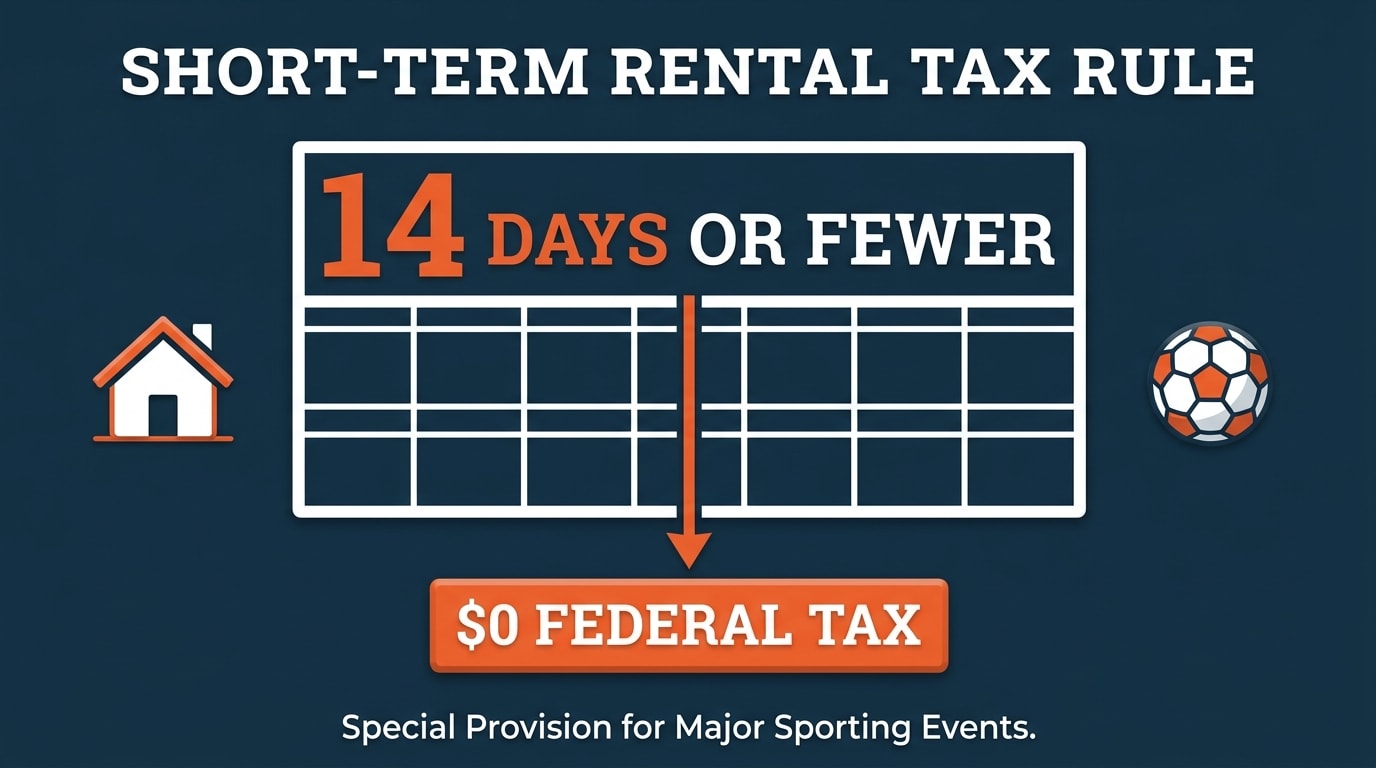
World Cup Income Can Be Tax-Free: The 14-Day Rule Most Hosts Miss
Rent your personal home for 14 days or fewer during the 2026 World Cup and pay zero federal income tax under IRC Section 280A(g). Here is the clean execution playbook for host-city operators.
By J. MasseyJune 24, 2026· 11 min read
Share
Disclosure: This post may contain affiliate links. If you purchase through our links, we may earn a commission at no extra cost to you. We only recommend tools and services J. Massey's team actually uses.
Learn more →
TL;DR: Rent your personal home for 14 days or fewer during the 2026 World Cup and pay zero federal income tax on that revenue. Section 280A(g) makes it legal. The threshold is strict: 15 days and the entire exclusion vanishes. This is the applied breakdown for operators in host cities who want to execute cleanly.
Core mechanics:
Rent your personal residence for 14 days or fewer in the calendar year
Federal rental income is excluded from gross income (IRS Topic 415, IRC Section 280A(g))
The trade-off: no income reporting, but no rental expense deductions either
World Cup match windows fit cleanly inside the 14-day threshold
State and local lodging taxes still apply
What Section 280A(g) Does
The 2026 FIFA World Cup runs June 11 through July 19 across 16 host cities in the United States, Canada, and Mexico. That's 39 days, 104 matches. A single match weekend rental fits inside the 14-day threshold.
I've spent 15+ years in this space, trained more than 10,000 operators through CashFlowDiary, and recorded 237+ podcast episodes breaking down the deals that work and the ones that don't. The pattern below shows up in every cycle.
Most World Cup hosting content focuses on pricing strategy and booking platforms. Almost none address the tax structure. Most generic "14-day rule" content never ties to a live event with real demand. This is the applied version: how to rent your home during the World Cup, collect the income, and owe nothing to the IRS when structured correctly.
14 days or fewer equals zero federal tax on World Cup rental income
Section 280A(g) of the Internal Revenue Code states that if a dwelling unit used as a residence is rented for fewer than 15 days during the tax year, the rental income is excluded from gross income. You don't report it. You also can't deduct rental expenses tied to those days.
The IRS spells this out in Topic 415: "There's a special rule if you use a dwelling unit as a residence and rent it for fewer than 15 days. In this case, don't report any of the rental income and don't deduct any expenses as rental expenses."
The threshold is 14 rental days or fewer. The days don't need to be consecutive. If you rent for two separate match weekends totaling 12 nights, you're still under the limit.
Key Point: The rule is binary. At 14 days or fewer, rental income is federally tax-free. At 15 days or more, all rental income becomes taxable from day one.
Why the World Cup Fits This Structure
The rule was inspired by homeowners in Augusta, Georgia, who rented their homes during the Masters golf tournament. For one or two weeks each April, a modest three-bedroom home in Augusta commands $5,000 to $15,000 in rental income. The homeowners leave town, collect the revenue, and return when the tournament ends. Congress codified this pattern into Section 280A(g).
The World Cup replicates that structure at scale. A single match window is well under 14 nights. Demand is concentrated, pricing is elevated, and hosts execute a clean rental without converting their home into a year-round operation.
Actual pricing data from the 2026 World Cup shows real market movement. Booked rates are up 47.6% compared to the same period in 2025, while available rates for unsold nights are up 145.5%. The Sweden vs. Tunisia match in Monterrey on June 14 shows the highest match-day premium at 387% versus the same day-of-week in 2025: $320 per night versus $66.
Host-adjacent markets near the stadiums are seeing sharp booking surges during the group stage. Each of the expected 382,000 Airbnb guests attending the World Cup is estimated to spend an average of $122 per night on lodging alone (Deloitte, commissioned by Airbnb).
The demand is real. The pricing is elevated. The tax exclusion is available when you structure the rental correctly.
Key Point: The 14-day rule was built for this exact scenario: concentrated demand, short rental window, elevated pricing, personal residence.
The 15-day cliff: crossing 15 rental days makes all income taxable
1. The property must be a personal residence
Section 280A(g) applies to dwelling units the owner uses as a residence. If you already operate the property as a full-time short-term rental or long-term rental, the rule doesn't apply. Landlords must report rental income and can't exclude it under this provision.
If you live in the home most of the year and rent it for a single World Cup match window, you meet the personal residence requirement.
2. You must rent for 14 days or fewer in the calendar year
The threshold is strict. At 14 days or fewer, all rental income is excluded from gross income. At 15 days or more, the exclusion vanishes entirely. All rental income from day one through day 15 and beyond becomes taxable. Not the income from the 15th day. All of it.
If you rent your home for a 10-night World Cup window in June and then rent it again for a wedding in September, you need to track total rental days for the year. Cross 14 days and the entire structure changes.
3. You don't report the income, and you don't deduct rental expenses
The trade-off is simple. The rental income is tax-free, but you can't deduct expenses tied to the rental period. No deductions for cleaning, utilities, or repairs specific to the rental days. Your normal homeowner deductions (mortgage interest, property taxes) remain unaffected because those apply to the property as a whole.
This is a reporting rule, not a deduction optimization strategy. You're trading the ability to deduct expenses for the ability to exclude income entirely.
Key Point: Personal residence, 14 days or fewer, no reporting, no deductions. Miss one condition and the exclusion fails.
Where Operators Get It Wrong
Mixing the 14-day rule with a year-round STR operation
If you already run the property as a short-term rental for most of the year, Section 280A(g) doesn't apply. The rule is for personal residences, not rental properties. You can't switch a year-round Airbnb into "personal residence mode" for 14 days and claim the exclusion.
The IRS looks at how the property is used overall. If you're operating it as a rental business, the income is taxable regardless of how many days you rent it.
Ignoring state and local lodging taxes
Section 280A(g) is a federal income tax exclusion. It doesn't exempt you from state income tax or local lodging taxes. Many cities charge transient occupancy taxes or hotel taxes on short-term rentals, even when the rental period is under 14 days.
You need to verify your city's lodging tax rules separately. The federal tax break doesn't override local tax obligations.
Failing to document the rental properly
The IRS doesn't require you to report the income, but you still need records in case of an audit. Improper documentation or inflated pricing triggers issues.
You should keep: rental agreements or booking confirmations, proof of payment, evidence supporting fair market rental value (comparable pricing data from similar properties in your area during the same period), and a record of total rental days for the year.
IRS Publication 527 suggests documenting comparables by considering purpose, size, condition, furnishings, and location. To substantiate the rate, retain third-party quotes or listings showing what similar properties charged during the World Cup.
Key Point: Year-round STR operators don't qualify. State and local taxes still apply. Document comparables to defend your rate.
The 14-day limit applies to the calendar year, not the World Cup event. If you rent your home for other events or periods during the year, you need to track total rental days. A 10-night World Cup rental plus a 5-night rental in August puts you at 15 days. The exclusion is gone.
Start a simple spreadsheet on January 1. Log every rental day. Know where you stand before you book the World Cup window.
Document fair market value
The IRS expects rental income to reflect fair market value, not an inflated rate designed to move money without economic substance. During the World Cup, fair market value will be elevated. That's fine. You need to show it's consistent with what similar properties charged during the same period.
Pull comparable listings from Airbnb, VRBO, or local property management companies. Save screenshots or PDFs showing what three-bedroom homes in your neighborhood charged for the same match dates. If your rate is within range, you have documentation.
Keep the rental agreement and payment records
Save the booking confirmation, rental agreement, and proof of payment. If you use a platform like Airbnb, the platform generates these records automatically. If you rent directly to a guest, create a simple rental agreement that includes the property address, rental dates, nightly rate, total payment, and guest name.
These records won't be submitted with your tax return because you're not reporting the income. But if the IRS audits you for any reason, they'll want to see proof that the rental was legitimate and priced appropriately.
Tell your CPA before tax season
Even though you're not reporting the income, your CPA should know you rented the property. If the IRS sees a large deposit in your bank account and you haven't explained it, they'll ask questions. Your CPA documents the Section 280A(g) exclusion in their workpapers and is prepared when the IRS inquires.
A two-minute conversation with your CPA in December prevents a two-hour scramble in April.
Check your homeowner's insurance policy
Some insurers require a rider or endorsement when a home is used for short-term rentals, even for a brief period under the 14-day rule. If a guest is injured on your property and your policy doesn't cover short-term rental activity, you're exposed.
Call your insurance agent before you list the property. Ask if your current policy covers short-term rental guests. If not, get the endorsement. The cost is typically minimal for a single event rental.
Key Point: Track total rental days from January 1. Document comparables. Save booking records. Tell your CPA. Verify insurance coverage.
Convert World Cup Demand Into Booked Nights
Airbnb's World Cup New Host Reward Program offers a $750 reward to new hosts who list an entire home in an eligible FIFA World Cup host city and complete their first qualifying reservation by July 31, 2026 (eligibility requires no active listings as of February 1, 2026). Searches for stays in host cities are already up 80% during the tournament.
Host-city residents are widely reporting that the extra income from hosting during the tournament would make a meaningful difference to their finances. One property manager in a host city noted: "They're like, listen, I'll figure it out. I'll go stay with my relatives for the month or for a few weeks to capitalize on this revenue."
The demand is confirmed. The tax structure is clear. The question is whether you execute cleanly.
If you're planning to rent your home during the World Cup and want to structure the rental correctly (pricing, documentation, tax compliance, insurance), book a free STR diagnostic call. We'll structure your event rental the right way.
For broader context on World Cup rental demand and how FIFA's canceled hotel blocks created unprecedented STR opportunity, read our World Cup demand analysis. For operators running year-round STRs who want to optimize tax strategy beyond the 14-day rule, see our STR tax strategy guide.
Key Takeaways
Rent your personal residence for 14 days or fewer during the calendar year and pay zero federal income tax on the rental income under Section 280A(g)
The threshold is strict: 15 days and the entire exclusion vanishes, making all rental income taxable from day one
The 2026 World Cup provides concentrated demand with single match windows that fit cleanly inside the 14-day limit
Year-round STR operators don't qualify. The rule applies only to personal residences
State and local lodging taxes still apply. The federal exclusion doesn't override local tax obligations
Track total rental days from January 1. Document fair market value with comparables. Save booking records. Tell your CPA. Verify insurance coverage before listing
Airbnb's World Cup New Host Reward Program offers $750 to new hosts who complete their first reservation by July 31, 2026
Frequently Asked Questions
Is World Cup rental income tax-free?
Yes, when you rent your personal residence for 14 days or fewer during the calendar year. The rental income is federally tax-free under Section 280A(g). State and local lodging taxes still apply.
What is the 14-day rule for renting your home?
Section 280A(g) allows homeowners to exclude rental income from federal taxes when the property is rented for fewer than 15 days in a year. The income isn't reported, and rental expenses aren't deducted.
Do I have to report income when I rent my house for less than 14 days?
No. When you rent for 14 days or fewer, you don't report the rental income on your federal tax return. You also can't deduct rental expenses for those days.
Does the 14-day rule apply when I already run an Airbnb?
No. Section 280A(g) applies only to personal residences. When you operate the property as a year-round short-term rental, the rule doesn't apply, and all rental income is taxable.
What happens when I rent for 15 days?
The exclusion vanishes entirely. All rental income from day one becomes taxable, not only the income from the 15th day forward.
Do I need to document the rental even when I'm not reporting it?
Yes. Keep rental agreements, booking confirmations, proof of payment, and comparable pricing data. The IRS doesn't require you to report the income, but you need records in case of an audit.
Does the 14-day rule exempt me from state and local taxes?
No. Section 280A(g) is a federal income tax exclusion. State income tax and local lodging taxes (transient occupancy taxes, hotel taxes) still apply in many cities.
How do I prove fair market value for my World Cup rental rate?
Save screenshots or PDFs of comparable listings from Airbnb, VRBO, or local property management companies showing what similar properties charged for the same match dates. Your rate should be within range of those comparables.
Disclaimer: This article is for educational purposes only and doesn't constitute tax, legal, or financial advice. Consult a licensed CPA or tax professional before making decisions based on this content.