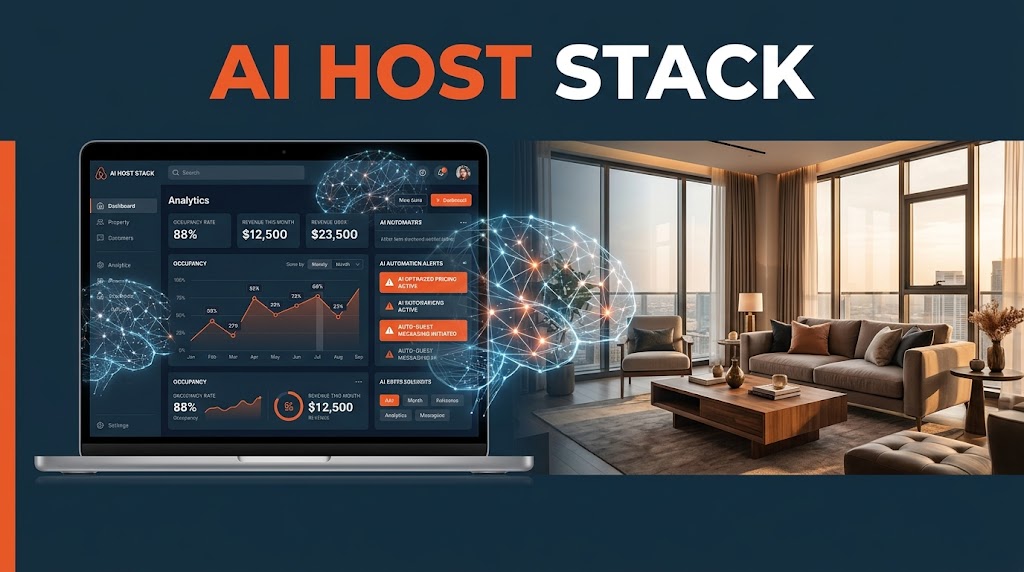
Everyone I'm talking to thinks Airbnb just declared war on property managers. They're half right — and half wrong about which side they're on. The Summer 2026 release is systematically absorbing the services PMs have been billing you for: grocery stocking, gear rentals, arrival logistics now operating in 125 cities. But the same release handed solo operators the full professional toolkit: photo-to-listing AI, listing diagnostics, an 800-signal ranking algorithm now transparent to every host. Airbnb didn't kill property management. It killed the excuse solo operators had for not competing with property managers.
Airbnb's Summer 2026 release is the most consequential platform shift for STR operators since dynamic pricing became table stakes — and it cuts in two directions at once. The services Airbnb is absorbing (baby gear, in-home logistics, 125-city arrival coordination, a marketplace spanning 1,300 Airbnb-friendly buildings across 75+ markets) are exactly what property managers have been billing a percentage of GBV to coordinate. Meanwhile, the AI host stack means a solo operator can now present like a professionally managed portfolio — without the PM's cut. The tension isn't threat or opportunity. It's both, depending entirely on which side of the middleman you're sitting on.
What Changed in the Summer Release
Airbnb's 2026 Summer Release isn't a feature update. It's a structural repositioning. The company that built its business connecting guests to hosts is now building infrastructure to connect guests to everything — and it's doing it at a scale that should get every serious STR operator's attention.
The headline numbers tell part of the story. Airbnb closed 2025 with $12.2 billion in revenue, up 10% year-over-year, and generated $4.6 billion in free cash flow at a 38% margin. That's not a company experimenting — that's a company with the financial firepower to execute a multi-year platform expansion. The Summer Release is what that execution looks like in practice.
Three product lanes define the release. First, a rebuilt AI host stack that automates listing creation, photo scoring, and booking performance analytics. Second, a Services Marketplace — now operating in 250-plus cities — that connects guests to chefs, massages, photographers, grocery delivery via Instacart, baby equipment, and gear rentals. Third, an expanded transportation layer through Welcome Pickups, now live in 125 cities outside North America as of March 2026. Layered underneath all of it: a loyalty mechanic that's already reshaping how search ranking works, and an Airbnb-friendly apartments program now covering 1,300 buildings across 75-plus markets, with partnerships in place with 16 of the 50 largest US multifamily managers.
Long-term stays — 28 days or more — now represent nearly 20% of total Airbnb nights booked. The platform isn't just a weekend-getaway engine anymore. It's competing directly with furnished rentals, extended-stay hotels, and corporate housing. That's a different competitive landscape than most operators built their models around.
The PM Disruption Threat
"Airbnb is absorbing services that property managers currently provide. Is this a threat or opportunity for STR operators?"
— J. Massey, CashFlowDiary
Property managers have historically justified their fee structures — typically 20-30% of gross revenue — by bundling services guests couldn't get from solo hosts: coordinated grocery stocking, concierge recommendations, seamless check-in logistics, professional photography, vendor relationships. The Summer Release is a systematic unbundling of that value proposition.
When Airbnb connects a guest directly to Instacart grocery delivery, that's one fewer touchpoint a property manager controls. When AI-generated photo scoring tells a solo host which shots to retake and in what order to display them, that's professional-grade listing optimization without a management contract. When the Host Services Marketplace gives independent operators access to dynamic pricing engines, cleaning marketplaces, and turnover management tools through a single integration layer — without requiring a full property management system — the infrastructure argument for hiring a PM weakens considerably.
This isn't theoretical pressure. It's structural. Every service Airbnb absorbs into its platform removes a line item from the PM value proposition. The question isn't whether this is happening — it is — the question is how fast and how completely.
Full PMS platforms face a parallel problem. Airbnb's integration layer is commoditizing the connective tissue those platforms have charged for. A solo host who can access dynamic pricing, booking analytics, and guest services through Airbnb's native stack has less reason to pay for a separate channel manager or operations platform. The PMS companies that survive this will be the ones delivering genuine multi-channel distribution, multi-market revenue management, cross-property orchestration, and hyperlocal expertise that Airbnb's platform can't replicate at property level.
For property managers, the survival path runs through the same logic: if you're competing on services Airbnb now provides natively, you're already losing the argument. If you're competing on what Airbnb can't do — market-specific relationships, cross-platform revenue optimization, operational scale across dissimilar markets — you still have a defensible position.
The AI Tools Opportunity
"How should hosts prepare for the AI-powered host tools? Does this level the playing field or widen the gap?"
— J. Massey, CashFlowDiary
The honest answer is: both, depending on what you do next.
Airbnb's AI host stack closes a real capability gap. Photo-to-listing automation — upload photos, receive a generated title, description, house rules, and amenity list — removes a barrier that kept inexperienced hosts from presenting professionally. Photo quality scoring with re-shoot suggestions means a solo operator in their first year can get feedback that previously required hiring a professional listing consultant. Booking success analytics with AI-suggested improvements — gallery reordering, pricing prompts, minimum-stay adjustments — puts performance optimization in reach for operators who don't have a revenue manager on staff.
For the host who's been flying blind on why their conversion rate is lagging, these tools are genuinely valuable. Airbnb's AI customer service already resolves roughly one-third of support issues without human agents. That same infrastructure logic — automate the repeatable, scale the judgment — is now being applied to host performance.
But leveling the floor doesn't flatten the ceiling. The search ranking model now evaluates more than 800 signals, with booking conversion rate as the number-one factor. A host who uses AI tools to build a better listing is still competing on those 800 signals against operators who've been optimizing for them for years. The tools reduce the penalty for inexperience; they don't eliminate the advantage of experience.
The real opportunity is for the mid-tier operator — running 3 to 15 properties — who's been underinvesting in listing quality and performance analytics because the tooling was either too expensive or too fragmented. That operator can now close the gap with larger PMs without adding headcount or infrastructure cost.
How to Stay Ahead of Platform Dependency
"With Airbnb pivoting to lifestyle and loyalty programs, do you see it becoming harder for new hosts to compete?"
— J. Massey, CashFlowDiary
The loyalty mechanic deserves direct attention because it's already live. Airbnb is testing a model where hosts offer a 20% discount in exchange for higher search ranking, targeting guests with 4.8-plus ratings. Read that plainly: you can pay margin for visibility. That's not a future risk — it's a current decision every host on the platform needs to make.
If your competitors opt in and you don't, your ranking erodes. If you opt in across your portfolio, your margins compress. Neither outcome is neutral, and the window to build alternatives before this mechanic becomes standard is closing.
The broader platform dependency risk is compounding. Nearly half of Experience bookings in Q4 2025 came from locals who weren't staying at an Airbnb property. The platform is building an audience that extends beyond the traditional host-guest relationship. That's good for Airbnb's revenue diversification. It's a reminder that the platform's interests and your interests are not the same.
Platform dependency mitigation looks like this in practice: direct booking infrastructure with a functioning email list and repeat guest incentives, distribution across VRBO, Booking.com, and direct channels, and market-specific positioning that's difficult to commoditize. Airbnb's $4.6 billion in free cash flow means they can keep building into your differentiation. The operators who survive platform pivots are the ones who built equity outside the platform while using it. J. Massey walks through the direct booking framework and platform-diversification playbook on the Cash Flow Diary Podcast — it's the starting point for any operator serious about reducing single-platform exposure before the next shift.
The Summer Release is a signal, not a ceiling. Act accordingly.
The Summer 2026 release is Airbnb's most consequential product move in years — and it cuts both ways. The AI host stack can free independent operators from PM dependency, but that same stack is how Airbnb absorbs the services layer, competes with the PMs it once relied on, and tightens its grip on guest relationships and platform loyalty. The threat and the opportunity are the same product release.
The operators who come out ahead won't be waiting for the next update. Audit your third-party service dependencies — pricing software, cleaning coordination, guest communication — before Airbnb bundles them into a subscription you didn't choose. Get hands-on with the AI host stack now, while the learning curve is yours to control. Build every direct guest touchpoint you legally can, because the loyalty program in this release is designed to make Airbnb the relationship, not you.
J. Massey is direct about this: "Every platform update is a curriculum if you're paying attention. The AI host stack tells you exactly where Airbnb thinks the value is — go build that value for yourself, not for them." The operators who read this as a signal — not just a feature announcement — will still be in control of their cash flow when the next release drops. That education starts at the 5-Day Challenge at cashflowdiary.com.