Airbnb Quietly Got Permission to Train AI on Your Listings. Most Hosts Haven't Read the Fine Print.
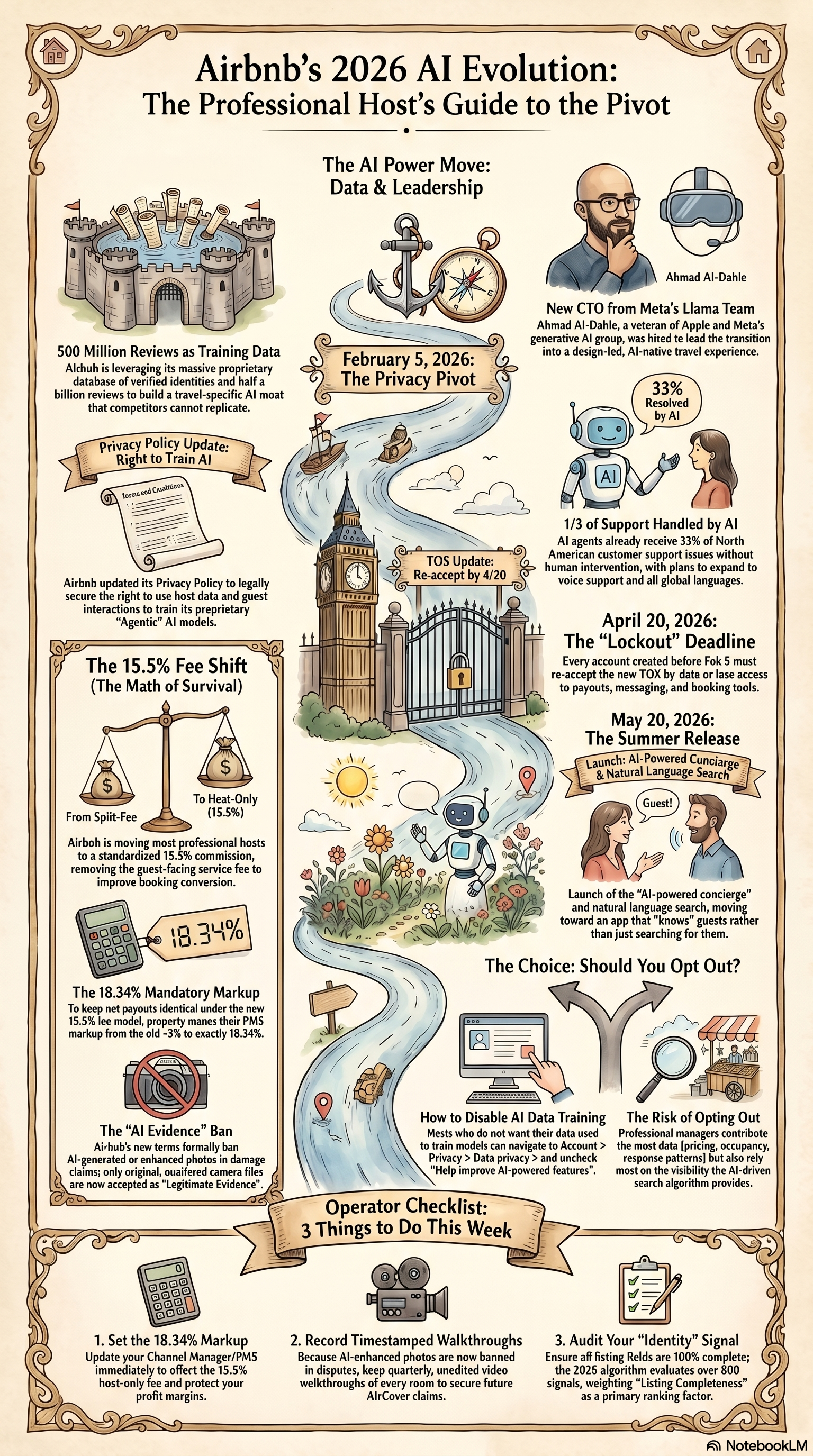
Today, Airbnb is shipping the biggest AI release in its history. Most coverage will miss the legal fine print hosts agreed to last month — Airbnb now has the right to train its AI on every booking you've taken, every price you've set, every guest conversation. And the smart play isn't to opt out.
Section 1 — You Assume Your Data Is Yours. It Isn't Anymore.

Most operators run Airbnb as if it were a billboard. You put your listing up, guests find you, you collect the rent. The platform is plumbing.
We've watched operators panic at every Airbnb policy shift since 2015 — through the original Smart Pricing rollout, the pandemic AirCover overhauls, three rounds of host-fee restructuring, and now this AI transition. The pattern is always the same: misread what changed, react defensively, miss the signal that actually matters. That mental model expired on April 20, 2026. That's the effective date of an Airbnb privacy policy update originally rolled out in February. The update added one new section to the policy — and that section is the legal foundation of every AI feature Airbnb has shipped since.
Here's what most hosts missed when they clicked "I agree":
Section 4.2 of the updated Privacy Policy explicitly grants the platform the right to process user data to "develop and improve our AI" — the legal foundation of the 2026 Airbnb AI strategy.
— [Airbnb Inc.](https://www.airbnb.com/help/article/3175), Updated Privacy Policy Section 4.2 (effective April 20, 2026)
That's not a privacy footnote. That's permission to feed your pricing decisions, your booking conversion rates, your message response times, your photo choices, your review history, and your operational behaviors into the machine learning models that — starting today — decide which listings get surfaced first in the new conversational search. Five hundred million reviews are already in the training corpus. Your data joined them last month.
The opt-out exists. It sits in Account → Privacy → "Help improve AI-powered features." Two clicks. And the contrarian case is that you should not use it.
Section 2 — The CFD Perspective: Airbnb Is Not Your Business. It's Your Customer Acquisition Channel.
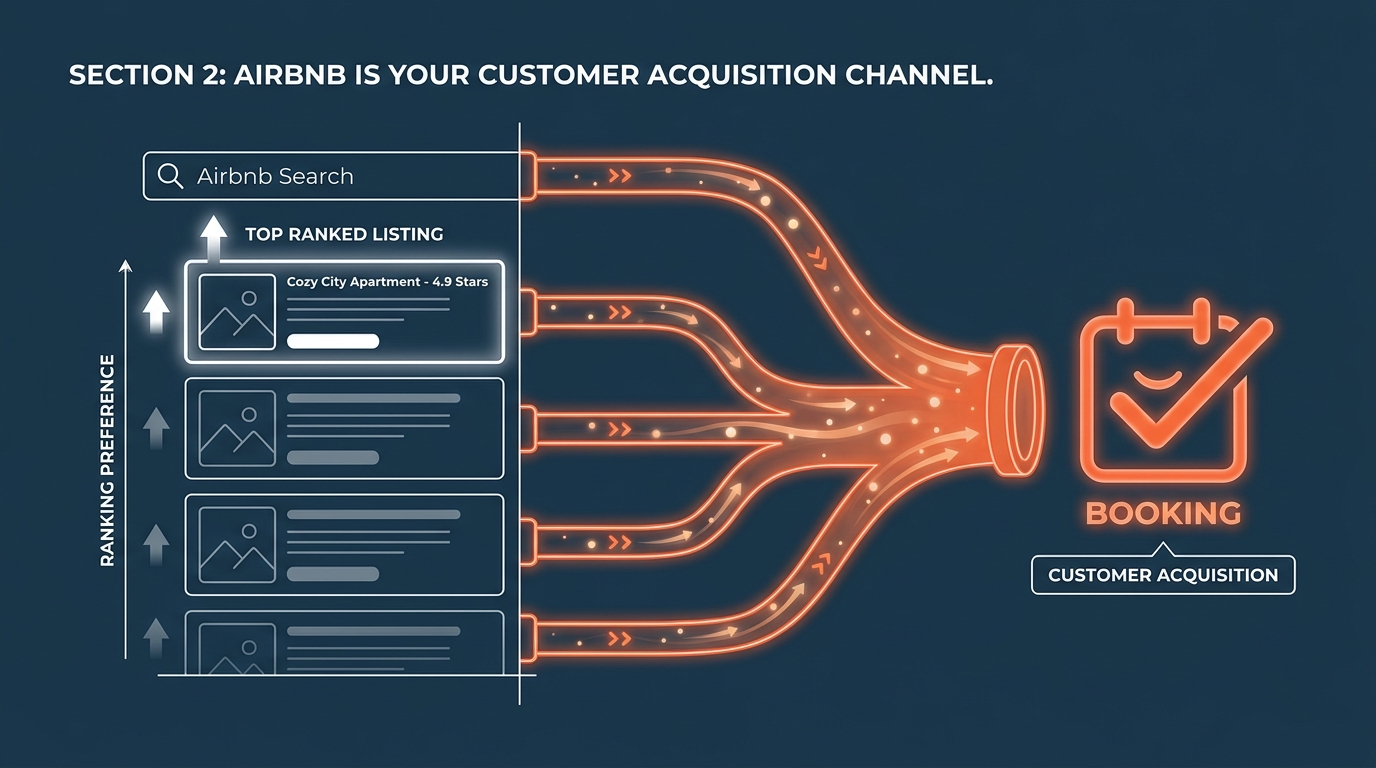
The reason most operators panic when news like this lands is they've quietly let Airbnb become their entire business. They treat the platform as if it were the genesis of their operation, rather than what it actually is — a search engine with a checkout button.
That misframing is what makes the AI training question feel existential. If you believe Airbnb IS your business, then training AI on your data feels like the platform absorbing your asset. If you understand Airbnb is your customer acquisition channel — not your business — then training AI on your data is the entrance fee. It's how you stay visible inside the system that brings you customers.
Airbnb is fundamentally a search engine. Like every search engine, it can award visibility positively or negatively for whatever it wants. The platform has been crystal clear about what it's building next. Brian Chesky, Airbnb's co-founder and CEO, hired Ahmad Al-Dahle — the architect of Meta's Llama family of open-source AI models — as Chief Technology Officer on January 14, 2026. Chesky's framing of the AI shift on the Q1 2026 earnings call was direct: AI, in his words, is "an accelerant to everything" — and the platform's product roadmap, leadership, and now its legal foundation all point at the same outcome.
"Airbnb is not your business. They're just your customer acquisition."
— J. Massey · CashFlowDiary
Now think through Airbnb's logical next move. The platform makes money on completed bookings. Hosts who help train the AI produce a better matching engine, which produces more reservations, which produces more revenue for Airbnb. The platform doesn't need to actively punish hosts who opt out. It just needs to give a small ranking preference to the hosts who help feed the model. That preference compounds across millions of searches per day.
If you help them get what they want, they'll help you get what you want. That's not a moral argument. That's how every search engine since Google's first PageRank update has worked.
Section 3 — Three Ranking Signals + The Exit Strategy You Cannot Skip
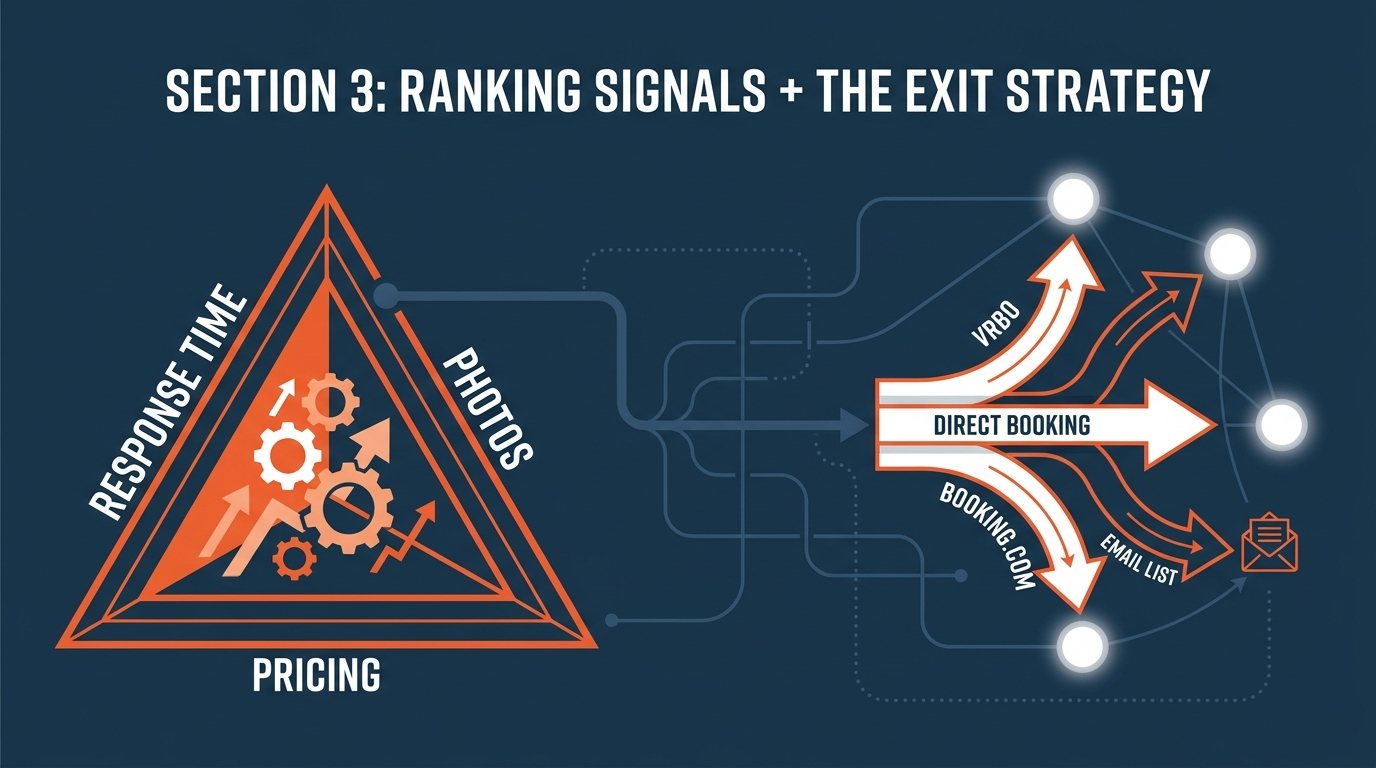
If the platform's AI is now ranking listings on signals it can measure directly, three things become non-negotiable for any operator who plans to keep getting Airbnb bookings in 2026:
Response time becomes automation, not effort. The algorithm's response-time bar is hours, not days, and the ranking benefit skews heavily toward responses within one hour. There are mature tools that handle this — Hostfully, OwnerRez, Hospitable, Lodgify, iGMS. Pick one. Set up auto-replies for the top 20 inquiry types. Operators who try to handle this manually in 2026 are leaving ranking on the table they cannot recover.
Pricing accuracy becomes table stakes. The platform's pricing signals reward listings that are priced competitively against comparable inventory in the same market. If you don't know your numbers — your true monthly operating cost, your minimum acceptable nightly rate, your cancellation exposure — the algorithm will assume you're overpriced and reduce your visibility. Tools like PriceLabs, Beyond, and Wheelhouse handle the daily adjustment. Your job is to know what your floor is.
Photo quality is the strategic edge no software can replicate. This is where amateur operators will lose ground that no automation can recover. Photos communicate amenities the description never will. The rule is: if you don't show it, guests assume you don't have it. The pack-and-play, the high chair, the stroller, the espresso machine — if those amenities aren't in your photos, they functionally don't exist to a guest doing a 30-second scroll. The barrier to ranking just rose, and photo storytelling is now the strategic advantage that requires human judgment, not just better tools.
That's the inside game. There's also an outside game, and it matters more.
The structural risk Airbnb just locked in goes deeper than ranking mechanics. Two academic economists — Thomas Philippon at NYU Stern and his co-author Germán Gutiérrez — formalized the dynamic in an NBER working paper on platform data asymmetry:
Data sharing increases gains from trade by improving match quality, but also generates two externalities which increase the market power of the platform and lower merchant entry. The gatekeeper externality arises from the platform's control over access to consumers. The copycat externality derives from its ability to compete with its own merchants.
— [Thomas Philippon & Germán Gutiérrez](https://pages.stern.nyu.edu/~tphilipp/), NYU Stern / NBER, "Data Sharing and Market Power with Two-Sided Platforms"
That's the structural answer to "why diversify." The more behavioral data Airbnb has on what guests want, the more accurately the platform can compete with its own hosts on upsell categories — HotelTonight integrations, partner services, lifestyle bundling, all announced this week. And the more dependent you are on Airbnb for customer acquisition, the less leverage you have when the platform decides what your business is worth.
The defense is direct. Build a customer acquisition channel that doesn't run through Airbnb. Direct booking on your own site (Boostly, OwnerRez Direct, Lodgify Direct). Multi-platform listing on Vrbo and Booking.com. A past-guest email list you control. A site structured for AI agents to read — schema markup, clean amenity data, JSON-LD for FAQs — because the next wave of distribution will be agent-to-agent. That mix is how you build a portfolio that keeps cash flow stable when a single platform decides to change its algorithm without telling you.
Section 4 — FAQ
Does Airbnb use host data to train AI?
Yes. As of April 20, 2026, Section 4.2 of Airbnb's Privacy Policy explicitly grants the platform the right to use host data — including pricing decisions, booking history, message logs, and review content — to develop and improve its AI models. The legal change was rolled out in February and took effect April 20.
Can hosts opt out of Airbnb AI training?
Yes, but most operators shouldn't. The opt-out toggle is at Account → Privacy → "Help improve AI-powered features" in your Airbnb settings, with an email alternative to dpo@airbnb.com per Airbnb's privacy controls page. However, the platform now uses behavioral data to drive search ranking. Opting out is a deliberate choice to remove yourself from the data pool the platform rewards.
How does Airbnb's AI affect listing ranking?
Listings that score well on three measurable signals — response time (under one hour), pricing competitiveness against comparable inventory, and photo quality — gain ranking preference in both traditional search and the new conversational AI search rolling out as part of the Summer 2026 release. Listings with poor signals lose visibility.
What about the new CTO from Meta's Llama team?
Ahmad Al-Dahle led Meta's generative AI group and the team behind the Llama family of open-source models before joining Airbnb on January 14, 2026. He previously spent 16 years at Apple, including time on the original iPhone team and the autonomous vehicle effort. His mandate, per Chesky's January announcement, is to build Airbnb's AI-native product layer. The AI integration on the platform is going to deepen, not slow down.
Is direct booking still worth pursuing if Airbnb's AI gets this good?
It's worth more, not less. The case for diversifying customer acquisition channels strengthens every time the platform's data advantage widens. The marketplace is getting more sophisticated, the barrier to entry is rising, and operators who depend entirely on a single platform for visibility are taking a structural risk that compounds.
If you want our take on what to actually do this quarter as the Summer 2026 release rolls out, the CashFlowDiary newsletter is where we break that down in detail.
Sources
• Airbnb Privacy Policy (Section 4.2 — updated February 2026, effective April 20, 2026)
• Airbnb — How to control your privacy preferences
• Airbnb announces Ahmad Al-Dahle as Chief Technology Officer
• PYMNTS — Airbnb CEO Predicts AI Will Rewrite Job Descriptions (Q1 2026 earnings coverage)
• Motley Fool — Airbnb (ABNB) Q1 2026 Earnings Call Transcript
• TechCrunch — Airbnb plans to bake in AI features for search, discovery, and support
• RentalScaleUp — What Privacy Terms Reveal About the Airbnb AI Strategy (Uvika Wahi, April 17, 2026)
• PriceLabs — Airbnb New Host Fee Structure for Property Managers
• NBER / NYU Stern — Data Sharing and Market Power with Two-Sided Platforms (Gutiérrez & Philippon)