I built a 34-unit, 46-bedroom short-term rental portfolio. And I didn't buy my first property to do it.
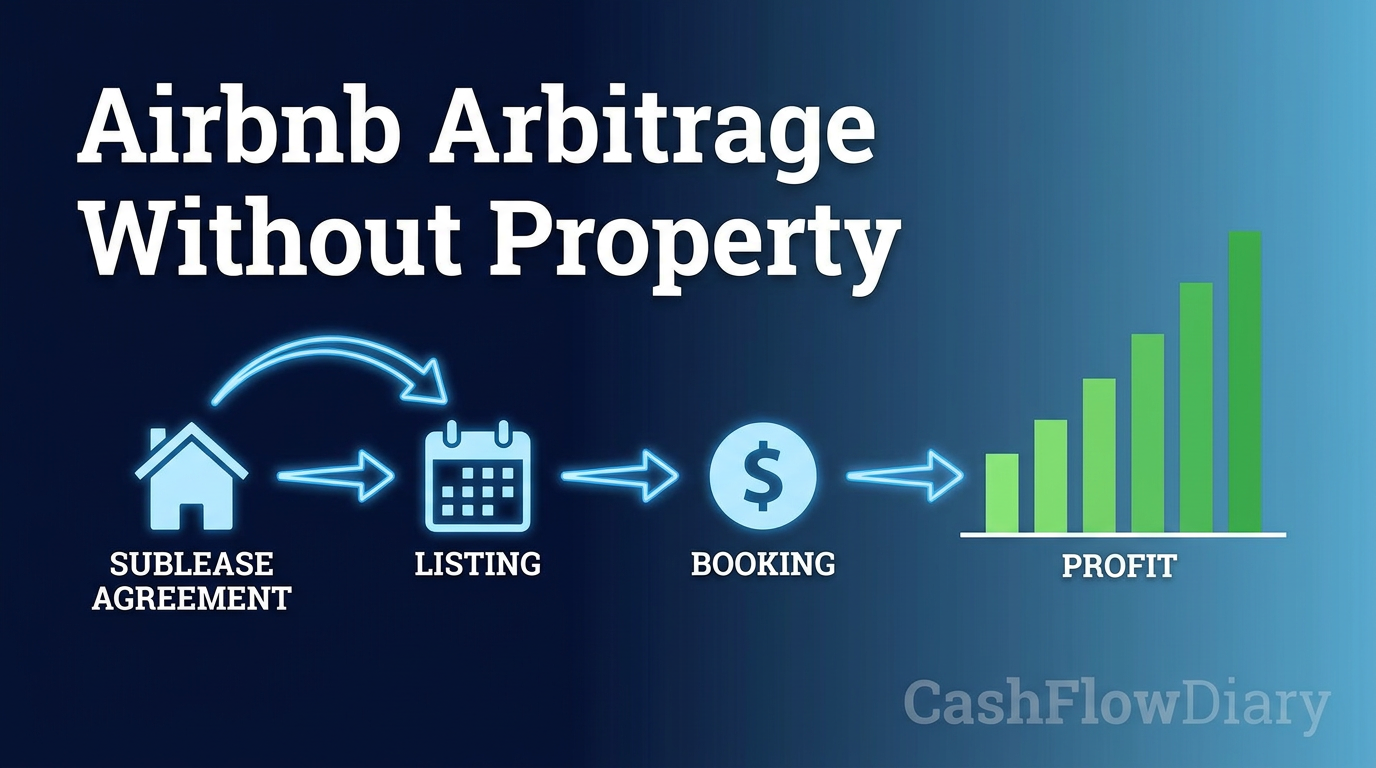
That's the power of airbnb arbitrage — a business model where you lease properties long-term and rent them out as short-term rentals on platforms like Airbnb and VRBO. The difference between what you pay in rent and what you collect in nightly bookings? That's your profit.
I've trained over 10,000 entrepreneurs to do this same thing. Some of my students have scaled to 100+ units. In this guide, I'm going to walk you through exactly how airbnb arbitrage works, how I approach it, and how you can get started — even if you have no real estate experience and limited capital.
What Is Airbnb Arbitrage?
Airbnb arbitrage is a business model where you rent a property on a long-term lease and list it as a short-term rental on platforms like Airbnb, VRBO, or Booking.com. You profit from the gap between your monthly rent and the income from nightly bookings.
It's the same concept behind any business: buy (or in this case, lease) at one price, sell at a higher price.
Here's a simple example. You sign a lease for a two-bedroom apartment at $1,500 per month. You furnish it and list it on Airbnb at $150 per night. If you book 20 nights per month, that's $3,000 in revenue — minus your $1,500 rent and maybe $300 in expenses, you're clearing $1,200 per month from a property you don't own.
Now multiply that by five, ten, or twenty units. That's the business.
The term "rental arbitrage" is sometimes used interchangeably with airbnb arbitrage. They mean the same thing — making money from the spread between long-term lease costs and short-term rental income.
How Airbnb Arbitrage Works
The process isn't complicated. But it does require you to think like a business owner, not like someone looking for a side hustle.
Here's the step-by-step:
1. Research your market. Before you sign any lease, you need to know the short-term rental regulations in your city. Some places require permits. Others have outright bans. Don't skip this step — it can save you thousands.
2. Find the right property. Look for units in areas with high traveler demand — near downtown, hospitals, universities, or business districts. Studios and one-bedrooms often perform best for arbitrage because the rent-to-revenue ratio is strongest.
3. Get landlord approval. This is where most people get stuck. I'll break down my exact approach in the next section. The short version: you need written permission from the property owner before you list anything.
4. Furnish and photograph the unit. Budget $3,000 to $5,000 to furnish a one-bedroom unit. Good photos are non-negotiable — they're the difference between getting bookings and getting ignored.
5. List on multiple platforms. Don't put all your eggs in one basket. List on Airbnb, VRBO, Booking.com, and direct booking sites. Use a channel manager to keep calendars synced.
6. Automate operations. Smart locks, automated messaging, professional cleaning teams, and automated pricing tools. These systems let you run 10 or 20 units with the same effort as one.
Ownership vs. Control: The $100K Comparison
This is the framework that changed everything for me. Most people think you need to buy property to make money in real estate. I thought the same thing until I ran the numbers.
Let's say you have $100,000 to put into real estate.
Option A: Buy one house. You purchase a property, fix it up, and turn it into an Airbnb. With four bedrooms, each generating about $800 per month in profit, you're making $3,200 per month.
Option B: Lease ten units. You use that same $100,000 to sign leases and furnish ten one-bedroom apartments. Each unit generates $800 per month in profit. That's $8,000 per month.
Same capital. Two and a half times the cash flow.
The concept comes from something the investor Peter Fortunato taught me about the five benefits of real estate: income, depreciation, equity, appreciation, and control. When you're just getting started, the benefit that matters most isn't ownership — it's control.
You don't need to own the building to profit from it. You just need the right to use it.
I started from foreclosure. I had no capital, no credit, and no real estate experience. Buying wasn't an option. But leasing? That door was open. And it turned into a 34-unit portfolio that I still own and operate today.
How to Get a Landlord to Say Yes
Here's where most people kill their chances before they even start: they walk into a landlord meeting and say, "I want to sublease your apartment on Airbnb."
Don't do that. Ever.
What we do is not subleasing in the legal sense. We're granting a license to guests to use the property for a set period. That's a more restrictive arrangement than a traditional tenancy — and it actually protects the landlord better than a standard renter would.
Here's how I teach my students to approach the conversation:
Lead with what your company does, not what you want. Open with: "My company provides clean, safe, and affordable housing for traveling professionals — doctors, professors, corporate consultants, people on temporary work assignments."
Focus on the value to the landlord. You pay rent on time every month, guaranteed. You maintain the property to a higher standard than most tenants because your guests leave reviews. You carry insurance. You're running a business, not throwing parties.
Target owner-managed properties. When you deal with big property management companies, you're going through layers of gatekeepers — a leasing agent, then a community manager, then a regional manager, then maybe the owner. With owner-managed properties, you talk directly to the decision maker. Your close rate goes way up.
Never say "Airbnb" in your first conversation. Talk about your business, your clients, and the quality of housing you provide. Bring up the specific platform later, after they understand the value.
Two of my students, Rebecca and Erica, used this exact approach and scaled to 150 short-term rental units. They even run a property called the Hicksville Trailer Palace in California — a destination Airbnb that people travel specifically to visit.
The 3 Phases of Building Your STR Business
I break the journey into three phases. Each one has a clear goal.
Phase 1: Get Your First Unit Running
Your only job in Phase 1 is to get one unit profitable. Learn the operations. Figure out your pricing strategy. Build your cleaning and guest communication systems.
Don't try to scale yet. The goal here is proof of concept. One unit that generates positive cash flow every month. That's your foundation.
Phase 2: The Down Payment Machine
Once you've proven the model, start adding units. This is where the real cash flow kicks in. Each new unit adds another $800 to $1,500 per month to your bottom line.
I call Phase 2 the "down payment machine" because the cash flow from your leased units starts generating enough money to fund Phase 3.
Phase 3: Own the Property
Now you've got cash flow, experience, and a track record. You can use the money from your arbitrage business to buy properties outright. And because you already know how to run short-term rentals, your purchased properties are immediately profitable.
This is the path I took. I started by controlling units I didn't own. Then I used the cash flow to buy my first properties. Today I own 34 units with 46 bedrooms — and the arbitrage model is what funded the entire thing.
How Much Can You Make with Airbnb Arbitrage?
Revenue depends on your market, property type, and how well you run operations. But here are some real numbers.
A well-run one-bedroom in a solid market can generate $500 to $1,500 per month in profit after rent, utilities, cleaning, and platform fees. Two-bedrooms and unique properties tend to do better.
In 2025, AirDNA reported the national short-term rental premium averaged 138% — meaning STR income was 2.38 times higher than long-term rent in the same market. That spread is your opportunity.
At CashFlowDiary, I've seen students hit $5,000 per month within their first six months with just three to five units. Some have pushed past $20,000 per month within a year.
The math is simple once you have systems in place. Your fixed cost is the lease. Your variable costs are cleaning, supplies, and platform fees. Everything above that is profit.
Risks and Downsides of Airbnb Arbitrage
I'd be doing you a disservice if I only told you the upside. There are real risks you need to understand.
Regulation risk. Cities can change short-term rental laws. What's legal today might require a permit tomorrow — or get banned entirely. Always research local regulations before you sign a lease, and don't put all your units in one city.
Seasonality. Most markets have slow months. If your rent is $1,500 per month but you only book $1,000 in January, you're covering the difference out of pocket. Build a reserve fund for this — I recommend keeping three months of rent per unit in savings.
Landlord risk. Your landlord can choose not to renew your lease. Protect yourself with longer lease terms (two to three years minimum) and a first right of refusal clause that gives you the option to buy the property if the owner decides to sell.
Operational complexity. Running five or ten units is a real business. You need systems for cleaning, guest communication, maintenance, pricing, and accounting. Without those systems, you'll burn out fast.
Upfront costs. Furnishing a unit costs $3,000 to $5,000. First and last month's rent adds another $3,000 to $4,000. Budget $7,000 to $10,000 per unit to get started.
I tell my students: this isn't a get-rich-quick play. It's a real business that requires real effort. But if you build the systems and put in the work, the returns are hard to beat.
How to Start Airbnb Arbitrage in 2026
Here's your action plan if you're ready to move:
Step 1: Learn your local STR regulations. Google "[your city] short-term rental laws" and check the city government website. Know what permits are required and what zones allow short-term rentals.
Step 2: Analyze three to five markets. Use free tools like AirDNA's Rentalizer and Mashvisor to compare average daily rates, occupancy rates, and revenue potential in your target areas.
Step 3: Set up your business entity. Register an LLC. Get a separate bank account. Treat this like a business from day one.
Step 4: Find properties and pitch landlords. Search for owner-managed rentals on Zillow, Craigslist, and Facebook Marketplace. Use the pitch framework I outlined above. Plan to contact 20 to 30 landlords to land your first unit.
Step 5: Furnish, photograph, and list. Buy furniture that photographs well and holds up to guest use. Hire a professional photographer — it's worth the $150 to $300 investment. List on Airbnb, VRBO, and at least one other platform.
Step 6: Automate from day one. Set up automated guest messaging, a smart lock, automated pricing software like PriceLabs or Wheelhouse, and a reliable cleaning team. These systems are what let you scale past one or two units.
Step 7: Track your numbers weekly. Revenue, occupancy rate, average daily rate, expenses, and profit per unit. If you don't measure it, you can't improve it.
FAQ
Is Airbnb arbitrage legal?
Yes, airbnb arbitrage is legal in most places — but it depends on your local regulations. Some cities require short-term rental permits or licenses. Others restrict STRs in certain zones. A few cities ban them entirely. Always check your local laws and get written landlord permission before listing any property.
How much money do you need to start Airbnb arbitrage?
Plan on $7,000 to $10,000 for your first unit. That covers first and last month's rent ($3,000-$4,000), furnishing ($3,000-$5,000), and initial supplies and setup ($500-$1,000). You can start with less if you find deals on furniture or negotiate move-in costs with your landlord.
Can you do Airbnb arbitrage with no money?
It's difficult but possible. Some people partner with investors who fund the startup costs in exchange for a share of the profits. Others negotiate with landlords to waive the security deposit in exchange for a longer lease. I started with almost nothing — but I had to get creative with financing and partnerships.
Is Airbnb arbitrage still profitable in 2026?
Yes. The national STR premium still averages over 130%, meaning short-term rental income is more than double what long-term rent brings in. Markets with strong tourism, corporate travel, or medical travel demand are especially profitable. The key is picking the right market and running tight operations.
What is the difference between Airbnb arbitrage and rental arbitrage?
They're the same thing. "Airbnb arbitrage" specifically refers to listing on Airbnb, while "rental arbitrage" is the broader term for leasing a property long-term and renting it short-term on any platform — Airbnb, VRBO, Booking.com, or direct booking sites. Most people use the terms interchangeably.
Get the Inside Track on STR Investing
Every week I share strategies, market data, and behind-the-scenes insights from my 34-unit portfolio — the kind of stuff I don't post on social media.
Subscribe to the CashFlowDiary newsletter →
Want to see the strategies in action? Watch on YouTube →
Related: CashFlowDiary Blog · CashFlowDiary Podcast · CashFlowDiary.com