The Best Airbnb Courses in 2026: An Operator's Honest Buyer's Guide
Most "best Airbnb course" lists online are affiliate rankings dressed up as editorial content. The author earns a commission on every click, which mea
By J. MasseyJune 22, 2026· 10 min read
Share
Disclosure: This post may contain affiliate links. If you purchase through our links, we may earn a commission at no extra cost to you. We only recommend tools and services J. Massey's team actually uses.
Learn more →
TL;DR: Most Airbnb course rankings are affiliate lists. This guide gives you the criteria to evaluate any STR course yourself: check if the instructor still operates, whether the curriculum has real deliverables, what support you get, refund terms, how current the content is, and if it matches your stage. Free resources cover basics. Paid courses work when they fill a specific gap you've diagnosed.
Core answer:
Active operator status matters most. The STR market in 2026 is different from 2021.
Real courses deliver tools week one: scripts, spreadsheets, checklists, templates.
Support structure justifies price. Video library alone isn't a program.
Start with free diagnostic to identify your actual gap before buying anything.
Match course type to your stage: basics for exploration, full programs for building, automation for scaling.
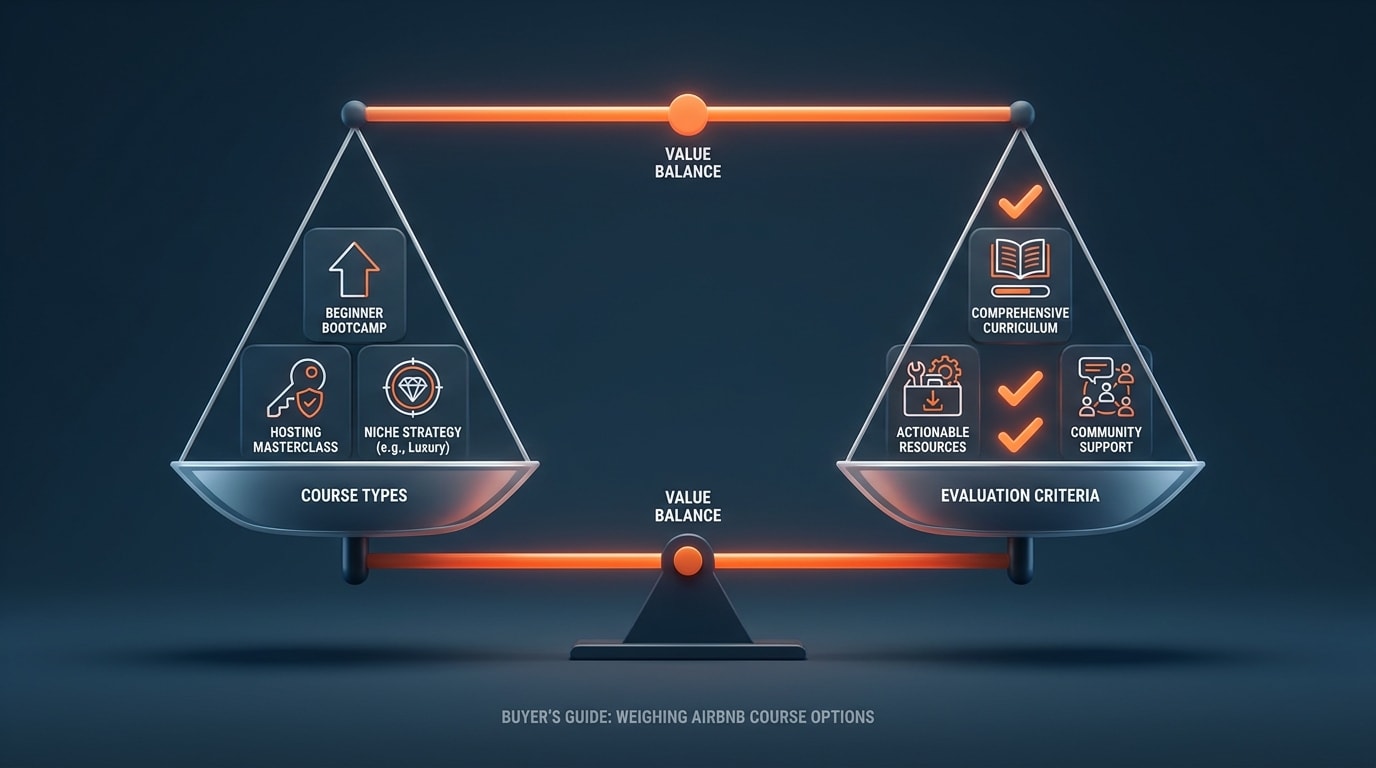
Weighing Airbnb course types against quality criteria
Before spending money, diagnose what gap you're closing.
Operators buy courses when what they need is a diagnosis. Where are you stuck? What's the next move? A course works when you have a defined gap (landlord negotiation, algorithm visibility, pricing mechanics) and the course fills it.
Wrong tool: you're still deciding if STR is right, or the bottleneck is execution, not knowledge.
Cheapest first move: free diagnostic call. Maps your situation to what you need to learn. Sometimes shows a course isn't the next step.
Operators who want the full learning landscape before committing: the short-term rental training guide covers orientation to advanced systems.
Key point: Diagnose the gap first. Courses fix specific problems, not general confusion.
What Course Types Exist?
Four categories exist. Each fits a different stage.
Platform-basics courses (Udemy, Lodgify Academy): Low cost, self-paced video. Cover listing setup, guest communication, platform policies. Good for beginners who want orientation before spending serious money. No live support, no depth. Treat as orientation, not education.
Udemy courses run $15 to $100 during sales. Most are 4 to 12 hours covering hosting basics, rental arbitrage, listing optimization, automation.
Full operator programs: A-to-Z systems covering acquisition, furnishing, pricing, operations, scaling. Include coaching or community access. Price reflects support structure. Right for operators building a real business who want a full operating system from someone actively running properties.
Courses in this category cost $600 to $800. Premium programs with ongoing live coaching run $7,000 or more.
Arbitrage-specific courses: Focus on rental arbitrage: market research, landlord negotiation, lease structuring, furnishing without ownership. Right for operators building a portfolio without buying real estate. The low-capital entry path.
Rental arbitrage starts at $3,000 to $8,000 per property. Covers first month's rent, security deposit, furnishing, supplies, photography. See the arbitrage guide for context.
Automation-focused courses ("automated Airbnb course"): Cover systematizing operations: messaging automation, dynamic pricing, cleaning management, channel management. Right once you have at least one unit running with real workflows to automate.
Automation courses before operations exist is tuning an engine you don't own.
Before buying paid courses, check free alternatives. Books, podcasts, free tools cover fundamentals at no cost.
Key point: Course type determines fit. Platform basics for exploration, full programs for building, automation for scaling.
Six Criteria That Predict Course Value
Run every course through these six. CashFlowDiary programs included.
Does the Instructor Still Operate?
Most important question. Most people skip it.
Meaningful difference between operated and still operates. The STR market in 2026 isn't the market from 2020. Algorithm changes, regulatory shifts, pricing tool evolution. Five-year-old experience teaches a different business.
Hosts struggling in 2026 operate the same way they did in 2021. Hosts thriving run professional operations: algorithm-aware listings, calibrated dynamic pricing, systematic guest communication. The skill gap costs more now.
Ask: How many properties do they manage today? Does their income still depend on STR performance, or only on course sales?
Incentive shift matters.
Is the Curriculum Substantive or Theoretical?
Best courses put a tool in your hand week one: lease negotiation scripts, pricing spreadsheets, cleaning management checklists, listing copy templates.
Worst courses give you frameworks and philosophy. No deliverables.
Before buying, ask for a curriculum outline. Check whether the outputs work immediately. If the sales page describes concepts without showing deliverables, ask for the outline.
What Support Exists After Purchase?
Video library isn't a program.
Does the course include a community for questions? Live Q&A or coaching calls? The price difference between a $15 course and a $1,000 program should show in the support structure.
Premium course with no live component and no ongoing community means you're paying for production value, not instructor access.
What Are the Refund Terms?
Course confident in its value has a clear refund policy. No refund terms at premium pricing is an oversight.
Know the exit before you enter.
How Current Is the Content?
Course not updated in two years teaches a different market.
Course recorded in 2023 doesn't address the regulatory wave hitting dozens of U.S. cities in 2024 and 2025. Best courses update quarterly, not annually.
Active operators update material because the market forces them to. Look for a stated "last updated" date on the sales page.
Does It Fit Your Stage?
Comprehensive scaling program is wrong for someone still deciding whether STR fits. Beginner-orientation course is wrong for an operator managing five units who needs pricing mechanics.
Match the course to where you are now, not where you want to be.
Key point: Six criteria filter courses. Active instructor, substantive curriculum, real support, clear refunds, current content, stage match.
An affiliate-driven rigged top-10 course ranking to distrust
Income screenshot marketing: Screenshots on sales pages are curated. Real social proof lives in forums (Reddit's r/airbnb, BiggerPockets threads, Facebook groups) where students the creator didn't select talk about the program.
Look for results with names, markets, numbers.
No verifiable operating record: Instructor who resists verification has something to hide. Legitimate operators at scale are findable: management companies have web presence, properties appear in public records, community forum history shows real participation over years, not marketing posts.
Is the course creator currently running an arbitrage portfolio? Meaningful difference between teaching from active experience versus past experience. Short-term rental market evolves every quarter.
False scarcity and "secret" framing: Sales page implying you're getting access to information nobody else has? That's positioning, not education. Real operational knowledge is transferable and teachable without artificial urgency.
Overpromising timelines: Honest timeline to first property for most markets is 60 to 90 days minimum: identify market, find property, negotiate lease or listing, go live.
Courses claiming "first booking in 30 days" target a specific scenario or are dishonest. Overpromising timelines is ignorance or sales tactics.
Endless upsells after purchase: Course requiring three additional purchases to become complete wasn't complete when you bought it.
Key point: Real courses have verifiable instructors, honest timelines, complete curricula. Walk from screenshots, secrets, upsells.
Absolute beginner, still exploring: Start free. Airbnb Academy (Airbnb's official training) covers platform basics at no cost. Udemy courses ($15 to $50) let you validate interest before committing real money.
Udemy's 30-day refund policy eliminates most financial risk. Use this stage to identify what you don't know, then invest in a program addressing your specific gap.
Free content on YouTube and TikTok covers basics. Three problems: scattered, outdated, no system.
Committed beginner, ready to build: Arbitrage-specific course or full operator program fits here. Evaluate using the six criteria above.
Key question: does the instructor still operate, and does the curriculum include real deliverables (scripts, templates, checklists) you use in the first week?
I've watched 1,600-plus students go through the program. The ones who succeed fast aren't smarter or wealthier. They follow a structured learning path and launch within 30 to 60 days. The ones who stall spend six months on YouTube piecing together strategy from 50 different creators.
Live listings, underperforming: Diagnose the bottleneck before buying.
Bookings too low? Problem is algorithm visibility. Revenue per booking low? Problem is pricing mechanics. Evaluating new markets? Problem is market selection methodology.
Buy the specialist course addressing your actual gap, not the comprehensive-sounding program.
Building scalable operation: Automation becomes the right focus here. Automated Airbnb course covering systematic guest communications, dynamic pricing configuration, cleaning management, channel management will compound results faster than foundational content.
Prerequisite: real workflows running before automation is worth optimizing.
Guests in 2026 expect fast Wi-Fi (50 Mbps minimum), smart TV, quality linens, fully stocked kitchen. Best Airbnb hosting courses teach you to furnish a property for $3,000 to $8,000 while creating a space that photographs well.
No single best course exists. Depends on stage and goals. Platform-basics courses suit beginners, operator programs suit people scaling, automation courses suit established hosts.
Judge any course by instructor's operating record, curriculum substance, support. Not by hype.
Are Airbnb courses worth it?
Good one compresses months of mistakes and teaches transferable skills. Many repackage free content.
Most Airbnb courses cost $600 to $800. That's not the financial risk. Real risk is spending 4 to 6 months applying the wrong framework (optimizing for occupancy when your problem is algorithm visibility).
Before buying, get a free assessment of what you need to learn. Often shows a course isn't your next step yet.
How much does an Airbnb course cost?
Pricing falls in 4 tiers: Free to $50 (platform basics), $600 to $525 (specialist skills), $800 to $2,997 (full programs with group coaching), $7,000-plus (premium with ongoing live coaching).
Price doesn't predict quality. A $20 course out-teaches a $5,000 one if the instructor operates and the curriculum is substantive.
What is an automated Airbnb course?
Course focused on systematizing operations (messaging, pricing, cleaning, channel management) so the business runs with less hands-on time.
Right once you have at least one unit running and real workflows to automate, not before you start.
How do I choose an Airbnb course?
Check instructor's verifiable operating record, whether curriculum teaches real skills (underwriting, operations, pricing, compliance), support and community, refund terms, how current content is, whether it fits your stage.
Avoid hype, screenshots, false scarcity.
Do I need an Airbnb course to start?
No. Many operators start with free content, solid plan, mentor. Course speeds you up, but real requirements are legal market, honest underwriting, action.
Learn fundamentals free first, then buy only what fills a real gap.
AirDNA's 2026 U.S. Outlook Report calls this year "best year to invest in short-term rentals since 2021." Only for hosts who understand market selection, dynamic pricing, operational efficiency.
The Credibility Problem
STR education market has a credibility problem. Most ranking articles are written by people with financial interests in what they recommend.
This guide gives you the evaluation framework. Judge any course (from any provider, including CashFlowDiary) against criteria that predict results.
Not sure which course type fits your situation or whether you need a course at all before your next move? Free diagnostic call maps your current situation to what you need. No cost, no pitch.
Free diagnostic call: Not sure which course fits or whether you need one yet? Get a free diagnostic call. We'll map exactly what to learn for your situation. No cost.