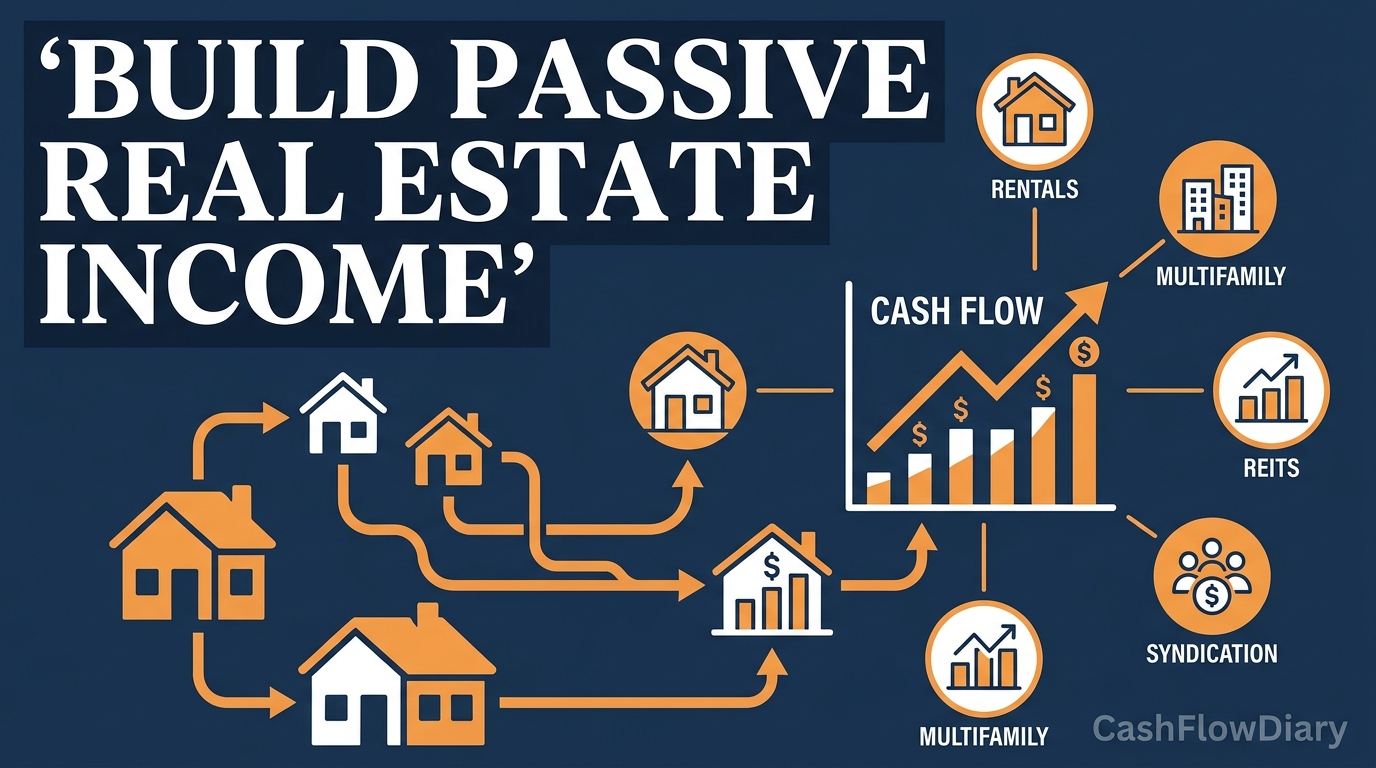
The phrase "passive income" gets used constantly in real estate circles. Most of the time, people are describing something that isn't actually passive — it's active income with the word "passive" stuck in front of it.
Real passive income from real estate is real. I've built it, and I've watched thousands of investors build it. But it doesn't happen by accident. It happens when you choose the right strategies, run the numbers honestly, and build the systems that let properties operate without your constant attention.
This guide breaks down how passive income with real estate actually works — and how to build it from where you are right now.
The Truth About "Passive" Income in Real Estate
Here's what most people don't tell you: real estate income isn't passive on day one. On day one, you're learning the market, finding properties, analyzing deals, managing tenants, and handling maintenance calls. That's active work.
The passive part comes after the systems are built.
Once you have a property in the right market, with the right tenants, managed by a reliable system (whether that's you or a property management company), the income largely runs on its own. Checks come in. Equity grows. You spend a few hours a month reviewing statements and handling the occasional issue.
That's the goal. But you have to build your way there.
[INTERNAL LINK: passive income real estate investing for beginners — full starter framework]
3 Core Ways Real Estate Generates Passive Income
1. Long-Term Rental Cash Flow
This is the foundation. You buy a property, rent it to long-term tenants, collect rent monthly, pay your expenses, and keep the difference. The cash flow — what's left after mortgage, taxes, insurance, maintenance, and property management — is your passive income.
The key metric here is cash-on-cash return: your annual cash flow divided by your total cash invested. A healthy long-term rental produces 6–10% cash-on-cash for most markets.
Lower active management than short-term rentals
Stable, predictable income
Works in most markets with the right property selection
Scales well with property management in place
2. Short-Term Rental Income
STR investing — renting your property on platforms like Airbnb or VRBO — can generate significantly higher gross revenue than long-term rentals in the right markets. A property that rents long-term for $1,500/month might generate $3,000–$5,000/month as an STR, depending on location and management quality.
Important caveat: STR investing is less passive than long-term rentals until you have strong systems and professional management in place. Once those systems are running, it can be highly passive — but the setup work is front-loaded.
[INTERNAL LINK: short-term rental investing guide — how to build and systematize an STR portfolio]
3. Private Lending / Notes
If you have capital to deploy, lending money to other real estate investors in exchange for a fixed return (secured by real estate) is one of the most genuinely passive income streams in real estate. You're the bank. You earn 8–12% annually in many cases, secured by property, without managing tenants or maintenance.
The barrier: this requires existing capital. It's typically a later-stage strategy once you've built equity through active real estate investing.
How to Build Real Estate Passive Income: The Framework
Here's the framework I've seen work consistently for investors building from scratch:
Phase 1: Buy One Cash-Flowing Property
Start with a single property that cash flows from day one. Don't buy on appreciation speculation. Don't buy in a market where the numbers only work on paper. Buy a property where rental income exceeds your expenses, even if the margin is modest.
This first property teaches you everything: how to find deals, how to finance, how to manage or work with a property manager, how to handle maintenance, how to think about taxes. Get this one right.
Phase 2: Reinvest and Repeat
Take the cash flow and any equity you've built and use it to acquire the next property. The snowball is slow at first — this is where most investors give up — but it accelerates significantly once you have two or three properties generating cash flow simultaneously.
The math compounds. The skills compound. The relationships compound.
Phase 3: Build the Systems
As your portfolio grows, the business can't run on your personal attention. This is where property management, maintenance systems, and accounting processes become essential. Investors who try to self-manage a 10-unit portfolio while working a day job burn out. Investors who build systems scale.
A good property manager typically costs 8–12% of monthly rent. That cost is worth it when it buys you genuine passive income vs. a second job.
Phase 4: Scale Strategically
Once the systems work, adding more properties is largely a capital and deal-finding challenge — not a management challenge. This is where real estate passive income becomes genuinely scalable.
[INTERNAL LINK: how to invest in real estate for passive income with $10K — starting with limited capital]
What J. Massey Has Seen Work (and What Doesn't)
I've worked with investors at every stage — people starting with nothing, people with capital who were making all the wrong moves, people who'd built solid portfolios but couldn't figure out how to get their time back.
The pattern I see in people who successfully build passive income is consistent: they pick one strategy and get genuinely good at it before adding complexity. They run real numbers, not optimistic projections. And they invest in systems early, before they feel like they need them.
The pattern I see in people who struggle: they chase appreciation instead of cash flow, they try to self-manage everything indefinitely, and they add properties before their existing portfolio is stable.
Real estate passive income is a business. Build it like one.
Where to Start: Practical First Steps
Choose your primary strategy. Long-term rental, short-term rental, or a hybrid approach. Each requires different market research and skill sets. Pick one and go deep before diversifying.
Research your target market. Look for markets with strong rental demand relative to property prices. Cash flow and appreciation potential both matter, but cash flow is non-negotiable for building passive income.
Understand your financing options. Owner-occupied loans (if you'll house hack), conventional investment loans, portfolio lenders, private money — know what's available and what you qualify for.
Run the numbers on real deals. Until you've analyzed 50+ properties, you're still calibrating your eye. Build a simple spreadsheet that calculates monthly cash flow and cash-on-cash return. Run every property you consider through it.
Build your team. A good real estate attorney, a CPA who specializes in real estate, a lender who does investment properties, and a property manager in your target market. You don't need to use all of them on your first deal — but know who they are.
Common Mistakes That Kill Passive Income Before It Starts
Chasing appreciation instead of cash flow. A property that doesn't cash flow requires you to fund it every month. That's not passive income — that's negative cash flow you're hoping time will fix.
Underestimating expenses. Maintenance, vacancy, property management, capital expenditures. These are real costs. Model them honestly or your cash flow projections will be wrong.
Not treating it like a business. Passive income from real estate requires business discipline: separate accounts, accurate books, a plan for what to do when things go wrong.
Trying to do everything yourself. The goal is passive income. If you're managing 5 properties yourself, handling all maintenance calls, and doing your own bookkeeping, you have a second job, not passive income.
Giving up after the first hard thing. Vacancies, difficult tenants, unexpected repairs — these are normal parts of real estate investing. They don't mean the strategy is broken.
Frequently Asked Questions
How much money do I need to start building passive income with real estate?
Less than most people assume. Conventional investment property loans typically require 20–25% down, but owner-occupied loans (including FHA) allow much lower down payments when you live in the property. Some investors start with house hacking for exactly this reason — it's a way into real estate with limited capital that still produces passive (or at least reduced) housing costs.
What type of real estate generates the most passive income?
It depends on your market and your systems. Long-term rentals are the most straightforward and passive once stabilized. Short-term rentals can generate higher gross income in the right markets but require stronger systems to be truly passive. Multi-family properties tend to generate better cash flow than single-family homes at comparable price points.
How long does it take to build meaningful passive income from real estate?
Most investors I've worked with reach their first meaningful passive income milestone — $1,000–$2,000/month net — within 3–5 years of their first acquisition, depending on how aggressively they reinvest and how their market performs. The compounding becomes much more noticeable after the second and third properties.
What's the difference between active and passive income from real estate?
Active real estate income — like flipping houses, wholesaling, or property development — requires your ongoing time and effort to produce income. Passive real estate income — rental cash flow, notes — is generated by assets operating with systems, without requiring your constant attention. Both are legitimate strategies, but only passive income scales without scaling your time.
Do I need to hire a property manager to have passive income?
Not necessarily for one or two properties — many investors self-manage successfully at small scale. But to have genuinely passive income at larger scale, professional management is almost always the right call. The 8–12% you pay a property manager is the cost of making the income actually passive.
Ready to Build?
Building passive income with real estate is one of the most reliable wealth-building paths I've found — and I've looked at a lot of them. It takes time, discipline, and a willingness to learn the business side of investing, not just the property side.
If you want a structured path to building your real estate passive income strategy — with real numbers, real case studies, and a community of investors who are doing it — CashFlowDiary is where that conversation lives.
[INTERNAL LINK: CashFlowDiary free training / community signup]