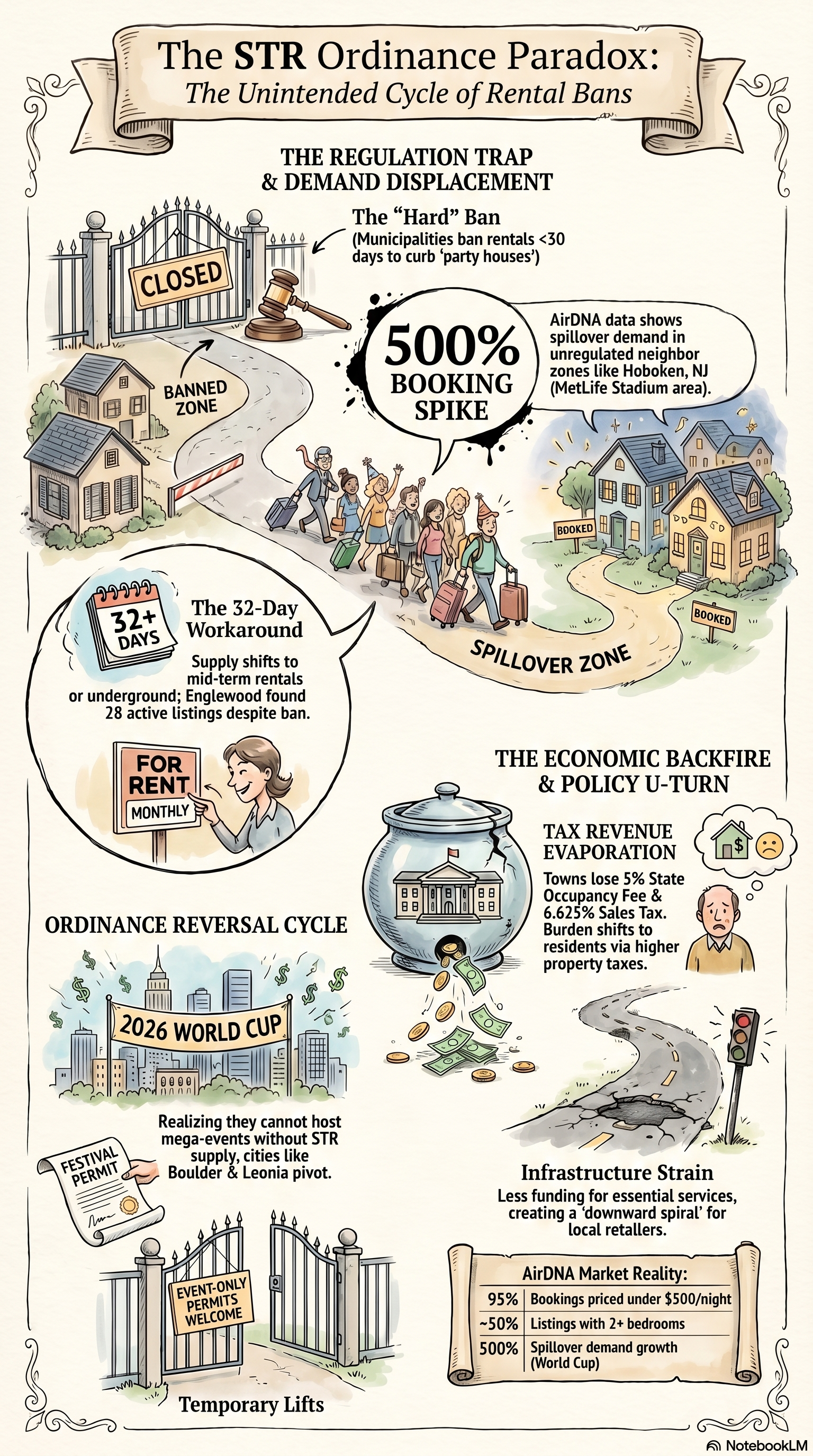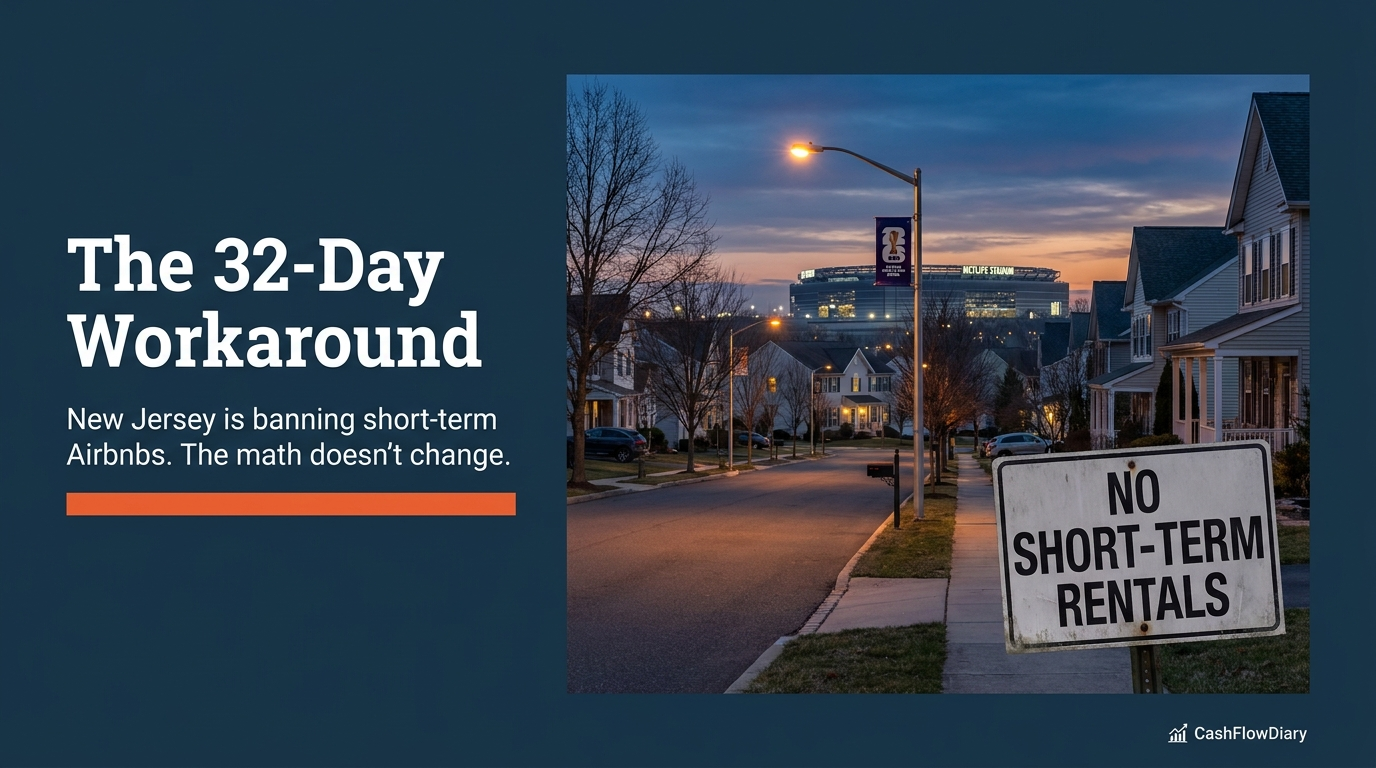
The 2026 FIFA World Cup is projected to be the largest tourism event ever held in North America. So why is Mountainside, New Jersey — a 20-minute drive from MetLife Stadium — voting to make a five-night Airbnb stay a $2,000-per-day crime, six weeks before kickoff?
Hand-on-the-keyboard answer: because the people writing the ordinance haven't read William Stanley Jevons.
The News Cycle Isn't The Story

If you've been watching the New Jersey Airbnb headlines, you'd think the World Cup is going to be a regulatory crackdown. The Mountainside Borough Council voted unanimously on May 14 to introduce an ordinance banning every short-term rental of 30 days or fewer, with fines up to $2,000 per day. The second reading and final public hearing are set for June 2.
Kearny — three miles from MetLife — expanded its 2017 ordinance in March to cover every residential dwelling, including multi-family buildings. The escalation tops out at $2,000 per day plus 30 days in county jail for a third offense. Central Jersey Newspaper Group reports that more than 75 New Jersey municipalities now prohibit short-term rentals outright.
That is the news cycle. It is not the story.
The story is that none of these ordinances will materially reduce the number of World Cup visitors who sleep in someone's house. They will reduce the number who file the paperwork at all. The activity reroutes. The math doesn't.
This is a 161-year-old economic insight at work — and most operators, regulators, and journalists are missing it.
What Jevons Paradox Tells Us About Airbnb Ordinances
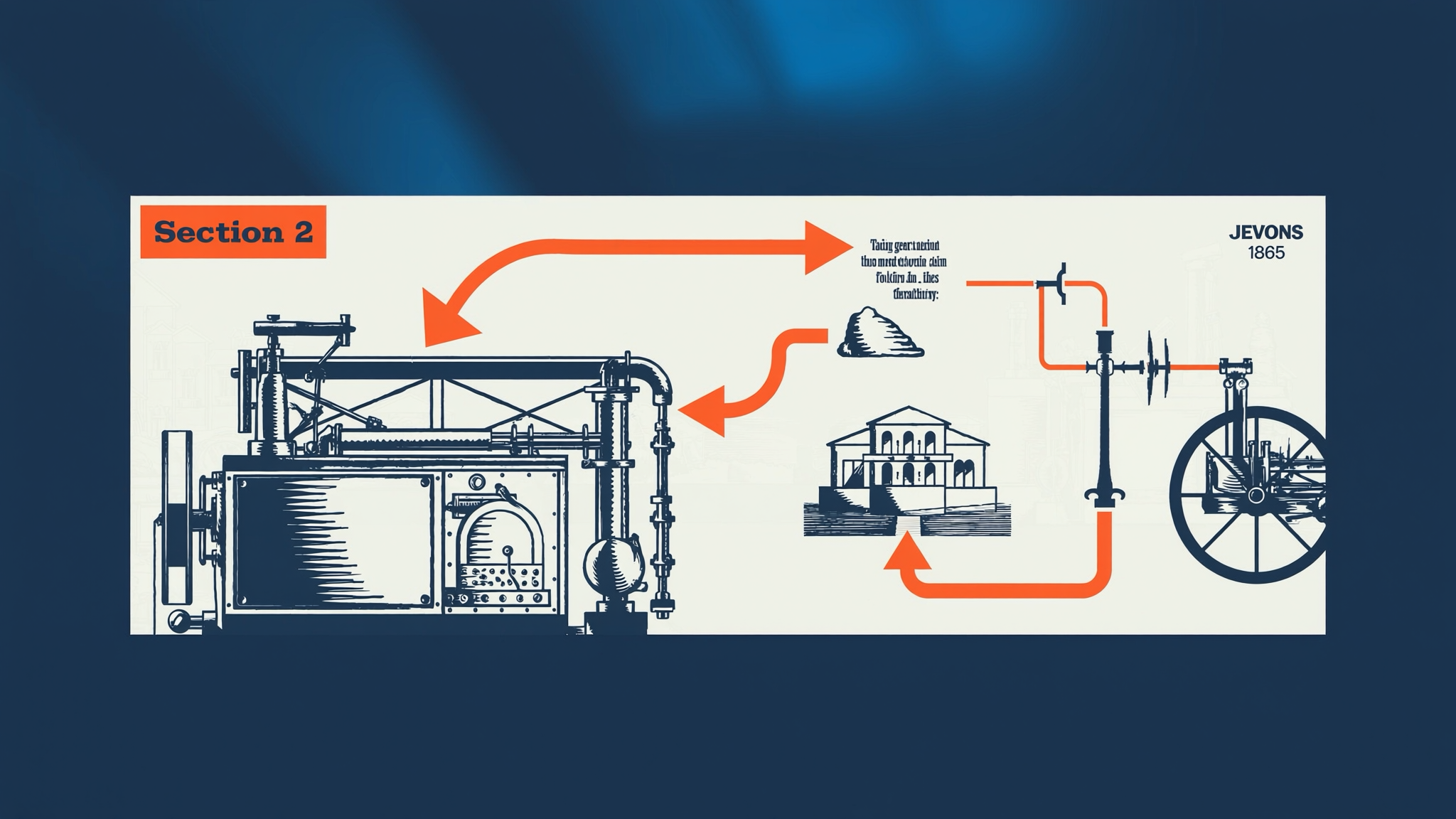
In 1865, English economist William Stanley Jevons published The Coal Question. Britain was nervous about running out of coal. Watt's improved steam engine was supposed to use coal more efficiently — and therefore reduce total coal consumption. Jevons observed the opposite. More-efficient engines made coal cheaper per unit of work, which made coal-powered machines viable in more applications, which drove total coal consumption higher. The intuitive policy lever produced the opposite of its intended effect.
That observation is Jevons paradox. When you change one variable to suppress a behavior, demand reroutes. Sometimes it concentrates. Sometimes it grows. It almost never simply disappears.
Apply this to a short-term rental ordinance. The Mountainside rule bans rentals of 30 days or fewer. It doesn't ban demand. It doesn't ban hospitality. It doesn't ban a French soccer fan from sleeping somewhere in northern New Jersey for five nights in June. It just changes the paperwork — and concentrates demand on the surviving compliant inventory.
We are not the only people watching this curve. As Jamie Lane, Chief Economist at AirDNA, said in a February 2026 podcast interview:
"Bans don't stop demand. They reroute it."
— J. Massey · CashFlowDiary
The 2026 World Cup will be the biggest travel event in short-term rental history.
The interesting part is the second half of his sentence: "Don't expect to earn $1,000 per night." Lane is forecasting massive demand AND massive supply — which means premium pricing will compress as first-time hosts flood the market.
That is the Marcus-Lee-relevant reading of Jevons. The ban doesn't kill demand. Inexperienced operators flooding the market is what compresses margins. Two different risk vectors. Conflating them is how operators get caught.
Three Questions a Cautious Investor Should Actually Ask
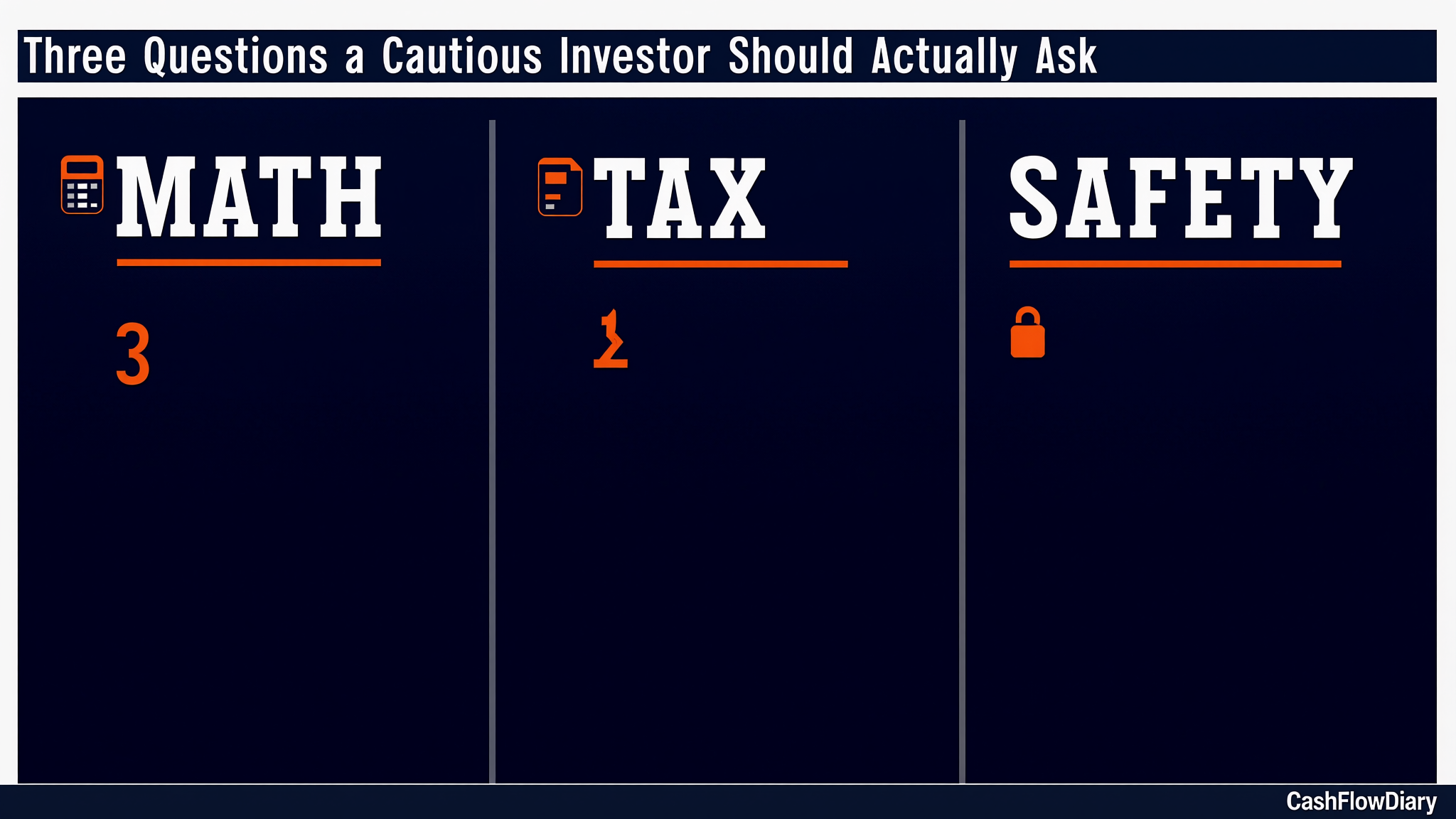
If you own a property in a banned town and you are cautious about World Cup math, there are three real questions.
Question one: does a 31-day reservation actually work?
The Mountainside ordinance prohibits rentals of 30 days or fewer. A 31-day reservation is, on its face, compliant. Consider the typical World Cup fan group: five nights in town, then a flight home because work resumes. A renter willing to pay $10,000 for a five-night peak weekend isn't going to change their travel plans. They are, however, going to be open to a 31-day reservation that pays the same $10,000 and uses the property for the same five nights.
To the owner, that $10,000 covers two to four months of mortgage. To the ordinance, it is compliant — fully and on its face.
Bobby Roufaeal, the founder of Settled In Property Management, told Fortune in March what the homeowner side of this conversation actually sounds like:
They're like, listen, I'll figure it out. I'll go stay with my relatives for the month or for a few weeks just to be able to capitalize on this revenue.
This is not theoretical. Roufaeal manages more than a dozen short-term rentals in New Jersey. He is already tripling rates ahead of the tournament. His luxury inventory could clear $240,000 between June 11 and July 19. The homeowners weren't talking about how to circumvent the ordinance — they were talking about how to vacate their primary residence to capture event revenue.
Question two: does the tax math also work?
This is where most amateur strategy collapses. New Jersey's transient occupancy tax bulletin TB-81R treats accommodations of 89 days or fewer as transient. The 90-day mark, not the 30-day mark, is where state and county occupancy taxes drop. A 31-day reservation is ordinance-compliant but still occupancy-taxable.
Plan for that. Add the tax to your modeling. Do not assume "compliant" means "tax-free."
Question three: what is your screening and safety protocol?
This is the risk Jamie Lane was actually flagging when he said "don't expect $1,000 per night." Margin compression is one thing. The bigger downside risk is that the operators flooding into the market this summer are first-timers. They do not have screening protocols. They do not have insurance policies that cover short-term events. They do not know what a Property Damage Protection bond looks like, or who to call when a guest brings 12 people instead of 4.
The 2026 World Cup will produce screening and safety news cycles. Mid-tournament, expect to read at least one story about an Airbnb damage event involving fans. The operators who survive the cycle are the ones who underwrote conservatively, screened thoroughly, and did not depend on a single tourism event to justify their pro forma.
The CFD framework on this: if your STR underwriting requires the World Cup to show up exactly as projected, your underwriting was wrong before the World Cup was announced. Event-driven STR revenue is upside, not baseline. The COVID lesson — backups for every conceivable AND inconceivable customer scenario — applies here. Always.
What History Actually Predicts
One more piece of context. When mandatory seat belt laws started arriving in the 1960s and 1970s, drivers complained. They complained about discomfort. They complained about seat belts covering their child's face. They complained about the nanny state.
In 1973, the National Highway Traffic Safety Administration required new cars to have an interlock mechanism that prevented the engine from starting unless the driver was buckled. Congress repealed it within a year — they received more constituent mail about it than they did about Nixon's Saturday Night Massacre. In 1981, the CDC reported that only 11 percent of Americans wore seat belts even when belts were installed and available. By 1985, states started enforcement. Today, you would be horrified to ride in a car without one.
Change is messy. The market adapts. The Mountainside Borough Council, the Kearny Town Council, and the 73 other New Jersey municipalities racing to ban short-term rentals before the World Cup are doing their version of the 1973 interlock — visible, swift, politically satisfying, and almost certainly subject to revision once the revenue math is complete.
We already see the early reversal signal. Maui's STR phase-out projected $900 million in visitor spending loss and $75 million in state and county tax revenue loss. New Orleans estimated $1.6 billion in unrealized annual economic activity from restrictive STR regulation. Anaheim eased restrictions after platform lawsuits exposed the cost. Clifton, New Jersey, temporarily relaxed its STR rules ahead of the 2026 World Cup citing budgetary needs. Politicians notice when lost lodging tax shifts the burden onto property and sales taxes paid by year-round residents.
The reversal cycle is observable in real time, not theoretical.
FAQ — The Questions Investors Are Actually Asking
Why are cities banning Airbnbs before the 2026 World Cup?
Three reasons, in roughly this order: resident complaints about parking, noise, and trash; the political optics of being seen to do something before a high-attention event; and hotel-industry lobbying.
Notably, the bans are happening in suburbs, not in the host city itself — because the host city wants the lodging tax. Jersey City has restrictive STR regulations dating to 2019 but did not impose a pre-World Cup ban. East Rutherford itself, the actual host municipality, has limited rules. The pattern of pre-event restriction is a suburbs phenomenon, not a host-city one.
Can I rent my house on Airbnb during the World Cup?
Depends entirely on your municipality. New Jersey has no statewide STR law. Of the towns near MetLife Stadium, more than 75 prohibit short-term rentals.
Hoboken is the contrast case. Councilman Joe Quintero told Gothamist: "The reality is that these short-term rentals are going to happen and so what we want to do is take this market out of the gray zone. If we don't have clear rules set, it will be the Wild West." Quintero is acknowledging the Jevons reality directly: demand will route somewhere, and you would rather have it routed through a regulated channel than a black market. Hoboken is drafting regulations, not bans, ahead of the tournament.
What towns near MetLife Stadium allow short-term rentals?
As of May 2026: Hoboken (regulated, not banned). Newark and Jersey City both operate permitting regimes with restrictions. Englewood, Kearny, West New York, Union City, Edgewater, Secaucus, Weehawken, North Bergen, Carlstadt, East Rutherford, Lyndhurst, and roughly 60 other towns either prohibit STRs outright or restrict them to owner-occupied stays only.
Before you accept a reservation, verify your municipality's specific ordinance — the patchwork is real, the fines are real, and platforms do not block listings in towns where rentals are prohibited. The host's compliance burden does not shift to Airbnb.
What happens if the bans don't reduce demand?
The bans get modified. The financial post-mortems start one to two tourism cycles after the event. Watch what the towns do in 18 to 24 months once the lost-revenue analyses circulate. That is when the second-order opportunities — and the second-wave entry points for patient investors — typically show up.
The Bottom Line for Cautious Investors
The playbook is simple.
Do not underwrite as if event-driven STR revenue is your baseline. Verify your specific ordinance and tax exposure before quoting any reservation. Build screening and safety protocols you would defend in a deposition. Diversify your guest profile so the World Cup is upside, not survival. And watch what the towns do in 18 to 24 months when the tax revenue post-mortems come in.
Bans don't stop demand. They reroute it. Plan for the route, not the headline.
Want CFD's playbook for cautious STR investing during megaevents? Subscribe to the CashFlowDiary newsletter for weekly market analysis.
Sources
• World Cup Rental Boom Meets NJ Short-Term Rental Bans — Central Jersey
• Airbnbs are topping $6,000 a night in World Cup housing frenzy — Fortune
• Has Airbnb peaked? Jamie Lane on STR demand, OTAs, the World Cup, and 2026 trends — Host Planet
• W. Stanley Jevons, "The Coal Question," 1865 — Energy History
• Why the AI world is suddenly obsessed with Jevons paradox — NPR Planet Money
• How short-term rental bans backfire — Rent Responsibly
• From Sundance to the Olympics, cities test event-only short-term rental permits — Rent Responsibly
• When New Seat Belt Laws Drew Fire as a Violation of Personal Freedom — HISTORY
• NJ Treasury TB-81R — Taxes Imposed on the Rental of Transient Accommodations
• Hoboken opens door to Airbnb as NYC and other NJ towns lock out short-term rentals — Gothamist