PMS vs Channel Manager: What's the Difference, and Do You Actually Need Both?
A channel manager syncs your calendar across booking platforms; a PMS runs operations. The difference, when you need both, and when one combined tool wins.
By J. MasseyJune 22, 2026· 10 min read
Share
Disclosure: This post may contain affiliate links. If you purchase through our links, we may earn a commission at no extra cost to you. We only recommend tools and services J. Massey's team actually uses.
Learn more →
TL;DR: A channel manager syncs your calendar across booking platforms to prevent double-bookings. A PMS runs your operations (guest comms, cleaning, payments). Different jobs. Sometimes sold as one product. Below 2 units and 1 platform, you don't need either. At 2+ platforms or 3+ units, you need both, or one tool that does both.
At 1 unit, 1 platform: Skip both. Use Airbnb's native tools. At 1 unit, 2+ platforms: Get a channel manager. Double-booking math makes it worth it. At 3-5+ units, multi-platform: Get both. You can't run comms and cleaning from memory. At serviced apartments or multi-unit buildings: Both are non-negotiable.
I have spent 15+ years in this space, trained more than 10,000 operators through CashFlowDiary, and recorded 237+ podcast episodes breaking down the deals that work and the ones that do not. The pattern below shows up in every cycle.
You've heard both terms in host forums. You're not sure if they're the same thing, two separate tools, or one thing with two names.
Here's what each tool does, where they overlap, and the honest threshold for when you need each. This comes from an operator who runs the stack and sells none of it.
PMS versus channel manager comparison: an operations tool versus a distribution tool, with the overlap zone
A channel manager is a distribution tool. It syncs your listings, rates, and calendar across Airbnb, Vrbo, Expedia, and Booking.com. Its job is to prevent double-bookings.
A PMS (property management system) is an operations tool. It handles guest messaging, cleaning schedules, payments, and reporting.
One faces outward, managing your presence across booking platforms. The other runs your business from the inside.
Channel Manager: Distribution. Syncs listings, rates, and calendars across platforms. PMS: Operations. Manages internal business processes and guest interactions.
Focus area:
Channel Manager: External reach and market presence. PMS: Internal efficiency and guest experience.
What it automates:
Channel Manager: Real-time OTA sync, centralized listing control, automated rate and availability pushes, double-booking prevention, multi-channel distribution (Airbnb, Vrbo, Expedia, Booking.com). PMS: Reservation management, guest communication (unified inbox), housekeeping and task scheduling, billing and invoicing and payments, property management data analytics (occupancy, ADR, RevPAR, channel performance), revenue management tools.
Where the data goes:
Channel Manager: Pushes availability and rates outward to booking platforms. Pulls reservations inward. PMS: Collects and organizes internal operational data, guest information, and financial records.
Revenue support:
Channel Manager: Maximizes visibility and occupancy across channels. Prevents lost bookings from overbookings. PMS: Optimizes pricing strategies. Tracks financial performance. Streamlines guest services to enhance reviews and repeat business.
Overlap zone:
Some PMS platforms include basic channel sync. Some channel managers offer basic messaging. Modern combined platforms blur these lines, integrating both sets of functions.
Key point: The overlap exists. Some combined platforms blur the line. The core jobs remain distinct.
When a short-term rental operator needs a PMS, a channel manager, or both, by unit count and number of booking platforms
Most vendors give you a self-serving answer. Here's the operator's perspective, based on your unit count and platform strategy.
1 unit, 1 platform
You don't need either yet.
If you're running a single unit on Airbnb, their native tools cover basic calendar and messaging. Adding paid software at this stage is overhead before you've validated the operation.
Focus on fundamentals first: good reviews, understanding your market, refining your guest experience.
1 unit, 2+ platforms (Airbnb + Vrbo, or adding Booking.com)
A channel manager earns its cost.
The math is simple: one missed sync at the wrong time costs more in refunds, penalties, and review damage than a year of channel manager fees.
A channel manager calendar with true two-way API sync solves this. Small investment to protect your reputation and your wallet.
Listing on more than one platform widens your funnel — more eyes on your unit, more booking opportunities. The catch is that the extra exposure only pays off if your calendar stays in sync across every channel, which is exactly the job a channel manager exists to do.
3-5+ units, multi-platform
Both tools start earning their keep.
At this unit count, you can't run guest comms, cleaning schedules, and payments out of your head or a spreadsheet. The PMS becomes the system that remembers for you.
Combined, a PMS and channel manager create the data loop that makes scaling work without adding headcount linearly. This is where your STR business becomes a system, not a series of manual tasks.
Operators who automate their messaging, task scheduling, and calendar sync consistently report getting meaningful hours back each week — time that otherwise disappears into manual coordination as unit count climbs.
Serviced apartments or multi-unit buildings
Both tools are non-negotiable.
When you're managing multiple identical or near-identical units under one roof across multiple OTAs, the volume of calendar conflicts and the operational complexity of coordinating turnovers across units makes manual management a liability.
A channel manager for serviced apartments is a distinct use case. You're managing multiple identical units under one roof across multiple OTAs. The sheer volume of calendar conflicts and the operational complexity of coordinating turnovers makes both a robust PMS and a channel manager essential.
Key point: If you're not sure where you fall, the free STR Software Stack Checklist walks through exactly what you need at each unit count.
Combined platform vs. two specialist tools
Operators face a choice: one platform that does both, or separate tools for each function.
Most modern platforms (Guesty, Hostaway, Hostfully, Lodgify) bundle both functions into one product. They market these as PMS and channel manager solutions. These are category examples, not endorsements or rankings.
Below 5 units
One combined entry-level tool beats two specialist subscriptions.
Lower total cost. One integration to maintain. One support relationship.
Some operators prefer best-in-class specialist tools connected via API. A dedicated channel manager feeding a dedicated PMS.
More power and customization. More to configure and maintain.
The tradeoff
Combined tools trade depth for simplicity. Specialist tools trade simplicity for power.
The right answer depends on your unit count, your tech comfort level, and how much time you want to spend managing software versus managing properties.
The unified calendar in a combined platform
In a combined platform, the unified channel manager calendar becomes your central dashboard. It eliminates the need to log into Airbnb, Vrbo, and Expedia separately.
One screen. All dates. All platforms.
Channel manager connections to Expedia and Booking.com
Most quality channel managers connect to Airbnb, Vrbo, Expedia, and Booking.com via two-way API sync.
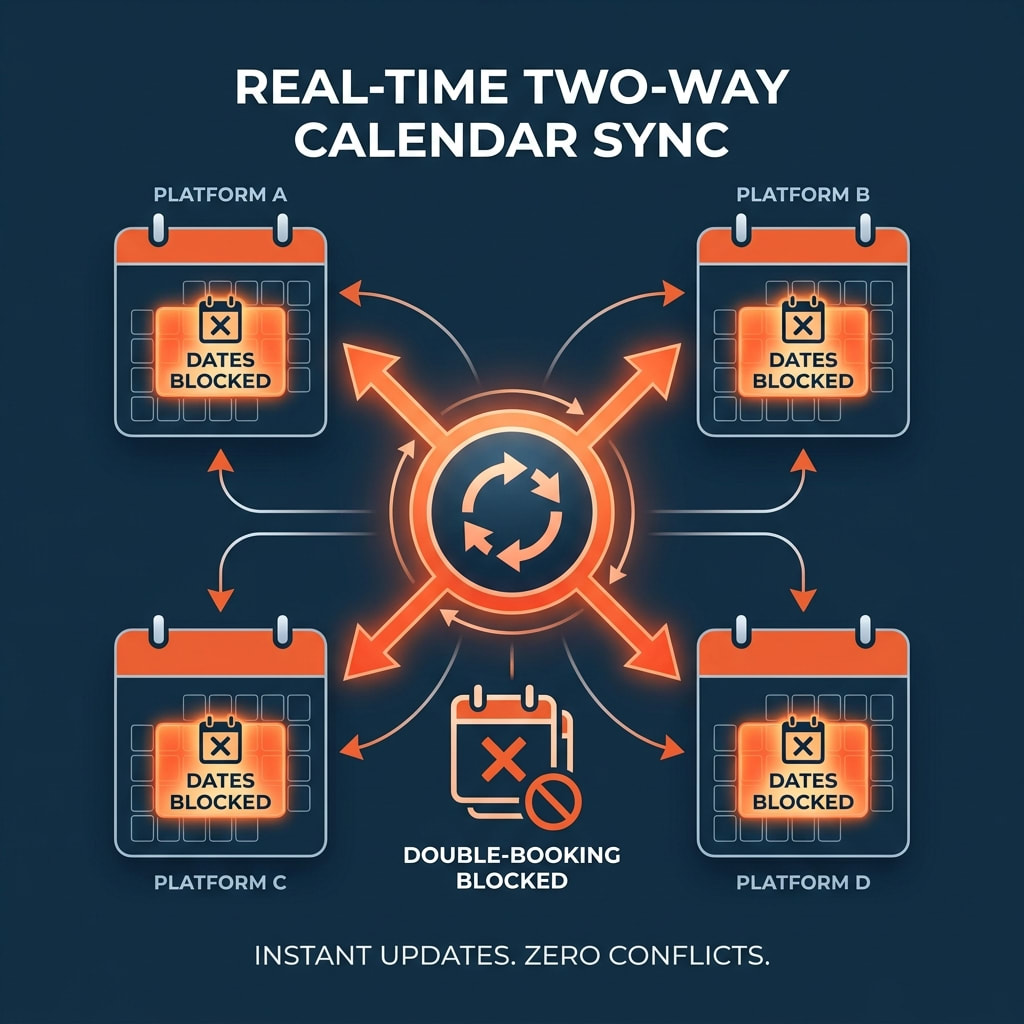
A booking on one platform instantly blocks those dates on all others.
Key point: Combined tools work for most operators. Specialist tools make sense above 10-15 units or when you need specific customization. The unified calendar is the central dashboard that prevents double-bookings.
Two-way API calendar sync instantly blocking the same dates across Airbnb, Vrbo, Expedia, and Booking.com to prevent a double-booking
Double bookings aren't a distribution problem. They're a sync latency problem.
They only happen when calendars update too slowly.
Airbnb's built-in iCal sync
Airbnb's iCal sync is one-way and slow. It takes hours to update, leaving a window where two guests book the same dates on different platforms.
iCal refresh intervals commonly range from about 30 minutes to several hours. For operators receiving more than a few bookings per month, that delay creates meaningful double-booking risk.
The cost is severe: platform penalty fees, refunds, lost Superhost status, and on some channels, hidden listing placements.
A channel manager provides true two-way API sync
A booking on Airbnb instantly blocks those dates on Vrbo, Expedia, and Booking.com.
API: Direct real-time connection. Instant, two-way, reliable.
API connections provide real-time two-way data sync including availability, rates, reservations, and sometimes messaging. iCal is a basic calendar file format that syncs availability but suffers from delays and lacks support for syncing photos, descriptions, or pricing rules.
For listing channel management across multiple OTAs, API connections are non-negotiable.
Serviced apartment nuance
When you're running multiple units in the same building, the channel manager calendar needs to track per-unit availability, not just property-level.
This is where generic tools sometimes fall short and purpose-built channel managers for serviced apartments add value.
Key point: The sync gap (the window between an external booking event and the moment your PMS and channel manager both reflect it) is where double bookings live. iCal is a starting point, not a strategy. For operators with growth ambitions, a channel manager with certified API connections is the infrastructure that makes scaling work without scaling risk.
FAQ
What's the difference between a PMS and a channel manager?
A channel manager is a distribution tool that syncs your listings, rates, and calendar across booking platforms (Airbnb, Vrbo, Expedia, Booking.com). A PMS is an operations tool that handles guest messaging, cleaning, payments, and reporting.
Do I need both?
If you list on multiple platforms or run multiple units, yes. You need distribution (channel manager) and operations (PMS). Most operators get both from one combined platform. A single unit on one platform doesn't need either yet.
Does one tool do both jobs?
Yes. Most modern platforms (Guesty, Hostaway, Hostfully, Lodgify) bundle channel management and PMS functions into one product. For most growing operators, one combined tool beats juggling two subscriptions.
Is a channel manager the same as Airbnb's calendar sync?
No. Airbnb's built-in iCal sync is one-way and slow to update, which still allows double-bookings. A channel manager provides faster two-way sync across all your platforms at once, so a booking anywhere blocks those dates everywhere.
Does a channel manager connect to Expedia and Booking.com?
Yes. Most channel managers connect to Airbnb, Vrbo, Expedia, and Booking.com, pushing your rates and availability and pulling in reservations through two-way sync so every calendar stays current automatically.
What is property management data analytics?
The reporting layer of a PMS. Occupancy, revenue, ADR, RevPAR, and channel performance pulled into one dashboard. A channel manager moves bookings. The PMS analytics tell you whether those bookings are making you money.
When do I move from free tools to paid software?
At 1 unit and 2+ platforms, get a channel manager. The double-booking risk outweighs the subscription cost. At 3+ units, add a PMS. You can't run comms and cleaning from memory.
What if I have serviced apartments?
Both a PMS and a channel manager are non-negotiable. The operational complexity of managing multiple identical units under one roof across multiple OTAs demands both tools. Generic tools sometimes fall short here. Look for purpose-built solutions that track per-unit availability.
Key takeaways
A channel manager syncs your calendar across platforms to prevent double-bookings. A PMS runs your operations. Different jobs, sometimes sold as one product.
At 1 unit and 1 platform, skip both. Use Airbnb's native tools.
At 1 unit and 2+ platforms, get a channel manager. The double-booking math makes it worth it.
At 3-5+ units and multi-platform, get both. The PMS becomes the system that remembers. The channel manager prevents sync failures that wreck reviews.
At serviced apartments or multi-unit buildings, both are non-negotiable. The operational complexity demands it.
Combined tools trade depth for simplicity. Specialist tools trade simplicity for power. Below 5 units, one combined tool beats two subscriptions. Above 10-15 units, some operators prefer specialist tools connected via API.
iCal is a starting point, not a strategy. For operators with growth ambitions, a channel manager with certified API connections is the infrastructure that makes scaling work without scaling risk.
Not sure whether you need a channel manager, a PMS, or one combined tool at your unit count? Book a free diagnostic call: cashflowdiary.com/diagnostic/