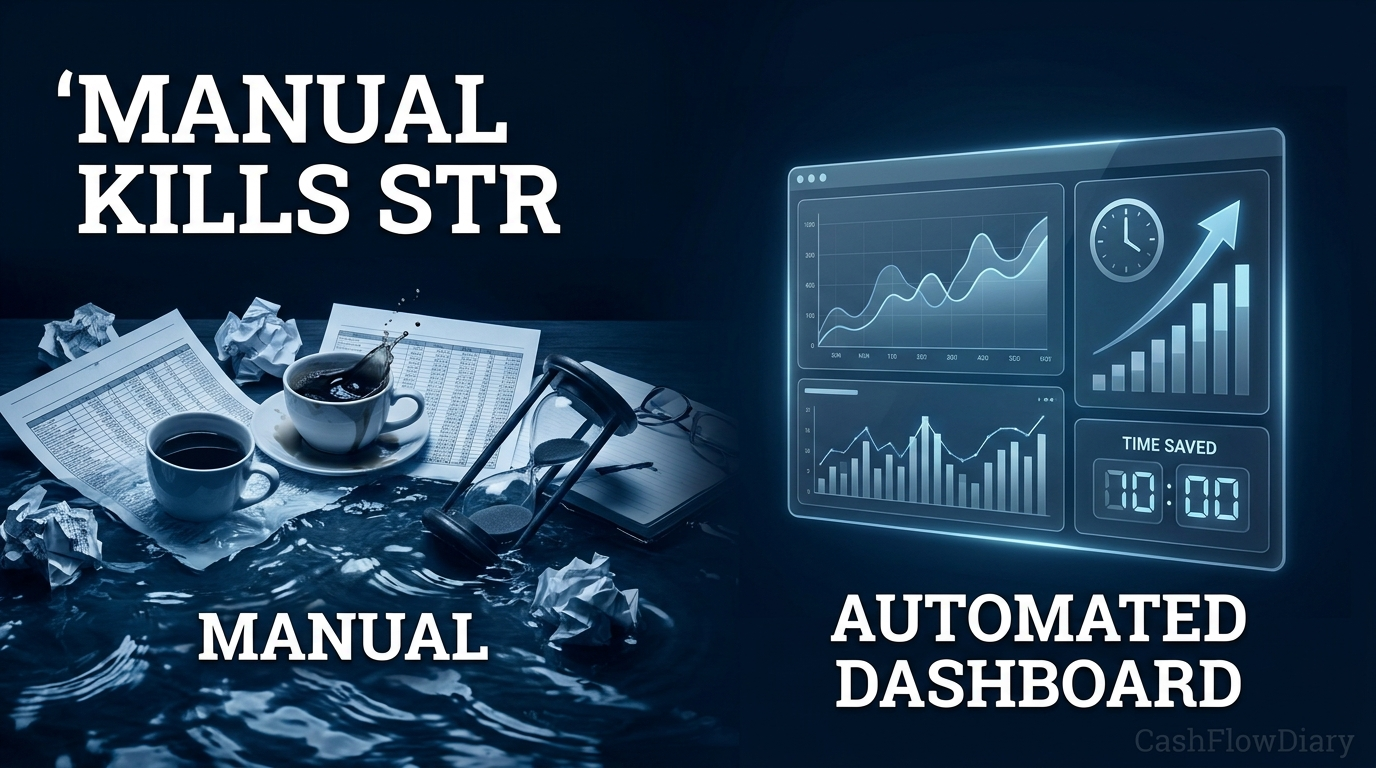
The operators selling off their units in 2026 aren't losing to city councils. They're losing to their own inbox.
You've heard the headlines. New regulations. Stricter enforcement. Cities cracking down on short-term rentals. And if you're sitting on the sidelines waiting for things to "settle down," I get it — that sounds scary.
But here's what nobody's talking about: regulation isn't what's wiping operators off the map. Manual management is.
The operators I watch exit this business — the ones quietly listing their furniture on Facebook Marketplace and walking away — they didn't get shut down by a city ordinance. They burned out answering the same guest questions at 11 PM, fumbling with Google Translate for international travelers, and wondering why their calendar looks like Swiss cheese while the listing down the street stays booked solid.
I've been in this game since the beginning. And I've always been into systems. I've never not had some form of dynamic pricing or automation running in my business. That wasn't optional for me — it was the only way I knew how to survive.
The Efficiency Gap Is Now a Canyon
This business runs on efficiencies. We all have a price ceiling — you can only charge so much per night before the market says no. So the profits don't go to whoever has the prettiest listing photos. The profits go to the man or woman who can run the most efficient house.
"Automation is more efficient. AI and automation together is even more efficient. And when you put the right human in place, you've got a very efficient human doing way more than what you could have done before."
— J. Massey, CashFlowDiary
The data backs this up. Operators running automated systems are seeing 15–30% revenue growth and up to 20% higher occupancy compared to manual operators, according to PriceLabs' 2026 industry analysis. That's not a marginal edge. That's the difference between a profitable business and a money pit.
And here's the part that stings: 61% of vacation rental operators are already using AI tools in their business. If you're still manually typing responses, you're not competing against other humans anymore. You're competing against systems that never sleep.
Start With Messaging — Everything Else Waits
When people ask me where to begin automating, the answer hasn't changed in years.
"The first thing you have to automate is your messaging. You have to start with messaging. You can't do much until that is automated."
— J. Massey, CashFlowDiary
This isn't about being lazy. It's about response time. Airbnb's algorithm rewards hosts who respond fast. Guests book with hosts who answer first. And modern AI messaging tools can now automate up to 90% of guest communications — handling check-in instructions, local recommendations, and FAQ responses — while sounding like a real person.
The platform I trust for this is Hospitable. Nothing else I've tested handles the nuance of guest messaging as well. It catches the questions you'd miss at 2 AM, responds in the guest's language, and keeps your tone consistent across every interaction.
If you do nothing else after reading this article, set up automated messaging. Today.
AI Compliance Isn't Optional — It's Table Stakes
There's a moment every manual operator hits. Bookings start thinning out. Gaps appear on the calendar that weren't there six months ago. And the instinct is to blame the market, blame the season, blame the algorithm.
"You'll start seeing large gaps of vacancies and you won't know why. You're like, but I... and you'll say things like, 'But I didn't have to do this before. It used to not be this way. I just put it up there and people showed up.' Yeah, that's right. Because the marketplace got more efficient. You didn't. And now you're overpriced."
— J. Massey, CashFlowDiary
Airbnb's algorithm is getting smarter every quarter. It factors in response speed, pricing accuracy, review quality, and listing completeness when deciding who shows up in search results. AI compliance — meaning your listing plays well with the platform's machine learning systems — isn't a nice-to-have. It's the cost of entry.
Dynamic pricing tools like PriceLabs analyze real-time booking trends, local events, competitor rates, and seasonality to adjust your nightly price automatically. Operators using dynamic pricing see 10–40% more revenue than those setting prices manually. The marketplace moves too fast for a spreadsheet to keep up.
The Realistic Tech Stack for 2026
Forget the 47-tool tech stack diagrams you see on Reddit. Here's what actually matters right now.
"You've got to absolutely have messaging on point — there's nothing better than Hospitable in my mind for that. You also need to have positioning. If you're going to use Airbnb, something like Rankbreeze is still required. You can't get crushed. And then it really depends on what you're going to do with this business, but you have to have some sort of internal communication. Maybe it's a Slack so that you can, worst case scenario, send messages back and forth with your cleaning team."
— J. Massey, CashFlowDiary
Three essentials:
1. Messaging automation (Hospitable) — Handles guest communication 24/7, in multiple languages, on brand. This is your foundation. Without it, everything else falls apart because you're stuck in your inbox.
2. Listing positioning (Rankbreeze) — Tracks where your listing ranks in Airbnb search results and shows you exactly what to change. You can't improve what you can't measure. If you're invisible on page 3, no amount of great hospitality matters.
3. Team communication (Slack or similar) — The moment you have a cleaner, a co-host, or a maintenance person, you need a central channel. Text threads get lost. Emails get buried. A dedicated channel keeps everyone on the same page.
Add dynamic pricing (PriceLabs or similar) once you have the first three running. Stack, don't sprint. Each tool should be fully integrated before you add the next one.
Documentation Is the Real Differentiator
I asked what separates the operators thriving right now from the ones listing their properties for sale. The answer surprised me — it wasn't about which tools they use.
"Documentation systems. Those who have documented their systems such that they can find replacements — because here's what documentation ultimately does: it lowers your labor cost. And even when you say to me 'I'm doing it myself' — okay great, well your labor cost is time. Your labor cost is emotional stress."
— J. Massey, CashFlowDiary
This is the part most people skip. They buy the tools, set up the automations, and then hit a wall when something breaks or someone quits — because nothing is written down.
But here's the progression that changes everything: once you've taken the time to document a workflow, you're not far from an SOP. Once you've got an SOP, you're not far from an automation. Once you've got an automation, you're not far from plugging in AI.
Documentation → SOP → Automation → AI. That's the ladder. And you can't skip rungs.
The Response Time Arms Race
The competitive landscape is shifting faster than most operators realize. We're not in a market where "pretty good" response times win anymore.
"You cannot expect to win when response times are going to continually drop. When AI-assisted communication can respond within minutes, in multiple languages, sounds like a human, on brand, 24/7 — you trying to manually type a message when you're awake isn't going to work. You trying to copy and paste something into Google Translate isn't going to work. It's just not going to cut the mustard."
— J. Massey, CashFlowDiary
AI-powered concierge systems now resolve 60–80% of routine guest questions without any human involvement. Properties using these systems report 40% reductions in front desk call volume while maintaining higher guest satisfaction scores. The hospitality technology market is projected to nearly double from $9.1 billion to over $16.2 billion by 2033.
This isn't a trend that reverses. The operators who wire their business for efficiency now will compound that advantage every single year. The ones who don't will keep wondering why the gaps on their calendar keep getting wider.
What to Do This Week
If you're reading this and you don't have automated messaging running on your listings — that's job one. Not tomorrow. Not "when things slow down." This week.
If you already have messaging handled, audit your pricing. Are you still setting rates manually? Dynamic pricing tools pay for themselves in the first month.
And if you've got both of those locked in, start documenting. Write down every step of your guest turnover process, your check-in flow, your maintenance request handling. It won't feel productive. It won't feel urgent. But it's the single highest-leverage thing you can do for your business right now.
The operators who survive the next two years won't be the ones with the best locations or the most capital. They'll be the ones who built systems that run whether they're watching or not.
📩 Get frameworks like this every week. Subscribe to the CashFlowDiary newsletter for real operator strategy — no fluff, no theory, just what's working now.
Frequently Asked Questions
What is the minimum tech stack for a new STR operator?
Start with automated messaging (Hospitable), listing positioning tracking (Rankbreeze), and a team communication channel (Slack). Add dynamic pricing once those three are running smoothly. You don't need 15 tools on day one — you need three that actually work.
How much does STR automation cost per month?
A basic stack — Hospitable, Rankbreeze, and a dynamic pricing tool — runs roughly $100–$200 per month depending on your listing count. That investment typically pays for itself within the first booking cycle through better pricing and faster response-driven bookings.
Can I automate my STR business if I only have one property?
Yes, and you should. Automation isn't about scale — it's about consistency. A single property with automated messaging and dynamic pricing will outperform a manually managed property almost every time. Build the systems now so scaling to properties two through five doesn't require rebuilding from scratch.
What's the biggest mistake operators make with automation?
Buying tools without documenting their processes first. If you automate a broken workflow, you just break things faster. Document your current process, identify where the bottlenecks are, then automate the steps that are repetitive and predictable.
Further Reading
PriceLabs: AI for Short-Term Rentals — Comprehensive breakdown of how AI is reshaping STR revenue management
SuiteOp: Vacation Rental Tech Stack Guide — Full tech stack comparison for operators at different scales
Hostaway AI Features — How AI-powered property management delivers measurable revenue increases