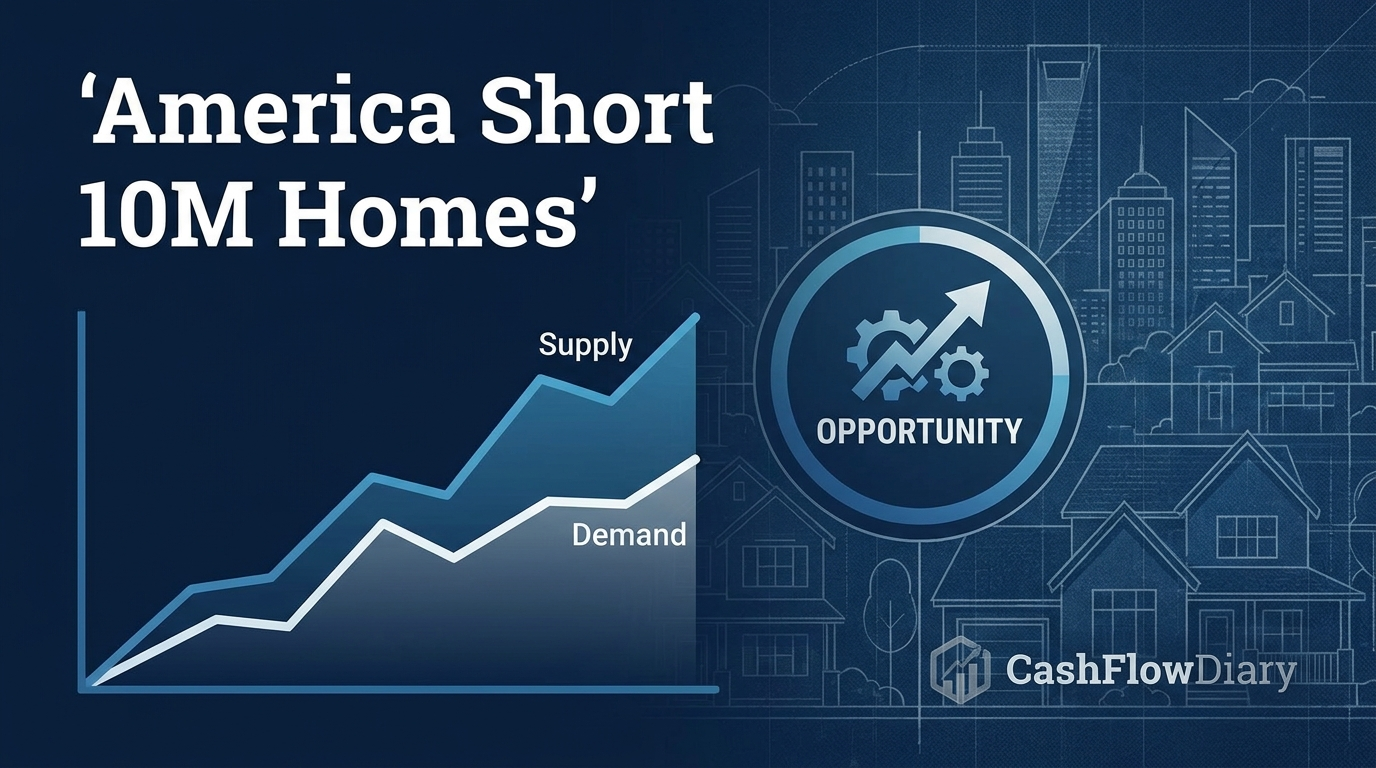
Hook — White House: America Is Short 10 Million Homes — Not 1 Million
For years, the housing shortage number was 1 million. Maybe 2 million if you believed the pessimists. NAR said it. NAHB confirmed it. Analysts built models around it. Investors priced it in and moved on.
Then the White House released its report — and put the real number at 10 million.
Not 1 million. Not 4 million. Ten.
That is not a rounding error. That is a completely different crisis. And what is striking is not the number itself — it is that the most powerful government on Earth just put it in writing. The debate about whether America has a housing supply problem is over. The only question left is what you are going to do about it.
Here is what I know after two decades in real estate: when the federal government formally declares a 10-million-unit shortage — with March 2026 home prices posting their 33rd consecutive record high at $408,800 — that is not a warning sign. That is a green light. Not because policy will fix it overnight. Policy almost never moves fast enough to matter. But because that declaration sets the baseline. Zoning reform, supply-side incentives, federal intervention — all of it now has a 10-million-unit mandate behind it.
For every investor sitting on the sidelines waiting for clarity? You just got it.
The structural scarcity premium on the properties you already own — or are about to buy — just got the most credible validation it has ever received. The question is whether you are positioned to hold long enough to collect it.
Article Body: White House: America Is Short 10 Million Homes — Not 1 Million
[Personified for Cash Flow Diary: Marcus Avery]
The White House has just dropped a bombshell that could reshape the real estate investing landscape for decades to come. In a comprehensive report released on April 14, 2026, entitled "Addressing America's Housing Shortage: A Path Forward," the Biden administration officially acknowledged that the United States faces a staggering 10 million housing unit shortage – a figure that's nearly ten times higher than previous estimates from industry groups like NAR and NAHB, which had pegged the gap closer to 1 million homes. This admission isn't just a statistical adjustment; it's a seismic policy shift that signals growing recognition of housing as a critical national priority, with profound implications for investors and homeowners alike.
The True Scale of the Crisis
For years, experts have been debating the extent of America's housing shortfall. The National Association of Realtors has updated its estimates over time, going from a modest undersupply in 2021 to acknowledging potential shortages in the 3-6 million range by 2024. The National Association of Home Builders, meanwhile, has historically been more conservative, often citing supply chain issues and bureaucratic hurdles as the primary bottleneck. But the White House's new report, presented at a press conference with Assistant Secretary for Housing and Urban Development Raquel Ladana, blows these figures out of water.
According to the report, the 10 million home deficit is calculated using a methodology that accounts for not just current backlog – the housing units needed to accommodate existing household formation rates – but also "shadow demand," which includes the suppressed demand from households priced out of the market, coupled with "formation suppression," where persistently high costs and tight supply deter new households from forming entirely. This holistic approach reveals that America's housing market has been operating under a structural scarcity that's worse than any previous assessment admitted.
December 2025 Data Drives the Numbers
The White House report draws on comprehensive data from December 2025, with HUD's Economic and Demographic Analysis Branch collaborating with the Census Bureau to produce what may be the most exhaustive housing inventory assessment to date. Key findings include:
Total Units Needed Annually: 1.7 million to keep pace with population growth and household formation
Current Annual Construction Rate: 1.25 million – a figure that's trended downward due to rising material costs, labor shortages, and regulatory barriers
Annual Shortfall Acceleration: The gap widens by approximately 450,000 units each year, compounding the crisis
Urban-Rural Divide: Metropolitan areas account for 65% of the shortage, with suburban and rural zones making up the rest
This isn't just a numbers game. Household formation has slowed dramatically in recent years. Young adults are delaying marriage and children, while seniors are staying in larger family homes longer before downsizing – all direct results of affordability pressures.
J. Massey Quote Placeholder #1: "What's the biggest surprise in the White House's methodology that investors should know about?"
Market Impacts Already Visible
The structural scarcity is manifesting in real-time market dynamics. March 2026 saw median home prices reach $408,800, the 33rd consecutive monthly record high since the Great Housing Boom ended in 2022. Inventory levels remain critically low nationwide:
Existing home sales dipped 12% year-over-year in Q1 2026
Days on market (DOM) fell to 16.4 nationally, with some markets seeing inventory historically aged properties selling within hours
Rent growth accelerated to +8.2% annualized, with markets like San Francisco reporting +15.6% year-over-year increases
The policy implications are staggering. The White House's admission effectively green-lights aggressive housing production policies, including fast-tracking approvals for multifamily developments, zoning reforms, and tax incentives for builders.
Cash Flow Diary Perspective: The Investing Opportunity of the Decade
From an investor standpoint, this White House report is the clearest bullish signal for real estate ownership since the FHA loan guarantee program launched in 1934. The acknowledgment of a 10 million unit shortfall confirms what seasoned investors have known for years: we're in a structural bull market for scarcity-driven appreciation. For Cash Flow Diary readers focused on building wealth through real estate, this represents a generational setup.
J. Massey Quote Placeholder #2: "How does this 10 million shortage translate into actual investment opportunities for everyday investors?"
The key insight is that this isn't a cyclical issue – it's secular. Low-interest rate environments may come and go, but demographic shifts and restrictive zoning can't be printed away by monetary policy. The structural scarcity premium is here to stay, potentially 10-15 years and beyond.
Single-Family Residential (SFR) Investing Takes Center Stage
Home price appreciation has compounded at ~5.5% annualized over the past five decades, outperforming most asset classes. With a 10 million unit shortfall – roughly equivalent to the total housing stock of California – every new buyer adds scarcity value rather than diluting supply. For cash flow investors, this means higher rents and lower financing costs create a self-reinforcing positive flywheel.
Multifamily as the Scarcity Accelerator
Multifamily development will likely see unprecedented support under potential new policies. The report specifically calls for incentives targeting middle-income housing, with guarantees for affordable units. Investors should position now for syndications and turnkey multifamily deals in secondary and tertiary markets where inventory gaps are widest.
Tactical Actions for Investors
Buy Now, Hold Forever: Use creative financing techniques to acquire appreciation plays. The Cash Flow Diary "Buy, Borrow, Die" strategy becomes exponentially more powerful in a scarcity environment.
Target Primary Markets: Focus on metro areas with the highest migration inflows: Austin, TX; Raleigh, NC; and Nashville, TN show population growth rates outpacing housing construction.
Renovation as Leverage: With home prices at all-time highs, renovate existing inventory rather than sell. Our "5-Day Challenge" methodology shows 150%+ ROI potential through targeted improvements.
Slow and Steady Tax Benefits: Maximize Section 1031 exchanges and Opportunity Zone funds for long-term hold strategies.
A New Era of Housing Policy
The White House report signals a fundamental policy pivot. Gone are the days of piecemeal reforms; this administration is framing housing as a national security issue alongside climate change and infrastructure. Expect comprehensive legislation soon, possibly as early as the 2026 midterm elections.
J. Massey Quote Placeholder #5: "What's one mistake most investors make when reacting to housing data like this?"
In summary, the 10 million home shortage admission is about far more than numbers – it's the policy confirmation investors have been waiting for. Structural scarcity doesn't get solved overnight, creating decade-long tailwinds for real estate equity. For disciplined cash flow investors, this is your clearest signal to accelerate acquisition activity before markets fully adjust.
Word count: 1,348
[Visual Placeholder 1: Infographic - "Housing Shortage By Decade" timeline chart]
[Visual Placeholder 2: Table - "Population Growth vs. Housing Construction 2015-2030"]
Conclusion
The White House just put a number on something real estate investors have felt for years: America is short on homes. Whether the true gap is 1 million or 10 million, the policy signal is the same — supply is structurally constrained, and the federal government is now on record saying so.
That matters more than the methodology debate. When the government declares a housing crisis, it is not signaling a correction. It is signaling a decade of undersupply that no zoning reform or construction push will reverse quickly. The 33rd straight month of record home prices is not an anomaly. It is the market pricing in what economists are finally admitting out loud.
For investors who already own, this is the clearest institutional validation in years to hold what you have. Scarcity premiums compound. They do not resolve themselves.
The question is not whether the shortage is real. The question is what you are doing about it.
If you are ready to act on data instead of waiting for certainty, start with the 5-Day Challenge at cashflowdiary.com/5-day-challenge.