Most people tell themselves they can't afford to get into real estate. They're wrong. They're just looking at the wrong first move.
House hacking is how thousands of investors — including many people who've come through CashFlowDiary — turned their very first home purchase into an income-producing asset. In the right scenario, your tenants cover your mortgage entirely. You live for free or close to it while building equity.
This guide covers exactly what house hacking is, why the math works so well, the strategies you can use, and how to get started — even if you've never bought a property before.
What Is House Hacking in Real Estate?
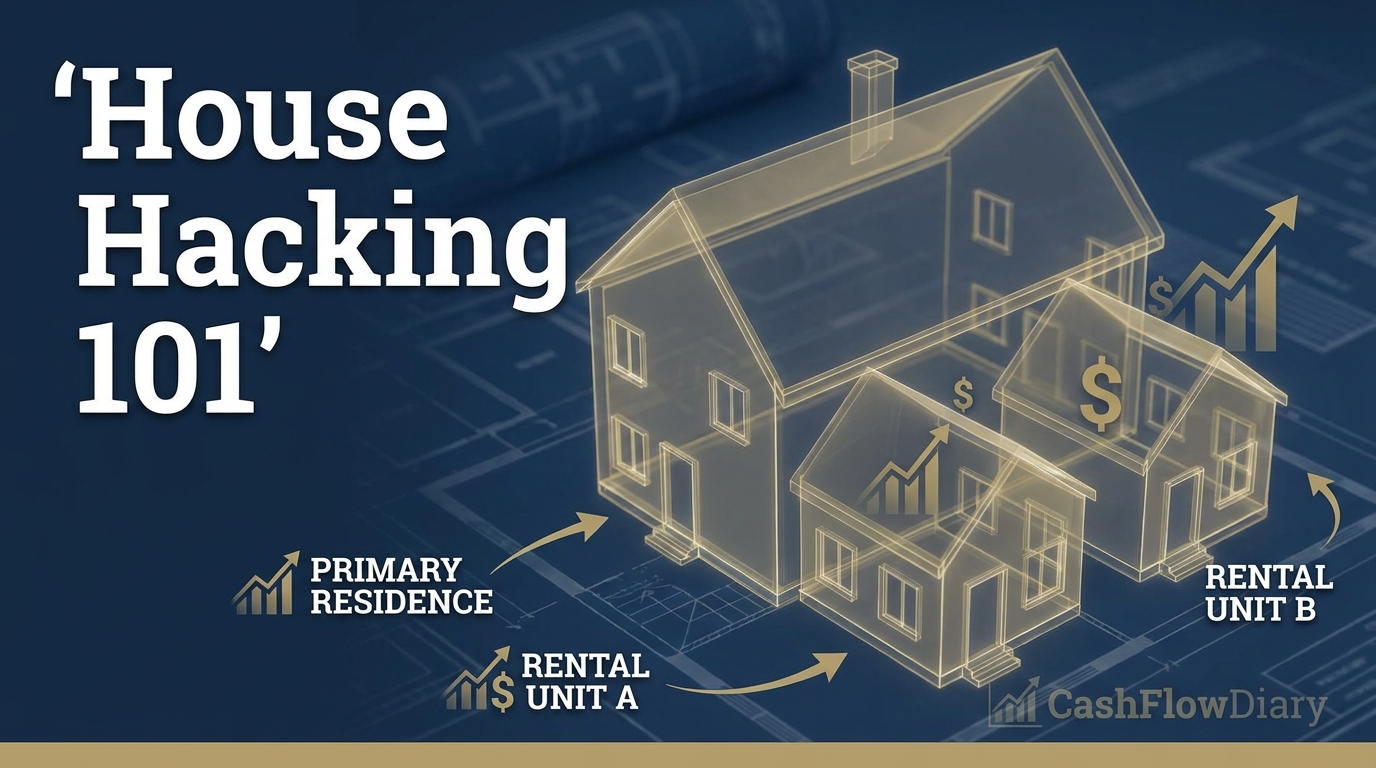
House hacking means buying a property, living in one part of it, and renting out the rest. The rental income from your tenants offsets — or completely eliminates — your mortgage payment.
The classic setup: you buy a duplex, live in one unit, and rent the other. Your tenant's rent covers most or all of your housing cost. You're now living in a property you own, at little to no cost, while that asset builds equity every month.
That's the core idea. But house hacking isn't limited to duplexes. It works with single-family homes, basement apartments, accessory dwelling units (ADUs), even spare bedrooms on short-term rental platforms.
The through-line is the same: you use the property to generate income that reduces or eliminates your housing expense.
Why House Hacking Works: The Math
Let's run through a simple example.
You buy a duplex. Your total monthly payment — mortgage, taxes, insurance — comes to $2,000. You rent the other unit for $1,100 per month. Your effective housing cost is $900. With two rentable units, you could potentially cover the full payment and pay nothing out of pocket.
Here's what makes this particularly powerful for first-time investors:
Owner-occupied financing. When you live in the property, you can access conventional loans or FHA loans — sometimes with as little as 3.5% down on a 2–4 unit property. Investment property loans typically require 20–25% down.
Equity growth. While your tenant covers your mortgage, you're building equity in an asset that appreciates over time.
Experience. Living next to your rental unit is the fastest real estate education you'll ever get. You learn property management, tenant relationships, and maintenance — without the stakes of a standalone investment.
Cash flow upside. Once you move out and rent both units, the property may generate positive cash flow on top of what it cost you nothing to live in.
Types of House Hacking Strategies
There are several ways to approach real estate house hacking, depending on your market, budget, and lifestyle.
Multi-Unit Properties (2–4 Units)
The classic house hacking strategy. Buy a duplex, triplex, or quadplex, live in one unit, and rent the rest. This is the most common approach because:
Owner-occupied financing applies (FHA, conventional)
Each additional unit adds more rental income
Separation between your space and tenants is built in
[INTERNAL LINK: house hacking duplex guide — how to buy and manage your first multi-unit property]
Single-Family Home Room Rental
You buy a single-family home with extra bedrooms and rent them out individually. This works well in college towns, cities with high rental demand, and markets where multi-unit properties are scarce or expensive.
The trade-off: less privacy, more tenant proximity, and typically higher turnover in shared-living setups.
ADU and Basement Apartment
Some single-family homes come with — or can be converted to include — an accessory dwelling unit or basement apartment. You live in the main home, rent the separate unit. More privacy than room rentals, similar math to a small multi-unit.
Short-Term Rental of Spare Space
In markets with strong tourism or business travel, renting a spare bedroom or basement unit on Airbnb or a similar platform can generate more income than long-term leasing — though with more active management required.
[INTERNAL LINK: house hacking strategies for beginners — full comparison of each approach with market-by-market considerations]
How to Get Started with House Hacking: Step by Step
Here's the practical path from where you are to your first house hack.
Step 1: Understand Your Local Rental Market
Before you look at a single property, know your rental market. What are comparable units renting for in the neighborhoods you're targeting? What's the vacancy rate? What do tenants want in your area?
This research tells you whether the math can work before you ever make an offer.
Step 2: Get Pre-Approved for Owner-Occupied Financing
Talk to a lender who understands multi-unit owner-occupied purchases. FHA loans allow 3.5% down on properties up to 4 units when you live in one of them. Conventional loans have similar owner-occupant programs with slightly different requirements.
Many lenders will count a portion of the rental income toward your qualification — which means the property's income can help you buy a bigger property than your salary alone would allow.
Step 3: Find the Right Property
You're looking for a property where the rental income from the non-owner units covers most or all of your payment. This requires discipline: don't fall in love with a property before you've run the numbers.
Screen for these factors: number of units, current rents vs. market rents, condition and deferred maintenance, location relative to tenant demand.
Step 4: Run Real Numbers Before You Buy
Calculate your total monthly payment (PITI: principal, interest, taxes, insurance). Compare that to realistic rental income — not the best-case projection, but what similar units actually rent for in that neighborhood.
If the numbers don't work, the property doesn't work. Move on.
Step 5: Set Up Systems Before Move-In
Get your leases, screening criteria, and tenant communication process in place before your first tenant moves in. It's much easier to build good habits from the start than to fix a chaotic landlord operation later.
What J. Massey Has Learned About House Hacking
I didn't start in real estate with a pile of capital and a clear plan. I started with a strategy that let the property pay for itself. That principle — make the asset cover its own costs while you're learning — is the foundation of everything I teach.
House hacking is one of the cleanest expressions of that principle. You're not speculating on appreciation. You're not hoping the market goes up. You're buying a property where the income math works on day one, and you're using it to build the skills and track record that open every door that comes next.
Your first property sets the pattern. Set it right.
[INTERNAL LINK: real estate investing for beginners — J. Massey's complete starter framework]
Common House Hacking Mistakes to Avoid
Buying based on optimistic rent projections. Use actual market comps, not what you hope tenants will pay.
Ignoring deferred maintenance. A cheap purchase price on a property with $30,000 in repairs isn't a deal.
Skipping tenant screening. Your tenant is your business partner for the duration of the lease. Screen carefully.
Not building reserves. Set aside cash for vacancies, repairs, and unexpected costs — even when the numbers look perfect.
Mixing your finances with the rental income. Keep your personal finances and rental income separate from day one.
Frequently Asked Questions
Is house hacking legal everywhere?
House hacking is legal in most places, but local zoning laws, HOA rules, and short-term rental regulations can affect what's possible. Always check zoning for multi-unit use and any HOA restrictions before buying. If you plan to use short-term rental platforms, check your city's STR regulations specifically.
What's the best property type for house hacking as a beginner?
A duplex is generally the best starting point. You get clear separation from your tenant, two distinct legal units, and owner-occupied financing. Triplexes and quadplexes offer more income potential but more management complexity. Start simple, build your systems, then scale.
Do I need to hire a property manager?
Not initially — especially when you're living in the property and can respond quickly. The experience of managing your first rental yourself is genuinely valuable. As your portfolio grows or you move out, a property manager becomes worth the cost. Budget 8–12% of monthly rent for professional management.
How does house hacking affect my taxes?
When you rent part of your primary residence, you can deduct expenses proportional to the rented portion — mortgage interest, property taxes, insurance, repairs, and depreciation. The tax benefits are significant, but consult a CPA familiar with real estate investing to make sure you're capturing them correctly.
How long do people typically house hack before moving out?
Most house hackers stay 1–3 years. After that, the property converts to a full investment, and the owner moves to the next house hack. Repeat this cycle a few times, and you've built a portfolio of properties you bought with owner-occupant financing and minimal down payment.
Ready to Get Started?
House hacking is one of the most accessible entry points into real estate investing — and one of the highest-leverage first moves you can make. You're building equity, reducing your living costs, and getting real-world education all at once.
If you want a deeper look at how to build a real estate portfolio using strategies like this — starting from where you are right now — join us at CashFlowDiary. We teach the strategies that actually work for people who don't start with unlimited capital.
[INTERNAL LINK: CashFlowDiary free training / community signup]