Getting Started
What Is Rental Arbitrage? (And How Someone With No Property Can Make $3,000/Month)
By
J. Massey
· Updated April 9, 2026 · 7 min read
Quick Answer
Rental arbitrage means renting a property long-term on a standard lease, then relisting it on Airbnb or VRBO for short-term stays. You keep the difference between what guests pay per night and what you pay per month. No property ownership required. Startup costs run $5,000–$15,000, and operators in well-selected markets typically earn 124% more than their rental costs.
I want to start with a question: what if the barrier to real estate income wasn't owning property at all?
I started in real estate from foreclosure. Zero credit. No savings. No property. What I found was a model that didn't require any of those things — and I've since watched 10,000 students use the same approach to generate real income without ever applying for a mortgage. That model is rental arbitrage.
Here's everything you need to understand it, from the basic concept to the exact steps and the real math behind it.
The Simple Version: What Rental Arbitrage Actually Means
Rental arbitrage is the practice of leasing a property at a fixed monthly rate and then renting it out nightly to short-term guests on platforms like Airbnb or VRBO. The profit is the spread — the difference between what guests pay you and what you pay the landlord.
Think of it like this: you sign a lease for $2,000 per month. You furnish the apartment and list it on Airbnb for $120 per night. At 70% occupancy (about 21 nights), you're bringing in $2,520. Your net before other expenses is $520 per month — from a property you don't own and never plan to buy.
The model is sometimes called "rent-to-rent," "Airbnb arbitrage," or "short-term rental arbitrage." They all describe the same thing: you're the operator, not the owner. The landlord keeps the property. You keep the margin.
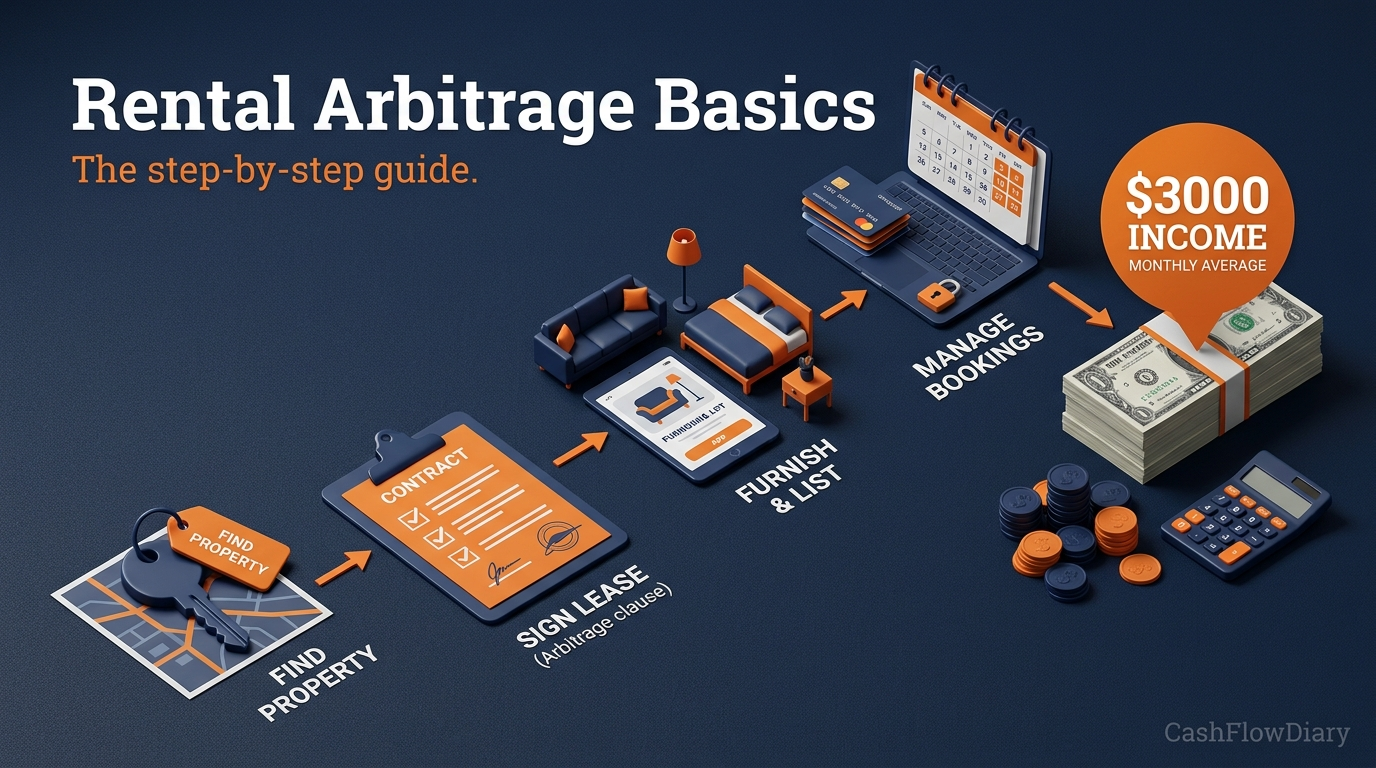
How Rental Arbitrage Actually Works (Step by Step)
Research your market Before looking at any properties, confirm that your target area has strong short-term rental demand. Use tools like AirDNA or Mashvisor to check average daily rates, occupancy rates, and what comparable listings earn. You're looking for markets where short-term revenue consistently outpaces long-term rental costs by 40% or more.
Check local laws first Many cities in 2026 require permits for short-term rentals — and some cities ban non-owner-occupied STRs entirely. New York City, Los Angeles, and San Francisco all have significant restrictions. Research your city's STR laws before you ever sign a lease. This step can eliminate a market from consideration entirely, and that's better to learn in the research phase than after signing.
Find the right property One- and two-bedroom units are the sweet spot for rental arbitrage. They're affordable to furnish, easiest for landlords to approve, and consistently achieve 60–65% occupancy rates — higher than larger or luxury properties. Look for properties near attractions, business districts, airports, or university areas. In-unit laundry, good Wi-Fi, and dedicated parking all increase bookings.
Get written permission from the landlord This is the single most important step, and also the one most beginners underestimate. Most standard leases prohibit subletting — you need the landlord to sign a sublease addendum explicitly permitting short-term rentals. Approach landlords as a professional property manager, not as a tenant. Frame it as: "I handle all guest management, your property is professionally maintained, and your rent is guaranteed every month."
Furnish and stage the space Guests care about cleanliness and comfort more than designer décor. A well-lit, well-organized space with quality basics — solid beds, clean linens, a reliable coffee maker, a smart lock — performs better than a luxury staging that's poorly maintained. Budget $4,500–$7,500 for a two-bedroom. Sourcing from IKEA and Facebook Marketplace can get this under $3,000 without sacrificing guest experience.
List, price, and launch Create your listing on Airbnb, VRBO, and Booking.com. Enable Smart Pricing and Instant Book. During the first two to three weeks, price 15–20% below comparable listings to build review velocity. Your first dozen reviews determine how the algorithm treats your listing for months afterward. That early margin sacrifice pays dividends for as long as you operate the unit.
The Math: How You Actually Make Money
Rental arbitrage profit has a simple formula: Gross Revenue minus (Rent plus Operating Expenses) equals your monthly take-home. Here's what that looks like in practice.
Real Example — 2-Bedroom Apartment
Monthly rent obligation
− $2,500
Utilities
− $300
Professional cleaning (12 turns × $50)
− $600
Software + dynamic pricing
− $80
Insurance
− $150
Miscellaneous (supplies, restocking)
− $100
────────
Total monthly expenses
$3,730
Nightly rate ($150) × 24 nights
$3,600
Nightly rate ($150) × 29 nights (75% occ)
$4,350
Monthly profit (at 75% occupancy)
$620–$3,200
The range is wide because market selection matters enormously. A $2,500/month apartment in Miami with $332 nightly rates at 65% occupancy generates $6,640 in revenue — leaving nearly $3,000 per month after all expenses. The same numbers don't apply in a low-demand market. This is why AirDNA research before you sign any lease isn't optional.
According to AirDNA data, short-term rental hosts today earn on average
124% more in revenue than their rental costs
. At the 2021 peak it was 170%. The market has normalized, but the fundamental arbitrage margin persists in well-selected locations.
Is Rental Arbitrage Legal?
Yes — with conditions. Rental arbitrage is legal when two requirements are met: your lease explicitly permits short-term subletting, and your city's regulations allow non-owner-occupied STRs. Both must be true simultaneously.
Where it gets complicated in 2026 is the regulatory landscape. Dozens of major U.S. cities have tightened STR laws significantly. New York City requires hosts to be present during guest stays, which effectively eliminates non-owner-occupied rentals. Los Angeles and San Francisco have primary residence requirements. Miami Beach has restricted units by zone. Nashville, Orlando, Scottsdale, and Gulf Shores remain among the most STR-permissive markets in the country.
The fastest way to confirm legality in any market: call or email your city's planning or licensing office directly. Do this before signing a lease, before approaching landlords, before spending a dollar. Thirty minutes of regulatory research can save you from a costly mistake.
Rental Arbitrage vs. Owning Property: What's the Real Difference?
Factor | Rental Arbitrage | Property Ownership |
|---|---|---|
Upfront capital | $5,000–$15,000 | $50,000–$150,000+ (down payment + closing) |
Mortgage / loan required | No | Usually yes |
Time to first revenue | 4–8 weeks | 2–6 months (purchase + renovation) |
Break-even timeline | 3–6 months | 12–36 months |
Scalability | Add units without capital tied in equity | Each unit requires new down payment |
Property appreciation | None — you don't own the asset | Yes — equity builds over time |
Long-term risk | Walk away with 30–60 day notice | Mortgage obligation, market value risk |
Major repairs / HVAC | Landlord's responsibility | Your responsibility |
Arbitrage wins on access and speed. Ownership wins on wealth accumulation. The smartest operators I've coached use arbitrage as the entry point — generate cash flow, build systems, prove the model — and then use profits to eventually acquire property. It's not either/or; it's a sequence.
What Rental Arbitrage Is NOT
Before you move forward, let's clear up three common misconceptions.
It is not passive income. Rental arbitrage requires active management: guest communication, cleaning coordination, pricing adjustments, maintenance oversight, and responding to problems when they arise. The more systems you build, the more passive it becomes over time — but in year one, plan to be involved.
It is not risk-free. Your rent obligation runs every month regardless of occupancy. A slow season, a bad review that tanks your ranking, or a regulatory change can all affect income. Managing these risks — with an operating reserve, proper insurance, and market diversification — is what separates operators who last from those who quit after one hard month.
It is not a get-rich-quick scheme. Real operators build this incrementally: one unit, then systems, then a second unit, then scale. Sam Zuo reached ~$200,000 per year managing nine subleases — but that happened over time, starting from a single $6,000 investment that paid itself back in 90 days.
The honest version of the opportunity:
Rental arbitrage is a legitimate, scalable business that can generate meaningful income without owning real estate. It requires real work, real compliance, and real capital — but dramatically less of all three than property ownership. That's why it exists as a real path for people who were told real estate wasn't for them.
FAQ Section
Know / Do / Track
KNOW: Rental arbitrage generates profit from the spread between a fixed monthly lease and higher nightly STR rates — no ownership required. In well-selected markets, operators earn 124% more than their rental costs (AirDNA 2026 data).
DO: Research 3 markets on AirDNA. Identify a 1–2 bedroom property with 70%+ projected occupancy and revenue at least 40% above rent. Approach the landlord with a written sublease addendum proposal before signing anything.
TRACK: Monthly net profit (revenue minus rent, utilities, cleaning, and operating costs). Target: positive margin by month 3, break-even on setup costs by month 6.
Your Next Step
Ready to start your first rental arbitrage unit? The SOAR Consulting program gives you the exact framework, market analysis tools, and direct guidance to find your first landlord, negotiate the sublease addendum, and launch your first listing. It's the same approach I used from zero capital — and that 10,000+ students have used since. The STR Blueprint is a self-paced option if you prefer to learn on your own timeline.
Frequently Asked Questions
Is rental arbitrage legal in my city?
It depends on your city. Rental arbitrage is legal when two conditions are met: your lease explicitly permits subletting, and your local government allows non-owner-occupied short-term rentals. Many cities now require STR permits. NYC, LA, and San Francisco have significant restrictions. Nashville, Orlando, and Gulf Shores remain STR-permissive. Always check local laws before signing any lease.
Do I need landlord permission for rental arbitrage?
Yes — you need written permission in the form of a signed sublease addendum. Most standard leases prohibit subletting. A verbal agreement isn't enough. No written permission means you're operating illegally regardless of what local STR laws allow. Approach landlords professionally: explain the arrangement, provide a management plan, and offer guaranteed rent in exchange for the addendum.
How much money do I need to start rental arbitrage?
Most operators start with $5,000 to $15,000, averaging $10,000. The main costs are furnishings ($4,500–$7,500), security deposit plus first month's rent ($3,000–$5,000), and an operating reserve ($2,000–$3,000). Some operators have launched for under $3,000 by sourcing used furniture and skipping professional photography initially.
Is rental arbitrage the same as subletting?
Rental arbitrage is a specific type of subletting where you rent to short-term guests on platforms like Airbnb rather than to a single long-term tenant. The key difference from standard subletting is the business model: you're capturing the spread between a fixed monthly lease cost and higher nightly guest rates across multiple stays.
Can I do rental arbitrage without owning property?
Yes — that's the entire design of the model. Rental arbitrage exists specifically for people who don't own property. You lease from a landlord, furnish the space, and host guests on Airbnb. You never need to buy real estate, qualify for a mortgage, or produce a down payment. The landlord keeps the property; you operate it and keep the margin.
Author Bio
JM
J. Massey — Founder, CashFlowDiary
J. Massey started in real estate from foreclosure with zero capital. He built a portfolio using zero-capital entry strategies — including rental arbitrage — and has since trained 10,000+ entrepreneurs at CashFlowDiary.com in the same approach.
Further Reading
Continue Learning
Rental Arbitrage Startup Costs: The Exact Numbers for 2026 →
The Complete 2025 Airbnb Arbitrage Guide: Markets, Tools + Scaling Playbook →
How to Find Landlords Who Allow Rental Arbitrage →