Picture this: You're sitting on a beach in Maui, watching the sunset paint the Pacific in gold, and your phone buzzes. It's another "urgent" guest message about checkout procedures you've explained 847 times. You handle it in sixty seconds while your family waits, then justify it as "good customer service."
Wrong.
What you just did was prove you don't own a business—you own a sophisticated job that follows you everywhere.
Recent studies show that while 57% of small business owners take vacations, 67% check work messages daily during their time off. STR operators are worse: industry research indicates most work 14-20 hours weekly during "normal" periods and up to 40 hours during peak seasons.
Here's the brutal math: If you're checking work while on vacation, you're not taking a vacation—you're working from expensive locations. That "week off" just cost you $50,000 in opportunity cost, and I'll prove it.
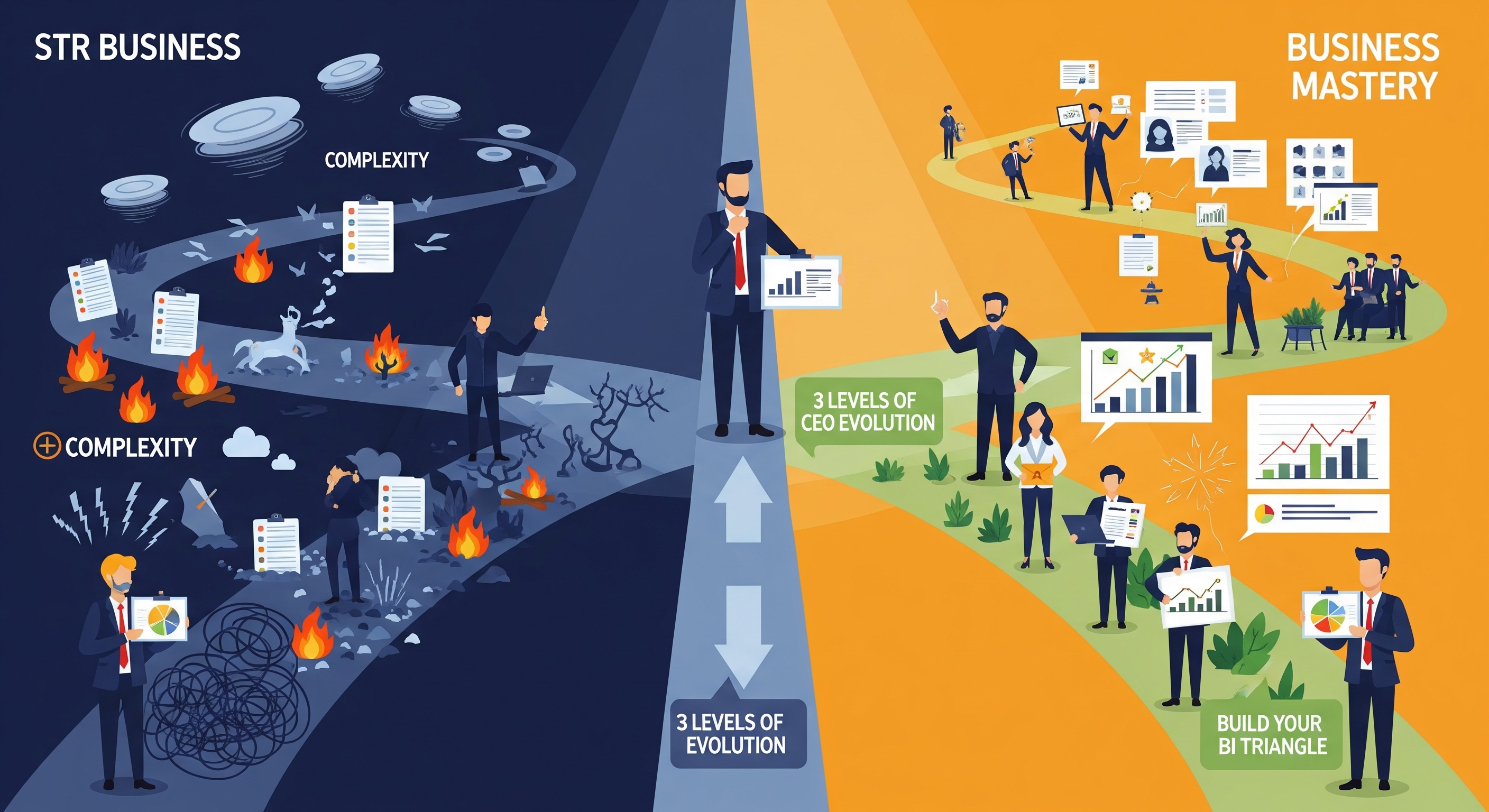
The Three Levels of CEO: From Chaos to Freedom
Most STR operators get trapped because they don't understand the evolution required to build a true business. There are three distinct levels of CEO development, and where you are determines whether you can actually take that vacation:
Level 1: Chief Everything Officer
This is where everyone starts. You're the reservation manager, customer service department, maintenance coordinator, marketing team, and financial analyst. You tell yourself this is "learning the business," but what you're really doing is building an unsustainable dependence on your personal involvement.
The smartphone becomes your electronic leash. You've digitized your job, not automated your business.
Level 2: Chief Executive Officer
This is the scaling phase where you learn delegation and team building. You start hiring cleaners, maybe a virtual assistant, possibly a property manager. You implement better software and create some standard operating procedures.
But here's the trap: You delegate tasks without delegating decision-making authority. Your team can execute, but they can't think. Every exception, every unusual situation, every "what should I do?" still routes back to you.
"The goal of delegation is not just to get things off your plate, it's to develop others and multiply your impact. Too many leaders delegate tasks but retain authority, creating a bottleneck that destroys the efficiency they were trying to create." - Michael Hyatt
Level 3: Chief Empowerment Officer
This is true business ownership. You've built people who build your business. Your team doesn't just execute your decisions—they make owner-level decisions using the frameworks and principles you've established. The business runs not because you're managing it, but because you've built a culture and system that operates independently.
This is where the six-month vacation test becomes possible.
Why Your Current 'Systems' Are Sophisticated Traps
The problem isn't that STR operators don't have systems—it's that they have the wrong kind of systems. They've built what I call "digital dependency" rather than true automation.
Research on business automation shows that 30-50% of automation projects fail because they automate processes without addressing the underlying decision-making bottlenecks. In STR, this shows up as:
Digital Delegation (Level 1 Systems):
Automated messages that still require your review
Property management software you check constantly
Cleaning crews that text you photos for approval
Guest communication that escalates to you for "special" situations
Premium Systematization (Level 2 Systems):
Standard operating procedures your team follows
Decision trees for common situations
Performance metrics and quality controls
Regular training and process improvement
But even Level 2 systems fail the vacation test because they rely on your judgment, your availability, your problem-solving ability.
The BI Triangle: Building True Business Ownership
Here's the framework that creates Level 3 operations—what is called the BI Triangle:
Mission (Clear Standards for Team Decisions): Your team needs more than task lists—they need decision-making criteria. Not "clean the property," but "maintain the standard that generates 5-star reviews and repeat bookings." Not "respond to guests," but "resolve issues using our guest satisfaction framework."
Team (Owner-Level Thinking Capability): This isn't about hiring better people—it's about building people better. Your cleaning crew should understand revenue per available room. Your virtual assistant should know profit margins by property. When your team thinks like owners, they make owner-level decisions.
"You don't build a business, you build people, then people build the business. The moment you realize that people are your most valuable asset, everything changes in how you recruit, develop, and retain talent." - Michael Hyatt
Leadership (Self-Correcting Systems): The highest level of systematization is systems that improve themselves. Quality control processes that identify their own gaps. Team feedback loops that evolve procedures. Performance metrics that trigger automatic adjustments.
Center: Autonomous Cash Flow Generation When Mission, Team, and Leadership align, you get the center of the triangle: autonomous cash flow generation. Money flows in regardless of your personal involvement because the business operates on principles, not personalities.
The $50K Opportunity Cost Calculation
Here's why vacation-checking costs you $50,000 annually:
Time Opportunity Cost: 2 hours daily checking work during "time off" = 730 hours annually. At $70/hour opportunity cost (what you could earn focusing on growth), that's $51,100.
Decision Quality Degradation:Harvard Business Review research shows that business leaders who take real vacations return with 15-20% better strategic thinking. Poor decisions compound exponentially in real estate.
Team Development Stunting: Every time you answer that "urgent" question, you rob your team of growth opportunity. You're paying for their development while preventing it from happening.
Scaling Limitation: Investors and acquisition opportunities look for owner-independence. A business that requires constant owner involvement sells for 2-3x less than autonomous operations.
The 90-Day Evolution Strategy
Here's how to transition from Chief Everything Officer to Chief Empowerment Officer:
Days 1-30: Audit Current Dependence Document every decision that routes to you. Create a "decision log" for one month. You'll be horrified by the volume and trivial nature of what you're handling personally.
Download the Decision Audit Framework here to identify exactly where you're the bottleneck.
Days 31-60: Build Decision-Making Frameworks For each recurring decision type, create criteria-based frameworks your team can apply independently. Not "ask me about pricing," but "use these profit margin guidelines to make pricing decisions."
Days 61-90: Test and Refine Autonomy Start with 48-hour communication blackouts. Then try a full week. Document what breaks, refine your frameworks, and gradually extend the periods until six months becomes achievable.
The Six-Month Vacation Test: Ultimate Business Autonomy
Can you disappear for six months and return to a more profitable, better-run business?
This isn't about actually taking six months off—it's about building a business capable of that level of autonomy. When you can pass the six-month test, you've transitioned from sophisticated job owner to genuine business owner.
The difference shows up in:
Valuation: Autonomous businesses sell for 4-6x revenue vs. 2-3x for owner-dependent operations
Lifestyle: True time freedom, not digital leash management
Growth: Teams that build the business instead of just maintaining it
Legacy: Sustainable wealth generation that doesn't require your mortality
Getting Started: Your 30-Day Action Plan
Week 1: Complete the decision audit. Track every decision that comes to you.
Week 2: Identify the top 10 recurring decisions. Start building criteria-based frameworks for these.
Week 3: Begin testing 24-hour communication blackouts. Train your team to solve problems using the frameworks.
Week 4: Plan your first real 72-hour vacation test. No checking work, no "emergency" access.
Get the complete 90-day implementation guide and framework templates here to accelerate your evolution from operator to owner.
The brutal truth: If you can't take a real vacation, you don't own a business—you've just digitized a job and convinced yourself otherwise.
Your properties should generate wealth while you sleep, not anxiety while you vacation.
The choice is yours: Keep playing business owner while remaining a sophisticated employee, or build the systems that create true business ownership.
Access the full Business Independence Strategy Session here to discover your specific path from where you are now to complete operational autonomy.
The six-month vacation test is waiting. The question is: Are you ready to build a business that passes it?
J. Massey