Invest Where Your Life Already Goes: The College-Town Housing Thesis
College towns offer predictable STR demand vacation markets lack — enrollment events, athletics schedules, family visits. How to evaluate one before you buy, and the family event that turned Eugene, Oregon into my next acquisition target.
By J. MasseyJune 11, 2026· 11 min read
Share
Disclosure: This post may contain affiliate links. If you purchase through our links, we may earn a commission at no extra cost to you. We only recommend tools and services J. Massey's team actually uses.
Learn more →
Table of Contents
TL;DR: College towns offer predictable short-term rental demand that vacation markets lack. Enrollment-driven events, athletics schedules, and family visits create year-round booking calendars. Before buying, verify enrollment trends, STR regulations, event density, and dorm capacity gaps. Your life events often reveal the best markets to invest in.
Core Answer:
College towns provide calendar-driven demand (move-in, parents' weekends, athletics, graduation) instead of seasonal vacation patterns
Enrollment stays stable during recessions, making these markets more durable than traditional STR locations
Check STR regulations first because many college towns restrict or ban non-owner-occupied rentals
Calculate the gap between total enrollment and dorm capacity to find your addressable rental market
Top athletics programs add recruiting visits, championships, and alumni travel on top of academic calendars
I've spent 15+ years in this space, trained more than 10,000 operators through CashFlowDiary, and recorded 237+ podcast episodes breaking down the deals that work and the ones that don't. The pattern below shows up in every cycle.
Interactive · score your market
How risky are this market's STR rules?
1. Are new STR permits currently being issued?
2. Is owner-occupancy required to operate?
3. Do residential zones allow non-owner-occupied STRs?
4. How has enforcement trended in the last 24 months?
What Is the "Invest Where Your Life Goes" Strategy?
My daughter is a championship discus thrower. She set a state record this spring. One of the top high school marks in the country. This fall she heads to a top-tier track program on scholarship.
Move-in is late September. Somewhere between booking the first parents' visit and pricing out flights to a city I had never thought twice about, a familiar voice in my head got loud.
I'm about to spend the next four years frequenting a place I have never invested in.
That's the exact moment my investing filter kicks in: invest where your life already goes.
This article covers what that filter looks like in practice, why college towns reward it, and how to evaluate one without getting burned by regulatory landmines.
Why Investing Where Your Life Goes Works
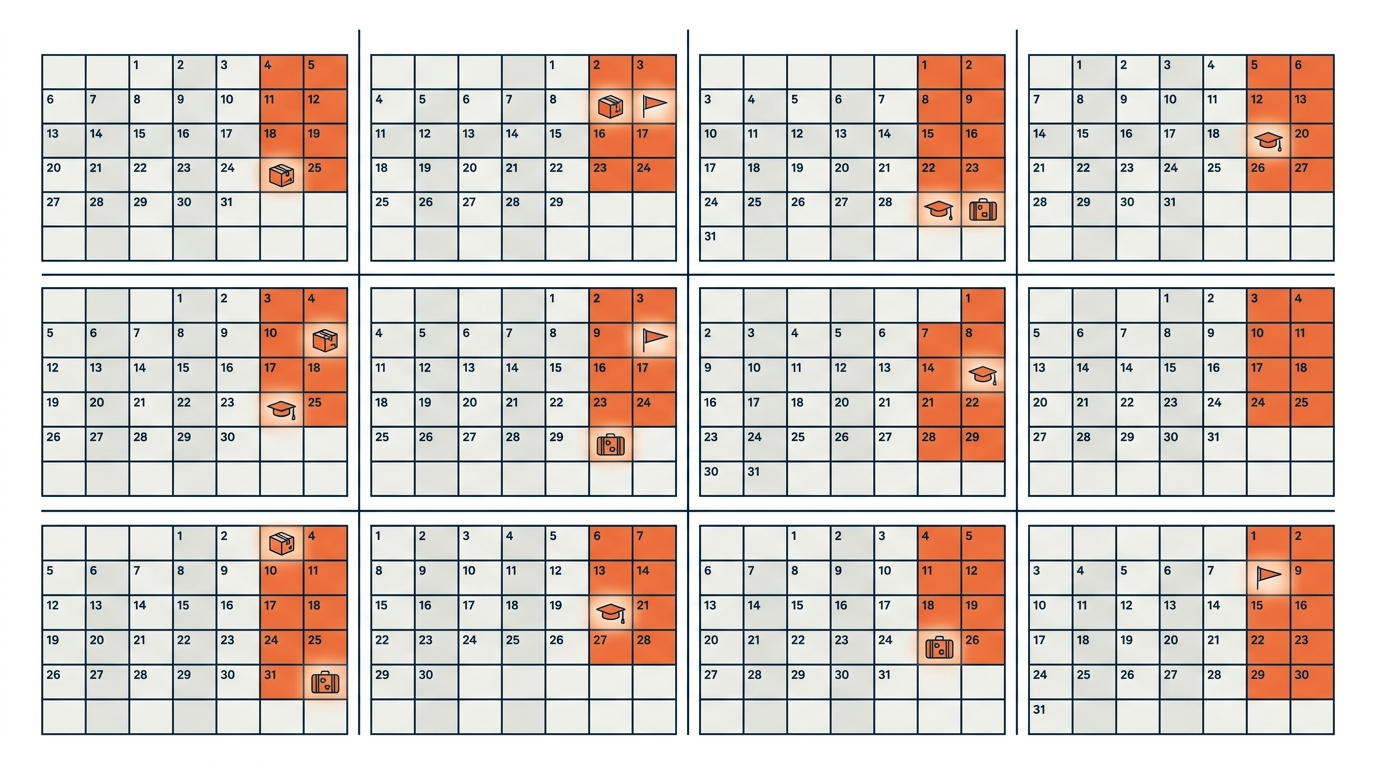
A college town runs on a calendar, not a season
The cheapest market research on earth is the research you were already going to do for free.
When your life puts you in a city repeatedly, you get four things most out-of-state investors pay for or never get:
You see neighborhoods at different times of year
You meet the locals who run things
You feel traffic patterns, parking realities, and which areas look fine on Zillow but feel off in person
You get natural oversight on any property because you're already showing up
"The cheapest market research on earth is the research you were already going to do for free."
— J. Massey · CashFlowDiary
Out-of-state investing fails when the operator guesses about a place they visit twice a year.
When your kid, your parents, your work, or your sport puts you in a market eight or ten times annually, the calculus inverts. The trip is happening regardless. The question becomes whether the trip pays for itself.
That's the filter.
Bottom line: Free market research beats paid research when your life naturally puts you in a location repeatedly.
What Makes College Towns Durable Rental Markets?
College towns have something most short-term rental markets don't: built-in demand that doesn't care about weather or the economy.
Vacation markets live and die by season. A beach town empties in November. A ski town empties in May. Operators spend half the year underwriting losses against the months that print.
The calendar fills itself. The dates are published years in advance.
Three Structural Advantages
1. Enrollment is recession-resistant
When the economy turns, application volume historically rises, not falls. People go back to school when jobs get scarce.
2. Dorm capacity rarely matches enrollment
Most universities house a fraction of their student body on campus. The rest spills into the surrounding rental market every August and stays there.
3. Short-stay supply is chronically thin
A town built around a 20,000-student university typically has a few hundred hotel rooms. On a home football weekend, that math breaks immediately.
The result is a market where occupancy is driven by calendar events, not discretionary travel spend.
That's a different animal than a vacation rental, and it underwrites differently.
Key point: Calendar-driven demand with published dates years in advance creates predictable revenue patterns vacation markets lack.
How Athletics Programs Stack Additional Demand
Off-season vacation market vs. game-day college town — two different demand engines
Some college towns have a sports program. Others have a sports identity.
The difference matters because a town built around a nationally-ranked athletics venue stacks demand on top of the standard college calendar in a way most markets don't replicate.
The standard college demand stack: move-in, parents' weekend, homecoming, graduation.
Add a top-flight athletics program and you also get:
Meets or games that draw competitors and families from every state
Recruiting visits for prospective athletes and their parents
Football or basketball weekends that fill a stadium
Alumni events tied to a program with deep donor engagement
Out-of-town coaches and officials who need housing closer than a chain hotel forty minutes from the venue
That's the demand to underwrite against.
Not "people who want to visit the city."
Specific guest profiles with specific reasons to come, specific dates, and specific willingness to pay for proximity to the venue or campus.
Key point: Top athletics programs add 15 to 25 high-ADR weekends annually on top of standard academic calendars.
How to Evaluate a College Town Before You Buy
The thesis is only as good as the diligence.
Before any college-town acquisition gets serious, four checks have to clear.
Step 1: Check Enrollment Trend and Dorm Capacity
Pull the last ten years of enrollment numbers from the university's institutional research page. Flat or growing is the bar.
Then compare total enrollment to on-campus housing capacity.
The gap between those two numbers is your addressable rental market.
If the university is building dorms aggressively, that gap is closing. If enrollment is rising and dorm construction is flat, the gap is widening in your favor.
Count the weekends where average daily rate (ADR) realistically clears two to three times the baseline.
If you have fewer than fifteen of those weekends a year, the thesis softens.
A town with a major athletics program layered onto the academic calendar typically runs well above that.
Step 3: Verify Short-Term Rental Regulations
This is where most college-town deals die. Most investors find out after closing.
A growing number of college towns have moved to restrict STRs aggressively. Outright bans in residential zones. Primary-residence requirements. Permit caps that are already maxed out.
Check the city's municipal code, the county code, and any HOA or neighborhood association rules.
Call the planning department before you write an offer.
Some markets allow STRs with a permit. Some allow them only if the owner lives on site. Some have grandfathered existing permits and stopped issuing new ones.
The wrong answer here turns a thesis into a long-term rental at half the projected income.
Step 4: Explore the Thirty-Day Rule
Many college markets that restrict STRs still allow mid-term rentals of thirty days or more.
Visiting professors. Families relocating. Traveling nurses at the local hospital. Parents who fly in for a month around graduation.
If the STR rules are tight, the mid-term play works, but the underwriting changes. You're pricing monthly, not nightly, and the guest profile shifts.
Key point: Regulatory diligence kills more college-town deals than bad numbers. Check permit availability before you write an offer.
College-Town STR vs Vacation-Market STR: Key Differences
15-25 high-ADR weekends, published years in advance
These are not the same business. Underwriting them the same way is how operators get hurt.
Demand Shape
Vacation markets: weather-driven and seasonal, with a sharp peak and a long off-season.
College-town markets: calendar-driven and event-stacked, with predictable high-ADR weekends spread across the academic year.
Guest Profile
Vacation guests: discretionary travelers buying an experience.
College-town guests: visiting families, recruits, alumni, parents, and out-of-town professionals attending a specific event.
Their booking lead times are longer. Their cancellation rates are lower. Their tolerance for higher rates around fixed dates is better.
Regulatory Exposure
Vacation markets: increasingly restrictive but the rules tend to be well-known and stable.
College-town rules: evolving fast and vary block by block. The diligence burden is higher and the rules change after you close.
Durability Across Cycles
Vacation demand contracts in recessions. College enrollment historically doesn't.
That alone reshapes a ten-year hold model.
Revenue Mix
Vacation rentals: chase ADR with moderate occupancy.
College-town rentals: lower average occupancy across the year, with a smaller number of very high-ADR weekends doing most of the heavy lifting.
The annual revenue pencils out the same way and arrives through a completely different door.
Neither is better in the abstract. They're different businesses. The operator who treats them the same way will mismodel one of them.
Key point: College-town STRs win on event-stacked calendars and recession-resistant enrollment, not year-round occupancy.
When to Act on This Strategy
Most real estate deals don't announce themselves. They hide inside life events that were going to happen anyway.
A kid going to college is one of those events.
So is a parent moving into assisted care. A job that pulls you to a new city twice a quarter. A sport that takes you to the same regional venue every spring.
The trip is happening. The market research is happening.
The question is whether you're paying attention to what your own life is telling you.
I didn't pick this market. My daughter did, with a discus and a college decision.
My job is to notice that, run the diligence and decide whether there's a deal hiding inside the next four years of plane tickets.
That's the work.
Frequently Asked Questions
Are college towns good for short-term rental investing?
The strong ones are. Look for stable or growing enrollment, a sizable gap between total students and on-campus housing capacity, a dense event calendar, and a regulatory environment that permits short-term or mid-term rentals. Athletics-heavy programs add another demand layer most college markets don't have.
How do I find out if a college town allows Airbnb and other short-term rentals?
Start with the city's municipal code and zoning ordinance, then check county rules and any HOA or neighborhood covenants. Call the planning department directly before you write an offer. Ask about permit availability, primary-residence requirements, and whether the city has paused new licenses. Get the answer in writing if you prefer. The rules in college markets are changing fast, and what was legal last year won't be legal this year in some cities.
What drives rental demand in a college town?
Five things, in roughly this order: move-in and move-out weeks, parents' and family weekends, athletic events, graduation, and summer programs or conferences. Towns with a national-caliber athletics program stack additional demand from recruiting visits, alumni travel, and championship events. The more of these layers a market has, the more weekends you have at premium ADR.
What is the biggest risk in college-town STR investing?
Regulatory restrictions. Many college towns have banned or heavily restricted short-term rentals in recent years. Some require the owner to live on-site. Some have capped the number of permits and stopped issuing new ones. You need to verify local rules before closing.
How does recession risk compare between college towns and vacation markets?
College enrollment historically rises during recessions because people return to school when jobs are scarce. Vacation travel drops when discretionary spending contracts. That makes college-town demand more recession-resistant than traditional vacation STR markets.
What's the ideal gap between enrollment and dorm capacity?
The larger the gap, the stronger your addressable market. If a university has 20,000 students and houses 6,000 on campus, you have 14,000 students looking for off-campus housing. Check whether the university is building more dorms, because that shrinks your market over time.
Do college-town rentals work as mid-term rentals if STRs are banned?
Yes, in many cases. Visiting professors, relocating families, traveling healthcare workers, and parents staying for extended periods around graduations or medical events all need month-long stays. The underwriting shifts from nightly to monthly rates, but the thesis holds if mid-term rentals are allowed.
How many high-ADR weekends do you need for a college town to work?
Fifteen or more weekends per year where ADR hits two to three times your baseline rate. Towns with major athletics programs layered onto academic calendars typically clear that threshold easily.
Key Takeaways
College towns offer predictable, calendar-driven demand tied to enrollment events, not seasonal travel patterns.
Enrollment is recession-resistant because application volume rises when jobs get scarce, making these markets more durable than vacation STRs.
The gap between total enrollment and on-campus housing capacity defines your addressable rental market. Track dorm construction trends before buying.
Regulatory restrictions kill more college-town deals than bad numbers. Verify STR permit availability, primary-residence requirements, and zoning rules before you write an offer.
Top athletics programs stack 15 to 25 additional high-ADR weekends annually on top of standard academic calendars through recruiting, championships, and alumni events.
College-town STRs succeed through event-stacked calendars with lower overall occupancy but higher peak rates, not year-round moderate occupancy like vacation rentals.
Invest where your life already goes. Life events (kids in college, aging parents, work travel) provide free market research and natural property oversight most investors pay for or never get.
If a life event is about to put you in a new market repeatedly, the trip is already happening. The question is whether there's a deal hiding inside it.
If that sounds like your next twelve months, book a strategy call and we'll figure out whether there's a deal in it.
Earnings & Income Disclaimer: West Egg Enterprises, Inc. / CashFlowDiary does not guarantee any specific income, profit, or financial results from information on this site. Individual results vary based on effort, experience, market conditions, and other factors outside our control. Past performance does not guarantee future results. Nothing on this site constitutes financial, legal, or tax advice.