Single Point of Failure — Why Regulation Isn't the Problem
The ordinance didn't break your business. It ran the audit you kept postponing. The operators who survive aren't lucky — they built redundancy before they needed it.
Disclosure: This post may contain affiliate links. If you purchase through our links, we may earn a commission at no extra cost to you. We only recommend tools and services J. Massey's team actually uses.
Learn more →
The ordinance didn't break your business.
It ran the audit you kept postponing.
I've spent 15+ years in this space, trained more than 10,000 operators through CashFlowDiary, and recorded 237+ podcast episodes breaking down the deals that work and the ones that don't. The pattern below shows up in every cycle.
I've watched this play out twice now. First with COVID. Now with the regulatory wave hitting markets from Barcelona to New York to every mid-sized city where a city council member just discovered Airbnb exists.
The pattern is the same. Operators panic. Blame the rules. Threaten to exit the market. Then a smaller group quietly adjusts and keeps operating.
The difference between those two groups isn't luck. It's architecture.
Interactive · risk diagnostic
Is your STR a single point of failure?
Your exposure
Check what's true for you
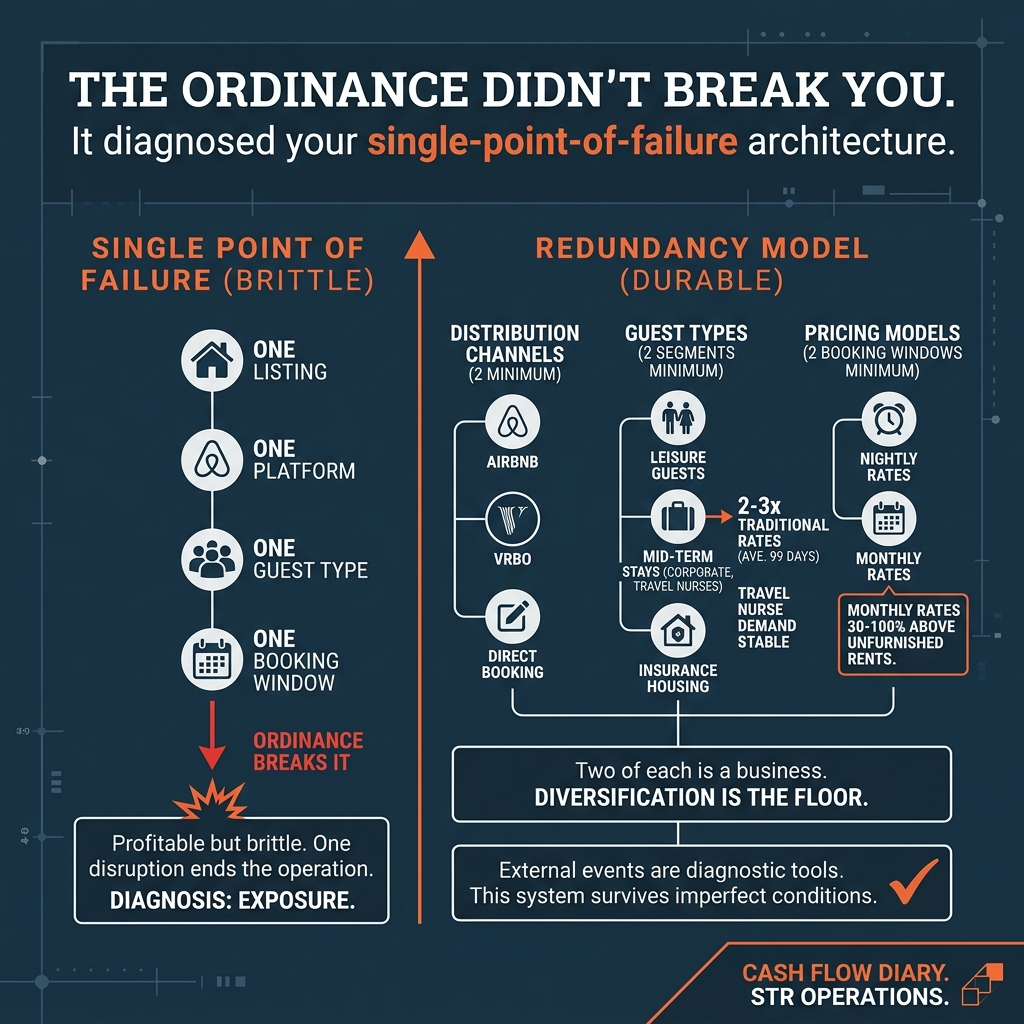
Real redundancy carries diversification in three places at minimum.
In the military there's a phrase that applies directly to STR operations: one is none, two is done.
A single point of failure is brittle by design. No redundancy. No backup system. The day it breaks, the whole operation breaks with it.
Most operators I consult with are running single-point-of-failure businesses without knowing it. One platform. One guest type. One pricing model. One city.
That's not a business. That's a listing with good margins and no floor underneath it.
When COVID shut down travel in March 2020, operators who relied exclusively on vacation guests from out of state went dark in 72 hours. The calendar emptied. The revenue stopped. No amount of hustle fixed it because the model had no alternate delivery method.
The operators who survived didn't out-work the shutdown. They had already built other ways to fill the calendar. Mid-term stays. Traveling nurses. Insurance housing. Corporate relocations.
They switched who they served and kept the lights on.
Regulation Is a Diagnostic Tool
Two parallel high-voltage power lines symbolizing operational redundancy
The current regulatory environment is running the same stress test COVID ran. Different trigger. Same exposed wiring.
The operators panicking right now didn't get unlucky. They built brittle.
Regulation doesn't create fragility. It reveals what was already there.
"Regulation doesn't create fragility. It reveals what was already there."
— J. Massey · CashFlowDiary
If your entire operation rests on Airbnb traffic, short-stay leisure guests, and one city's permissive zoning, the ordinance didn't break you. It diagnosed you.
The distinction matters. A diagnosis tells you what's actually wrong. Most operators think they have a regulation problem. What they actually have is a single-point-of-failure problem that regulation exposed.
Fix the diagnosis and the next regulatory change doesn't end the operation. It becomes a variable you adjust for.
Profitability Doesn't Equal Durability
Here's what I tell every operator in the first consulting call: profitable and durable are not the same word.
A listing can print $4,000 a month for 18 straight months and still be one ordinance away from zero. Margins don't equal a floor. Diversification does.
The math is simple. If 80% of your revenue comes from one platform and one guest type, you don't have a business. You have exposure dressed up as a revenue stream.
I've run this audit with operators across 12 markets. The pattern repeats. Pull the last 90 days of bookings. If more than 70% came from a single channel serving a single guest type, the next disruption takes you out.
Platform dependency is structural risk most operators don't see until it's too late. When an operator depends almost entirely on a single OTA, they're exposed to risks that stay invisible until a disruption occurs. Platform policy changes can alter cancellation terms, payment timelines, or listing requirements overnight. Algorithm updates can cut inquiries in half without operators being able to audit or influence the proprietary systems.
According to Expedia Group research, 80% of travelers visit an OTA at some point before making a travel purchase even if they book elsewhere. Single-channel operators miss the majority of potential guests by design.
The Airbnb 2025 policy changes created a double challenge for smaller, Airbnb-only operators who now must simultaneously learn guest screening procedures they've never needed before while also diversifying their booking channels to reduce platform dependence. That's a steep learning curve where they're implementing new operational processes across multiple platforms at the same time.
What Redundancy Actually Looks Like
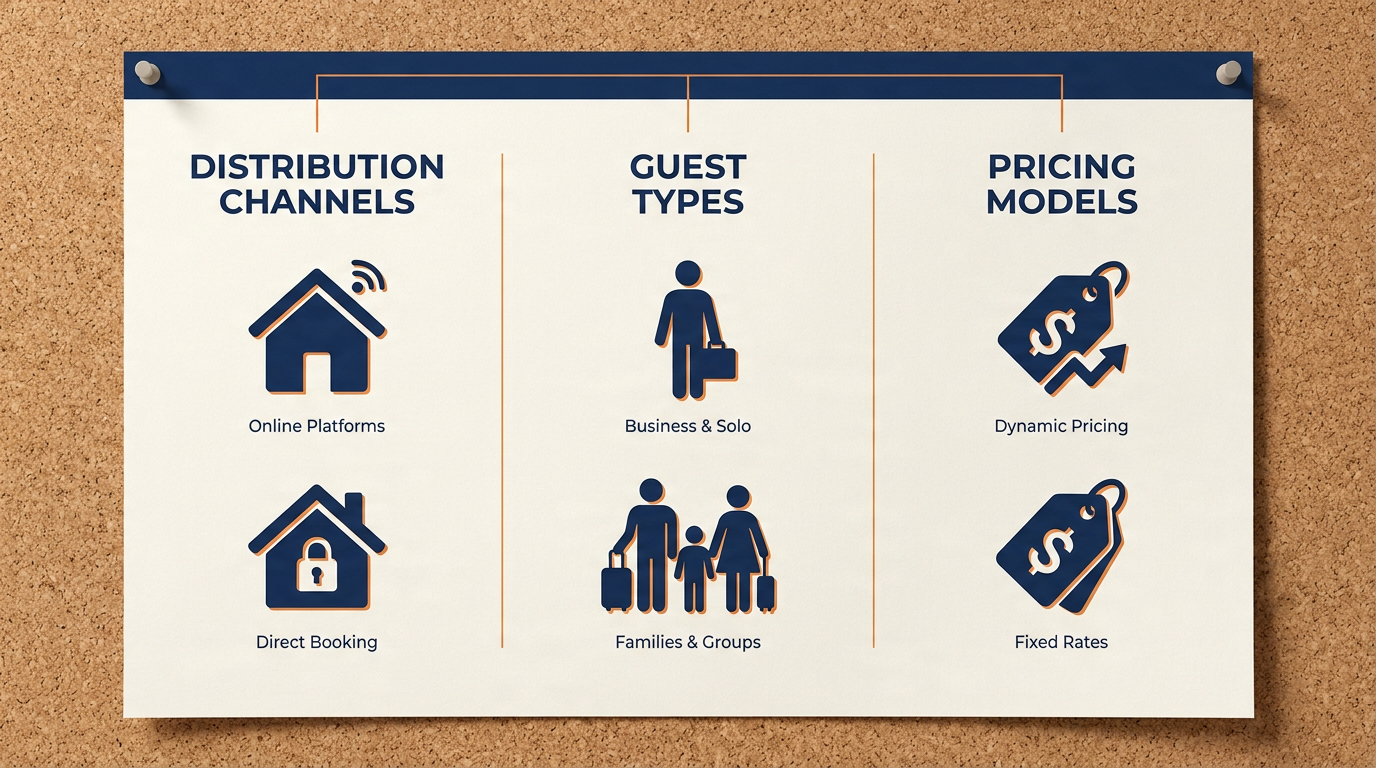
A real STR business carries redundancy in three places at minimum:
1. Distribution channels
Two platforms minimum. Airbnb plus Vrbo. Airbnb plus direct booking site. Airbnb plus corporate housing network.
If one channel goes dark Friday, Saturday still books. The calendar doesn't depend on a single algorithm or a single platform's policy team.
Direct booking infrastructure matters more than most operators think. You own the relationship. You control the terms. You keep the full revenue. When the platform changes the rules, your direct pipeline keeps running.
2. Guest types
Two guest segments minimum. Leisure and mid-term. Leisure and insurance housing. Leisure and traveling nurses.
When the city kills stays under 30 days, you already have the 30-plus play running. When leisure travel drops during a recession, corporate housing demand stays stable.
Corporate housing generates 2-3x traditional rental rates with average stays of 99 days per guest. The global corporate housing market is valued at $12 billion and projected to grow at a 6.5% CAGR from 2026 to 2029.
A recent client whose property operated under a hybrid STR/MTR structure hit $136,732 in annual revenue, compared to a $98,800 projection under an STR-only strategy. That's a 38% revenue premium driven almost entirely by filling off-peak calendar gaps with corporate and insurance relocation tenants.
The travel nurse industry grew dramatically during COVID-19, reaching over six times its 2019 market size by 2022. As of 2025, roughly 1.7 million traveling nurses work across the U.S., creating consistent demand for mid-term housing that operators can access when leisure travel falters.
Mid-term rentals saw a 25% year-over-year increase in longer stays coming out of the COVID-19 pandemic. Operators exploring mixed-use strategies including renting to traveling nurses, digital nomads, and corporate relocations stabilize cash flow during market corrections.
3. Pricing models
Two booking windows minimum. Nightly and monthly. So when the rules change, the P&L doesn't.
Monthly rates for corporate housing are typically 30-100% above standard unfurnished rents. The corporate tenant base brings reliable payment, low damage risk, and predictable demand cycles.
Diversified revenue models generate premium returns while single-strategy operators compete on margin compression.
The COVID Precedent
When COVID-19 brought global travel to a standstill, short-term rentals experienced one of their strongest surges in demand as hotels shut down. But the operators who survived the subsequent market correction had already built redundancy into their operations through multiple guest types and distribution channels.
Many businesses and homeowners that relied heavily on the short-term rental market during COVID had to pivot quickly to survive. Companies like Airbnb rapidly changed their approach to offer long-term monthly rentals as vacation travel collapsed.
The pandemic created an unsustainable surge in STR demand. The current slowdown is part of a natural market correction where operators must be smarter, more strategic, and more adaptable than during the boom years. Many are pivoting to long-term or mid-term rentals to stabilize cash flow.
Here's what that taught me: external events are diagnostic tools. That's all they ever were.
COVID didn't create brittle operations. It exposed them. Regulation doesn't create fragility. It reveals what was already sitting there.
The operators who panicked during COVID and the operators panicking now are running the same architecture. One input. One output. One path to revenue.
The day that path gets blocked, the operation stops.
Market Maturation, Not Market Death
Brittle single platform vs durable three-platform stack comparison
The short-term rental market isn't disappearing. It's evolving.
Demand remains healthy in top destinations as operators who were better marketers than operators exit the market. Professional operators who built redundancy are thriving.
For operators, regulation is tightening but demand is healthy. In the EU, Eurostat recorded 678.6 million guest-nights booked through major platforms in 2023 with double-digit growth continuing into 2024. In the U.S., AirDNA reported a new record in July 2025 with 3.9% year-over-year growth and 26.4 million nights stayed.
The lesson is clear: compliance is the path to durable growth.
These patterns reflect market behavior within regulated environments, not just the impact of the rules themselves. Macroeconomic conditions, shifting travel patterns, and local dynamics remain powerful drivers of performance. Market-level visibility is essential for operators.
Professional operators with diversified portfolios may actually benefit from increased regulation. They already maintain presence across multiple platforms and have long implemented comprehensive guest screening and risk management procedures for VRBO, Booking.com, and direct bookings — platforms that never offered the same perceived protection as Airbnb.
As of July 2025, there were 1.77 million short-term rental listings in the U.S., with 89% being whole-home listings according to AirDNA. That represents about 1.2% of the country's housing stock. The operators facing existential risk are those who built single-channel, single-guest-type models rather than architectural resilience.
The Audit You Should Run This Week
Sit down. Pull your last 12 months of revenue. Answer three questions:
What percentage came from a single platform?
If it's more than 70%, you have platform risk. Build the second channel now. Direct booking site. Corporate housing network. Second OTA. Pick one and start the build.
What percentage came from a single guest type?
If it's more than 70%, you have guest-type risk. Identify the second segment your property can serve. Mid-term stays. Traveling professionals. Insurance housing. Corporate relocations. Set up the intake process this quarter.
What percentage came from a single pricing model?
If it's more than 70%, you have strategy risk. Add the monthly booking option. Test the hybrid model. Build the flexibility before you need it.
One of each is a hobby with good months. Two of each is a business.
The operators sleeping fine this week aren't lucky. They built two of everything back when it cost them margin to do it. That cost was the insurance premium.
Fighting the Wrong Battle
I'm not saying don't engage with local regulation. I'm saying don't stop there.
Fighting the ordinance is fighting the symptom. Your single-point-of-failure architecture is the disease.
Win the regulatory fight tomorrow and the next disruption still takes you out. Different cage. Same lock.
The operators who survive long-term aren't the ones who win every regulatory battle. They're the ones who build businesses that don't depend on winning.
Redundancy isn't about pessimism. It's about math. The probability that one channel stays open forever is low. The probability that two channels both close at the same time is lower. The probability that three channels serving three guest types all disappear simultaneously approaches zero.
That's the floor you're building.
What to Build Next
Three-column STR redundancy framework
If this audit revealed a single point of failure, here's the sequence:
Week one: Pick the second distribution channel. Set up the listing. Get it live.
Week two: Identify the second guest type your property can serve. Research the intake process. Build the initial funnel.
Week three: Add the monthly pricing option. Update your booking settings. Test the hybrid model with one property.
Week four: Run the audit again. Measure the percentage shift. Adjust.
Geographic diversification strategies help reduce risk from local market downturns, regulatory changes, or seasonal demand variations. Operators should consider building portfolios across different markets with complementary seasonal patterns, diverse economic bases, and varying regulatory environments to create more stable overall income.
This isn't about building a perfect system. It's about building a system that survives imperfect conditions.
The ordinance is coming. The platform policy will change. The algorithm will shift. The next pandemic will hit.
The operators who built redundancy before they needed it will adjust and keep operating. The ones who didn't will panic and blame the disruption.
Same pattern. Different trigger. Same outcome.
Build the redundancy now. That's the only fight worth running.
Common Questions About STR Redundancy
Why are STR operators panicking in the current regulatory wave?
They built single-point-of-failure businesses without knowing it. One platform, one guest type, one pricing model, one city. When regulation hits or platform policy changes, there's no backup to absorb the disruption. The panic is the symptom; the architecture is the disease.
What does single-point-of-failure architecture look like in a short-term rental business?
A listing that gets 80% or more of bookings from a single platform serving a single guest type at a single price point. That's not a business — it's exposure dressed up as a revenue stream. The next disruption takes it out.
How does redundancy protect against STR regulation and platform changes?
Real redundancy carries diversification in three places at minimum: two or more distribution channels (Airbnb plus Vrbo plus direct booking), two or more guest types (leisure plus mid-term or corporate housing), and two or more pricing models (nightly plus monthly). When one closes, the others keep operating.
What's the difference between a profitable STR and a durable STR business?
A listing can print $4,000 a month for 18 straight months and still be one ordinance away from zero. Margins don't equal a floor. Diversification does. Profitable means good margins; durable means margins survive disruption.
How long does it take to build STR redundancy?
Four weeks following a structured sequence: week one pick the second distribution channel and get it live, week two identify and set up intake for a second guest type, week three add the monthly pricing option and test the hybrid model, week four re-audit and measure the shift. Build redundancy before you need it — that cost is the insurance premium.
Why do regulations expose STR business weakness rather than create it?
Regulation doesn't create fragility — it reveals what was already there. Operators who built brittle, single-channel models with no redundancy weren't unlucky when the ordinance hit. They built brittle. Fix the underlying single-point-of-failure architecture and the next regulatory change becomes a variable you adjust for, not an existential threat.
Build Your Redundancy Roadmap
Most operators don't realize they're running single-point-of-failure businesses until a disruption forces the audit. If you want to map your own exposure before the next ordinance, platform policy change, or market correction does it for you, book a strategy call.
We'll walk through your last 12 months of revenue, identify which of the three redundancy categories you're shortest on, and build the first concrete step toward a durable operation.
Earnings & Income Disclaimer: West Egg Enterprises, Inc. / CashFlowDiary does not guarantee any specific income, profit, or financial results from information on this site. Individual results vary based on effort, experience, market conditions, and other factors outside our control. Past performance does not guarantee future results. Nothing on this site constitutes financial, legal, or tax advice.