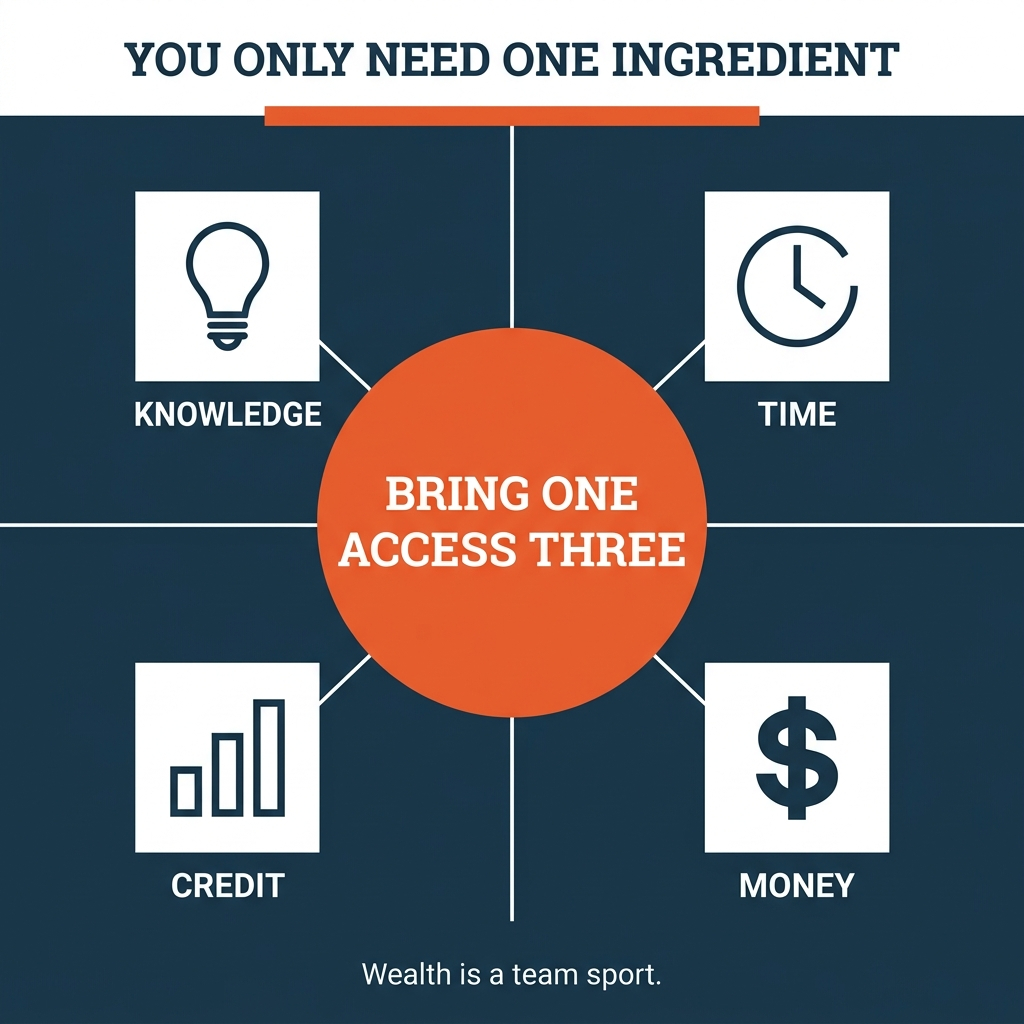
Real estate needs four ingredients — knowledge, time, money, and credit. You only need one in sufficient quantity. “No money or credit” isn’t a wall; it’s a different entry point.
Disclosure: This post may contain affiliate links. If you purchase through our links, we may earn a commission at no extra cost to you. We only recommend tools and services J. Massey's team actually uses.
Learn more →
TL;DR: Real estate needs four ingredients: knowledge, time, money, and credit. You only need one in sufficient quantity. The rest come through partnerships and leverage. "No money or credit" isn't a wall. It's a different entry point.
Core Answer:
I've spent 15+ years in this space, trained more than 10,000 operators through CashFlowDiary, and recorded 237+ podcast episodes breaking down the deals that work and the ones that don't. The pattern below shows up in every cycle.
Every real estate deal requires knowledge, time, money, and credit to close.
You only need to bring one ingredient in sufficient quantity.
The other three come through strategic partnerships and leverage.
"No money or credit" is a contributing factor, not a determining factor.
Your entry path changes based on which ingredient you have.
Interactive · run your own numbers
When does an arbitrage unit pay you back?
$2,200
$180
70%
$10,000
Monthly profit
$1,330
after lease + ~25% opex
Months to recoup setup
7.5
then it's pure cash flow
First profit lands in
Month 2
Compare that to 18+ months for new-build ownership.
This line ends the real estate conversation before the first property gets sourced.
It sounds like a fact. It feels like a wall. Operators treat it as the determining factor.
It's not.
Real estate requires four ingredients: knowledge, time, money, and credit.
Operators stop at "I don't have money and credit" and close the book. They ignore the two ingredients sitting right in front of them: knowledge and time.
The frame that changes the game: you only need to bring one ingredient to the table.
The rest comes through leverage.
Bottom Line: Money and credit aren't gates. They're ingredients you access by bringing what you have in sufficient quantity.
What Real Estate Needs to Close
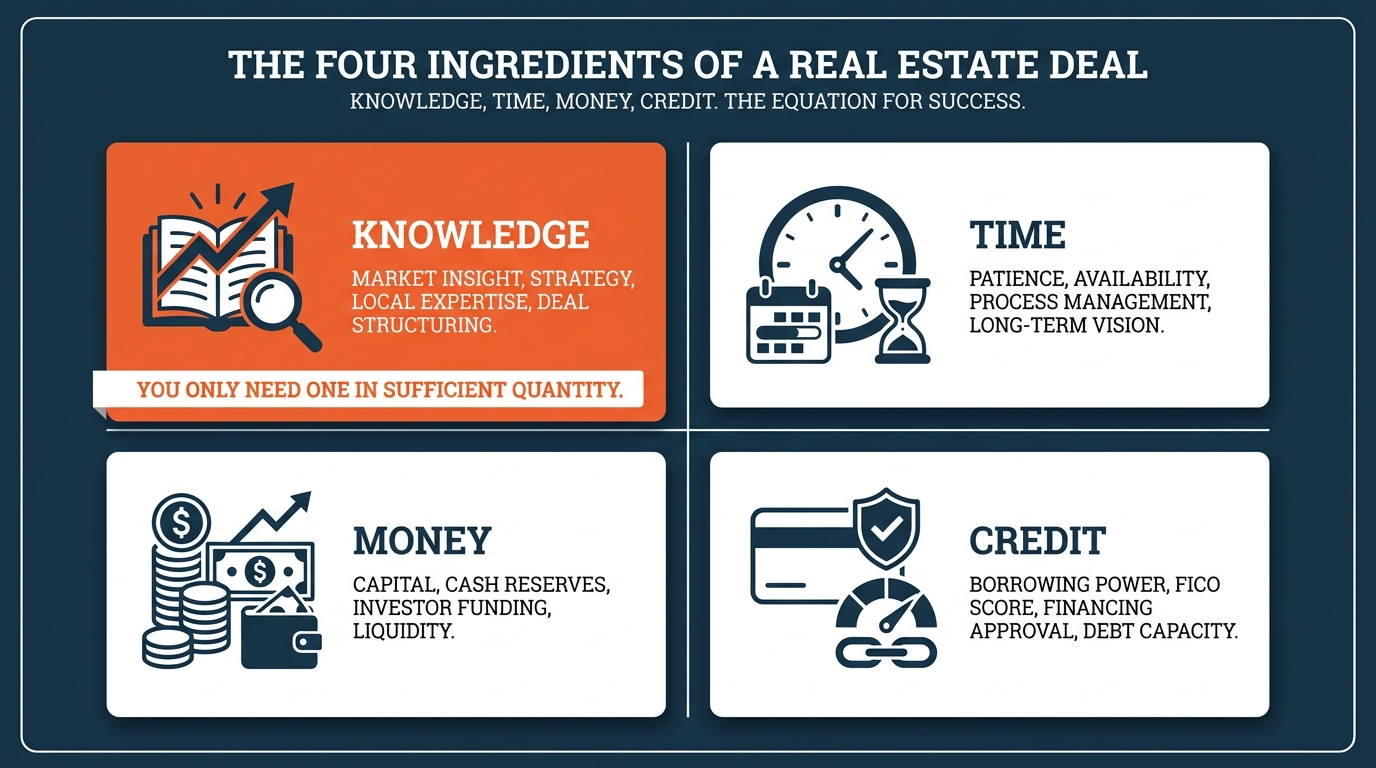
The four ingredients of a real estate deal — knowledge, time, money, credit, with knowledge highlighted
Every real estate transaction needs the same four components. Rental arbitrage, wholesale deal, property purchase, partnership structure — all four ingredients show up.
Knowledge. You know how to find deals, structure offers, run properties, or deploy systems for cash flow.
Time. You have hours to source, analyze, execute, and manage operations.
Money. Capital for down payments, earnest deposits, operating reserves, or deal funding.
Credit. Access to financing, loan approval, or the ability to sign on debt.
All four have to be present for the deal to close.
"“No money or credit” isn’t a wall. It’s a different entry point."
— J. Massey · CashFlowDiary
They don't all have to come from you.
If you have knowledge and time in sufficient quantity, you use those two to access someone else's money and credit.
The inverse works too. Excess capital sitting idle? You use your money to access someone else's knowledge and time.
Wealth is a team sport. The four ingredients don't all come from you. They all have to be present.
What This Means: Stop trying to acquire all four ingredients solo. Start structuring deals where each party brings what they have.
How Each Ingredient Opens the Door
If you have knowledge: Structure deals for capital partners. Consult for operators who need systems. Wholesale properties to buyers with money but no deal flow.
If you have time: Run operations for owners who want cash flow without the day-to-day. Manage rental arbitrage agreements. Execute on someone else's capital while learning the skillset.
If you have money: Fund deals sourced by operators with knowledge. Invest in turnkey properties managed by people with time. Bankroll someone's first rental arbitrage deal in exchange for equity or a revenue split.
If you have credit: Sign on financing for deals structured by partners with knowledge. Co-sign for operators with time but no loan access. Use your credit score to access capital you don't personally hold.
The math is clear. Bring one ingredient in sufficient quantity. Access the other three through partnerships.
Operational Reality: Your entry point depends on which ingredient you bring. The door opens the same way.
Contributing Factor vs. Determining Factor
Operators complain about contributing factors and treat them as determining factors.
A contributing factor makes the path harder. A determining factor makes the path impossible.
"I don't have money or credit" is a contributing factor. It changes your entry point. It doesn't close the door.
The determining factor: do you have one ingredient in sufficient quantity? If you have no knowledge, no time, no money, and no credit, the door is closed.
But if you have knowledge and time? The door is open. You enter through a different frame.
Rental arbitrage doesn't need money or credit. It needs knowledge of how to structure a master lease and time to manage the property. You bring those two. The landlord brings the asset. The guests bring the revenue.
Wholesaling doesn't need money or credit. It needs knowledge of how to find deals and time to work the pipeline. You bring those two. The buyer brings the capital.
Consulting doesn't need money or credit. It needs knowledge of systems and time to deploy them for clients. You bring those two. The client brings the revenue and the properties.
The sequence changes. The entry point shifts. The equation still works.
The Pattern: Different ingredient, different path. Same destination.
How to Use What You Have
A heavy locked door — the false belief that no money or credit closes the door
Most education skips this part: you access the missing ingredients by having what you have in sufficient quantity.
Sufficient quantity doesn't mean world-class. It means enough to create value for someone who has what you're missing.
You know how to find off-market rental properties. You have 20 hours a week to work the pipeline. A capital partner who wants cash flow but no time to source deals will fund your first property for equity or a revenue split.
You know how to automate guest communication and pricing systems. You have time to deploy those systems for other operators. An operator with three properties and no systems will pay you to fix what's broken.
You have $50K sitting in a savings account earning 0.5%. An operator with knowledge and time but no capital will structure a deal where your money funds the down payment and you split the cash flow.
The ingredient you bring doesn't have to be rare. It has to be valuable to someone who's missing it.
The Test: Does what you have solve a problem for someone who has what you need?
Why Solo Operators Stall
The belief that stops operators isn't "I don't have what I need." It's "I have to acquire everything myself."
You don't.
Real estate at scale is a team sport. The operators who build portfolios producing six figures in annual cash flow aren't running solo. They're accessing missing ingredients by partnering with people who have them.
The operator with knowledge and time partners with the investor who has capital.
The investor with capital partners with the property manager who has time and systems.
The wholesaler with deal flow partners with the rehabber who has credit and construction knowledge.
Every operator I've worked with over the last 15 years has figured out the same thing: you don't need all four ingredients. You need one and the willingness to structure a deal where the others show up.
Proof Point: The six-figure portfolios I've seen built all started with one ingredient and a partnership structure.
Where to Start
An open doorway with the four ingredients connected — partnerships and leverage open a different entry point
The question to answer first:
Which of the four ingredients do you have right now?
Not which one you wish you had. Not which one sounds easiest. Which one do you have in sufficient quantity to create value for someone else?
You have knowledge if: you've run properties, closed deals, deployed systems, or studied operations long enough to diagnose what's broken and prescribe what fixes it.
You have time if: you've got 10 to 20 hours a week to source, analyze, execute, or manage without collapsing your current income or family obligations.
You have money if: you've got capital sitting idle for a down payment, earnest deposit, or operating reserve.
You have credit if: your score is high enough to qualify for financing, or you're willing to co-sign on a deal structured by someone with knowledge.
Pick one. Then ask:
Who has what I'm missing, and what deal structure gives them a reason to bring it to the table?
Your entry point isn't "how do I get all four ingredients." That's the trap. The entry point: I have one, I need three, and I'm going to structure a deal where the value I create is worth more than the ingredients I'm accessing.
Next Move: Identify your one ingredient. Find someone who has what you're missing. Structure the split.
What Changes When You Stop Waiting
When you stop treating "I don't have money or credit" as a determining factor and start treating it as a contributing factor, the path opens.
You're not stuck. You're entering through a different door.
Rental arbitrage instead of property ownership. Wholesaling instead of rehabbing. Consulting instead of portfolio building. Revenue share partnerships instead of solo operations.
The sequence shifts. The timeline adjusts. The outcome stays the same: cash flow decoupled from labor.
The operators who build real businesses don't wait for all four ingredients. They start with one and partner their way to the rest.
Key Takeaways
Real estate needs four ingredients: knowledge, time, money, and credit. You only need one in sufficient quantity.
"No money or credit" is a contributing factor, not a determining factor. It changes your entry path.
Sufficient quantity means enough to create value for someone who has what you're missing.
Wealth building is a team sport. Access missing ingredients through partnerships.
Your first move: identify which ingredient you have, find who has the rest, structure the deal.
Different ingredient means different path. Same destination: cash flow decoupled from labor.
Frequently Asked Questions
Do I need money to start in real estate?
No. You need one of four ingredients: knowledge, time, money, or credit. If you have knowledge and time, you access money through partnerships. Rental arbitrage and wholesaling both require zero capital to start.
What does "sufficient quantity" mean for each ingredient?
Knowledge: You've run properties, closed deals, or studied operations enough to diagnose and prescribe solutions. Time: 10 to 20 hours per week without collapsing your income. Money: Enough capital for a down payment or operating reserve. Credit: A score high enough to qualify for financing.
How do I find partners who have what I'm missing?
Start where operators gather: local real estate investor groups, STR operator forums, wholesaling networks. Lead with what you bring. Structure the value split before the first deal.
What's the difference between rental arbitrage and property ownership?
Rental arbitrage means you lease a property and sublease it short-term. You need knowledge and time, not money or credit. Property ownership requires capital or credit for purchase. Different paths, same cash flow outcome.
Is wholesaling legal without a real estate license?
Yes, in most states. You're assigning a contract, not selling property. Check your state's regulations. The ingredient you bring is knowledge of deal sourcing and time to work the pipeline.
How long does it take to build cash flow with one ingredient?
Timeline depends on which ingredient and which path. Rental arbitrage: 30 to 60 days from lease signing to first guest revenue. Wholesaling: 60 to 90 days to close your first assignment. Consulting: first payment within 30 days of deploying systems.
What if I don't have any of the four ingredients right now?
Then the door is closed until you acquire one. Start with knowledge or time because those don't require capital. Study operations, shadow operators, or offer to manage someone's property for free to learn the systems.
Do partnerships always work, or do they fall apart?
Partnerships work when the value split is clear and the ingredient each party brings is tested upfront. They fall apart when expectations aren't documented or one party stops bringing their ingredient. Structure the deal in writing before the first dollar moves.
Earnings & Income Disclaimer: West Egg Enterprises, Inc. / CashFlowDiary does not guarantee any specific income, profit, or financial results from information on this site. Individual results vary based on effort, experience, market conditions, and other factors outside our control. Past performance does not guarantee future results. Nothing on this site constitutes financial, legal, or tax advice.