STR profitability collapsed 66% since 2021. The amateur era ended. Professional operators with systems, compliance, and tax knowledge survive — everyone else exits.
Disclosure: This post may contain affiliate links. If you purchase through our links, we may earn a commission at no extra cost to you. We only recommend tools and services J. Massey's team actually uses.
Learn more →
TL;DR: STR profitability collapsed 66% since 2021 due to oversupply and rising costs. NYC's STR ban backfired, raising rents and hotel prices instead of improving affordability. 100% bonus depreciation returned in 2025, creating a tax window for operators who act fast. The amateur era ended. Professional operators with systems, compliance, and tax knowledge survive. Everyone else exits.
The Bottom Line
STR margins compressed 66% from 2021 to 2025 as supply rose 25% and costs climbed 35-45%
41% of hosts earned less in 2025 than 2024, and 22% plan to exit
NYC's STR ban raised rents past $4,000/month and hotel rates to $524/night without improving housing affordability
100% bonus depreciation returned in 2025, allowing $150,000+ first-year deductions on $500,000 properties
Operators with systems, compliance, and cost segregation studies survive. Operators without them exit.
Interactive · risk diagnostic
Is your STR a single point of failure?
Your exposure
Check what's true for you
Real redundancy carries diversification in three places at minimum.
I've been running STR operations since before the gold rush started. I watched the amateur era unfold in real time.
I've spent 15+ years in this space, trained more than 10,000 operators through CashFlowDiary, and recorded 237+ podcast episodes breaking down the deals that work and the ones that don't. The pattern below shows up in every cycle.
The math that worked in 2021 doesn't work in 2025. That's not opinion. That's the data talking.
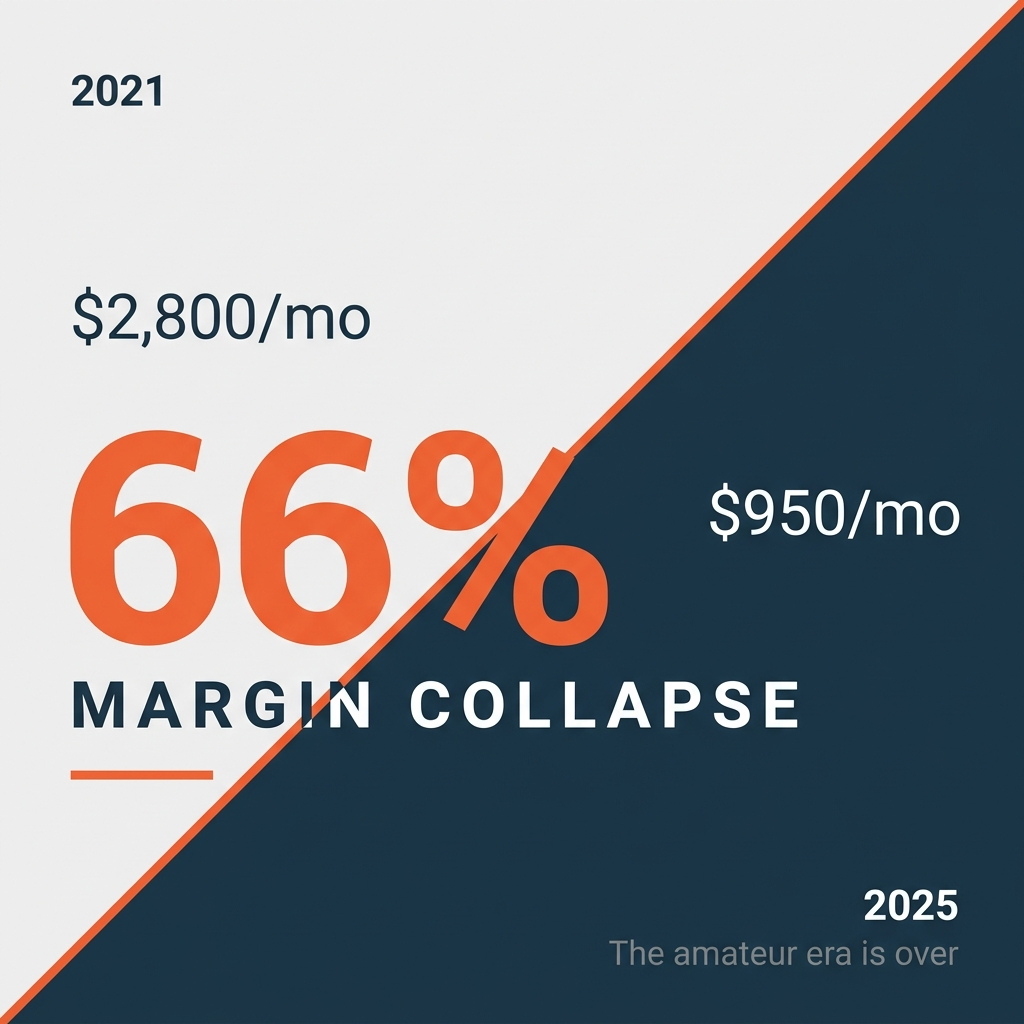
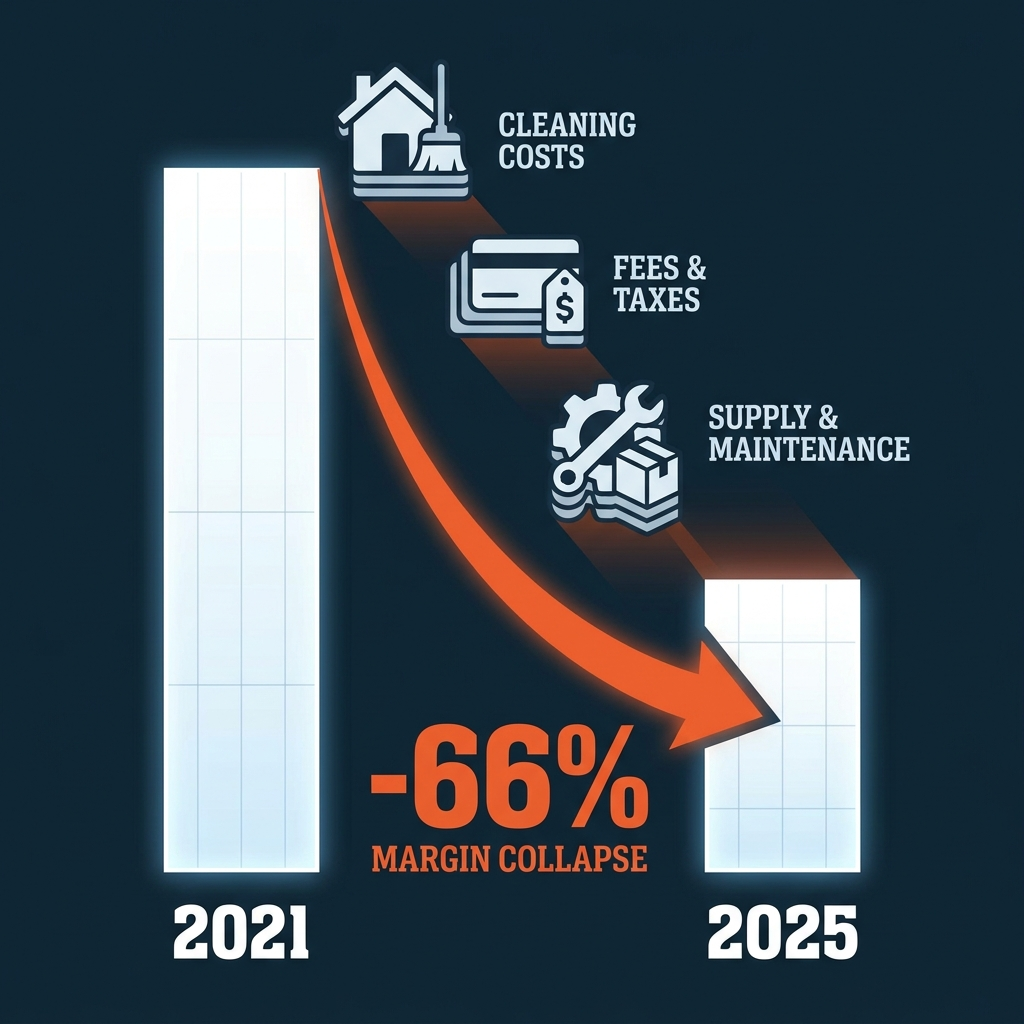
Nearly one in four STR owners reported no profit or losses in 2024. The same Nashville property that generated $2,800 in monthly profit in 2021 produces $950 in 2025. That's a 66% margin collapse.
Supply increased 25% globally. Operating costs climbed 35-45% across the board. Nightly rates stayed flat or declined. The squeeze is real.
41% of hosts made less in 2025 than they did in 2024. 22% plan to exit entirely.
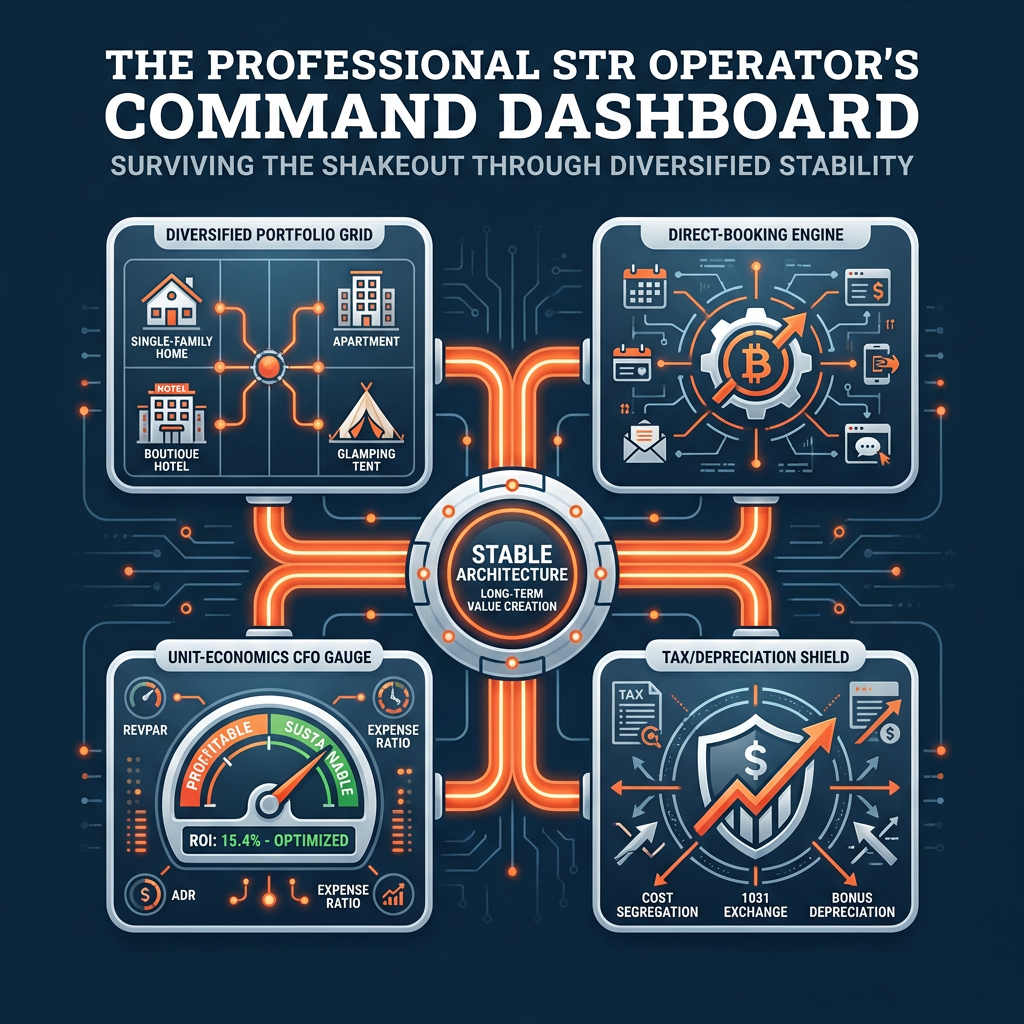
The operators who survive this compression aren't the ones who work harder. They're the ones running diversified portfolios, direct booking engines, and tracking unit economics like a CFO.
The amateur era ended. The professional era started.
Three data points prove it. Margins compressed for operators without systems. Regulatory bans backfired in ways cities didn't predict. And the tax architecture right now favors operators who know how to use it.
What's Driving the Margin Collapse
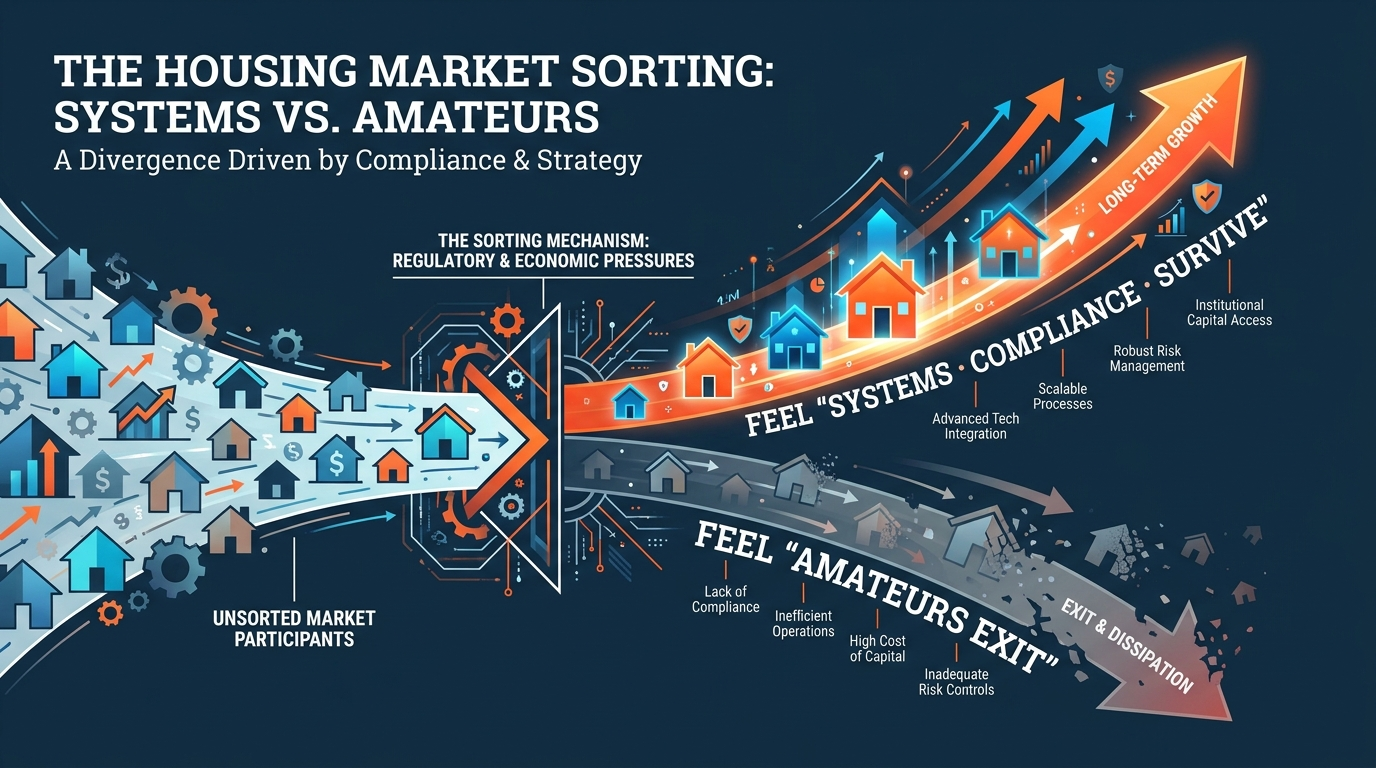
Houses sorted into a surviving professional lane and an exiting amateur lane
When I sit down with operators in the first consulting call, most of them think they have a pricing problem or a marketing problem.
They don't. They have a unit economics problem.
Cleaning costs for 1-bedroom vacation rentals surged 25.08% since Q1 2021. 2-bedroom rentals climbed 24.71%. 3-bedroom rentals rose 19.67%.
Operating expenses for STRs now consume roughly 50% of revenue. Long-term rentals run at 35%.
The adjusted paid occupancy rate from January through August 2024 was 47%. That's down from 50% in 2023 and 54% in 2022.
North America's hosts earned 6% less on average in 2024 compared to 2023.
76% of respondents in Hostaway's survey reported heightened competition in 2024. 55% of STR operators cite market saturation as a major challenge.
"The amateur era ended. The professional era rewards systems, data, compliance, and tax architecture — everyone else exits."
— J. Massey · CashFlowDiary
Roughly one in four hosts has stopped renting at least one property in the past year.
This isn't a dip. It's a reset.
The operators still standing adapted. They're using dynamic pricing. They're driving incremental revenue through upsells, add-ons, and fees. Property managers in declining markets like Atlanta grew revenue by generating up to $147 per listing per month in extra income through upsells alone.
They're not working harder. They're running different systems.
The market is maturing with smarter supply: more listings in underserved destinations, sharper design decisions, and stronger operator tech stacks. The hosts seeing the strongest profitability today treat their properties like a business. They track statistics. They adjust to shifting occupancy rates. They adapt their offering to evolving guest expectations.
Key Point: The margin collapse is structural, not cyclical. Operators who track unit economics like a CFO and deploy revenue-generating systems survive the compression. Operators who treat this as a temporary dip exit.
Why NYC's STR Ban Backfired
New York City banned short-term rentals to solve housing affordability.
The result: rents and home prices skyrocketed by double digits.
For the first time on record, the median rent across all of Manhattan surpassed $4,000 per month. That's a 4.1% increase since the law took effect.
Hotel Average Daily Rate rose by 6% from May 2023 to May 2024. New York City reached a record-high ADR of $524, an over 50% year-over-year increase.
Rents rose faster in areas that previously had higher concentrations of Airbnb listings before LL18 took effect. Citywide vacancy rates remained unchanged at 1.9%.
The law succeeded in reducing Airbnb listings. Availability dropped over 90% between the time of enactment and early 2025.
Housing affordability did not improve.
The outer boroughs face $1.6 billion less in projected visitor spending, over 15,700 fewer jobs, and $573 million less in worker earnings.
The average hotel prices in New York rose 7.4% in 12 months, compared with only 2.1% nationally.
The biggest winners from STR bans aren't residents. They're hotel chains and hotel unions.
Big hotel chains have been the primary supporters and defenders of the restrictions found in LL18. Their real motivations: limiting competition and consolidating the market.
Before New York City's stringent short-term rental law took effect, Airbnb listings made up less than 1% of the city's total housing supply. The causal link between STRs and housing unaffordability was overstated.
Cities considering similar bans should study NYC's outcome closely.
Operators who stay compliant and registered typically get grandfathered in when new rules hit. The operators who ignored registration requirements got wiped out. The operators who ran legitimate, compliant operations are still operating.
The regulatory environment is tightening. The operators who treat compliance as a core system survive. The operators who treat it as an afterthought exit.
Key Point: NYC's STR ban raised rents to $4,000+ and hotel rates to $524 without improving housing affordability. The primary beneficiaries were hotel chains, not residents. Compliant, registered operators survived. Non-compliant operators got wiped out.
How the Tax Window Works Right Now
Shrinking bar chart showing 66% STR margin collapse 2021 to 2025
100% bonus depreciation is back in 2025.
The One Big Beautiful Bill Act, signed into law on July 4, 2025, permanently restored 100% bonus depreciation for qualifying property acquired after January 19, 2025.
Qualifying STR properties generate first-year deductions exceeding $150,000 on a $500,000 investment.
R.E. Cost Seg typically identifies 25-30% of a short-term rental's basis as five, seven, or fifteen-year property. A properly executed cost segregation study identifies this portion as eligible for immediate write-off.
An investor purchasing a $600,000 property with a cost segregation study identifying 30% ($180,000) as short-life assets deducts the full $180,000 in year one, offsetting W-2 income.
The operating losses of short-term rentals are deducted against other sources of income, including that from your primary employment, unlike long-term rentals.
The short-term rental loophole is built directly into the U.S. tax code under IRC Section 469. The IRS recognizes that rental activities with average stays of seven days or less qualify as non-passive when the owner materially participates.
Full expensing is temporarily reinstated for qualifying property placed in service after January 19, 2025, and before 2031. Taxpayers deduct the entire cost of eligible assets with a useful life of 20 years or less in the first year.
Long-term rental investors don't have access to these same benefits. Only commercial and multifamily properties get comparable treatment.
In buyer's markets like Austin, creative financing stacks on top of the tax advantage. Seller financing at 4.5% with 10% down changes the cash flow equation entirely.
This window may not stay open beyond 2025.
Bonus depreciation benefit had declined to 40% in 2025 under the old phasedown schedule. The restoration to 100% is significant. The operators who understand how to deploy cost segregation studies are reducing taxable income to near zero while generating positive cash flow.
The operators who don't know this exists leave six figures on the table.
Key Point: 100% bonus depreciation returned in 2025, allowing operators to deduct $150,000+ in year one on a $500,000 property through cost segregation. This benefit is exclusive to STRs and commercial properties. Long-term rentals don't qualify. Operators who deploy this reduce taxable income to near zero while maintaining positive cash flow.
Who Survives and Who Exits
Professional operator command dashboard with diversified systems
The operators exiting the market right now aren't failing because they didn't work hard enough.
They're exiting because they ran the wrong systems in the wrong sequence.
They bought properties before they understood unit economics. They scaled before they automated. They ignored compliance until the rules tightened. They didn't track the three numbers that matter: occupancy, ADR, and review score.
The operators still standing built systems first. They automated guest comms. They deployed dynamic pricing. They tracked unit economics like a CFO. They stayed compliant. They used cost segregation studies to reduce tax liability.
They didn't out-hustle the competition. They out-system the competition.
The STR industry isn't dying. It's sorting.
The amateur era rewarded anyone who listed a property and answered messages. The professional era rewards operators who build systems, track data, stay compliant, and understand the tax architecture.
The margins compressed. The regulatory environment tightened. The tax window opened.
The operators who adapt survive. The operators who don't exit.
Key Point: Operators exit because they ran the wrong systems in the wrong sequence, not because they didn't work hard. Operators survive by building systems first, automating operations, tracking unit economics, staying compliant, and deploying cost segregation studies.
What to Do Next
Pull your unit economics for every property. Calculate occupancy, ADR, and operating expense ratio. If any property is running below 50% occupancy or above 50% operating expense ratio, diagnose the structural cause. Fix the system or exit the property.
If you're acquiring in 2025, talk to a tax advisor about cost segregation studies before you close. The deduction window is open. Use it.
If you're in a city considering STR bans, get compliant now. Registration, licensing, insurance. The operators who wait get wiped out. The operators who move first get grandfathered in.
The sorting is happening. Make sure you're on the right side of it.
Common Questions About the STR Market in 2025
Why are STR profits down 66% since 2021?
Supply increased 25% globally while operating costs climbed 35-45%. Occupancy rates dropped from 54% in 2022 to 47% in 2024. Nightly rates stayed flat or declined. The combination compressed margins for operators without diversified portfolios or dynamic pricing systems.
Did NYC's STR ban solve housing affordability?
No. Manhattan rents surpassed $4,000/month for the first time, a 4.1% increase since the law took effect. Hotel rates hit $524/night, up 50% year-over-year. Vacancy rates stayed at 1.9%. The primary beneficiaries were hotel chains and unions, not residents.
What is 100% bonus depreciation for STRs?
A tax benefit that allows operators to deduct the full cost of short-life assets in year one. A $600,000 property with 30% identified as short-life assets generates a $180,000 deduction in year one, offsetting W-2 income. This benefit is exclusive to STRs and commercial properties.
How does cost segregation work for STR operators?
A cost segregation study identifies 25-30% of a property's basis as five, seven, or fifteen-year property. With 100% bonus depreciation, operators deduct this portion immediately instead of depreciating it over 27.5 years. This reduces taxable income to near zero while maintaining positive cash flow.
Why don't long-term rentals qualify for the same tax benefits?
Under IRC Section 469, rental activities with average stays of seven days or less qualify as non-passive when the owner materially participates. Long-term rentals don't meet this threshold. Only STRs, commercial properties, and multifamily assets get comparable treatment.
What happens to operators who aren't compliant when STR bans hit?
They get wiped out. Operators who stay compliant and registered typically get grandfathered in when new rules take effect. Operators who ignored registration requirements lost their ability to operate when regulations tightened.
What are the three numbers STR operators must track?
Occupancy rate, Average Daily Rate (ADR), and review score. If occupancy drops below 50% or operating expense ratio exceeds 50%, the property has a structural problem that requires system-level fixes or exit.
Will 100% bonus depreciation stay available after 2025?
The current law reinstates full expensing for property placed in service after January 19, 2025, and before 2031. The window is open now, but operators should act before conditions change.
Key Takeaways
STR margins collapsed 66% from 2021 to 2025 due to 25% supply growth and 35-45% cost increases. This is structural, not cyclical.
NYC's STR ban raised rents past $4,000/month and hotel rates to $524/night without improving affordability. Hotel chains won. Residents lost.
100% bonus depreciation returned in 2025, allowing $150,000+ first-year deductions on $500,000 properties through cost segregation studies.
Operators who track unit economics like a CFO, automate operations, stay compliant, and deploy cost segregation survive. Operators who don't exit.
The amateur era ended. The professional era rewards systems, data, compliance, and tax architecture knowledge.
If occupancy is below 50% or operating expenses exceed 50%, diagnose the structural cause and fix the system or exit the property.
Get compliant now. Registration, licensing, insurance. Operators who wait get wiped out. Operators who move first get grandfathered in.
Learn STR Operations the Right Way
The operators who survive this sorting aren't working harder — they're running systems. Diversified channels, direct booking, unit economics tracked like a CFO, compliance locked in, and a tax architecture that actually uses the depreciation window. That's the exact audit I run with every operator before we rebuild the model.
If you want that build mapped to your specific market and portfolio — the platforms, the compliance sequence, the cost-segregation play — that's what we map on a strategy call.
Earnings & Income Disclaimer: West Egg Enterprises, Inc. / CashFlowDiary does not guarantee any specific income, profit, or financial results from information on this site. Individual results vary based on effort, experience, market conditions, and other factors outside our control. Past performance does not guarantee future results. Nothing on this site constitutes financial, legal, or tax advice.